0
0

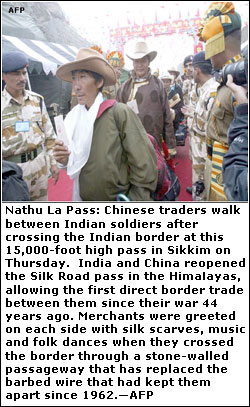 NATHU LA (China-India Border), July 6: India and China opened a Himalayan border pass to trade on Thursday, 44 years after a brutal war shut the ancient Silk Road route.
Traders, soldiers, politicians and bureaucrats from the two sides braved a freezing drizzle, mist and altitude sickness at 14,200 feet to mark what analysts said was a new chapter in bilateral ties.
Businessmen lined up on soggy red carpets, waving their trade licences that would allow them to cross the border post at Nathu La pass — ‘the pass of the listening ear’ — to visit newly built markets on either side after the formal opening ceremony.
Indian and Chinese soldiers posed for pictures and videos under colourful arches while locals, many dressed in traditional costumes, shared bread and sweets as music blared.
“Today is a historic day,” said Pawan Chamling, chief minister of India’s Sikkim state, connected by the pass to Tibet.
“A contact that started centuries back between our two civilisations is being re-established today. The formal re-opening of this trade route will be a win-win situation for both countries.”
Businessmen are keen to take advantage of the new opportunities opening the pass will create in the remote area.
“I am excited. How can I not be, considering this is international trade,” said Dhurba Sharma, a cosmetics businessman from Sikkim.
“Although the list of goods that can be traded is restricted, I want to see how good their leather is.”
Ties between India and China, the two most populous nations, were dogged by mutual suspicion for almost three decades after a border war in 1962, until surging trade and economic ties pushed political disputes into the backseat.
The reopening of the pass, part of the historic Silk Road — a network of trails that connected ancient China with India, western Asia and Europe — occurred on the birthday of the Dalai Lama, the Tibetan and Buddhist leader in exile in India.
It came days after Beijing linked the Tibetan capital of Lhasa with a railway and is seen as another move by China to help modernise the long-isolated region.
“This is a major event for the China-India relationship,” Sun Yuxi, Beijing’s envoy in New Delhi, told Reuters.
“Nathu La border trade markets will not only benefit border inhabitants in both countries and promote local openness and development, but also further motivate and open up a new channel for the blooming China-India trade relations.”
Although the two countries have agreed to resolve their border rows politically, talks have made slow progress and much of their 2,200-mile frontier remains disputed.
Trade, on the other hand, has soared to $18.7 billion in 2005, a 37.5 per cent jump over the previous year.
This year, it is expected to reach $22-23 billion.
Nathu La is the third border trading point opened by India and China but is the most important because it controlled almost 80 per cent of their trade before it closed in 1962.
Today, border exchanges account for a paltry $100 million of the total trade, with the rest going by sea or air.—Reuters