0
0

LAHORE, July 5: Chief Justice Iftikhar Mohammad Chaudhry said here on Wednesday the superior judiciary was under a constitutional, legal and social obligation to ensure provision of justice to the poor and the destitute at the grassroots level.
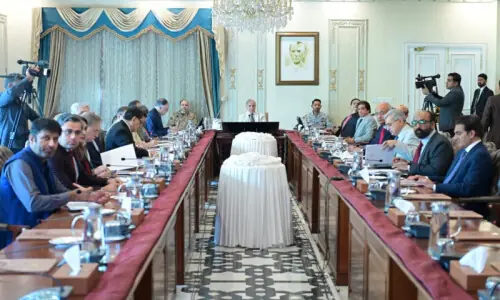
“We the members of the bench and the bar have a national responsibility towards the needy and the helpless to provide them legal assistance to mitigate their sufferings as far as possible”, the chief justice of Pakistan was quoted as observing while presiding over a joint meeting of the Pakistan and the Punjab Bar Councils’ free legal aid committees at the SC building.
The chief justice said the judiciary had to win back people’s confidence, and this was possible only when courts were functioning for the development and strengthening of the state institutions and protecting the fundamental rights of all citizens without discrimination.
Expressing concern for the prisoners who could not afford lawyer to defend themselves in the court, Justice Chaudhry asked the committee members to constitute legal teams down to tehsil level to ensure that such people should not remain in jails only because they had no financial means.
Earlier, committee head Mohammad Ramzan Chaudhry submitted in his report that the PBC had moblised the lawyers’ community to provide legal aid to the needy and the destitute in districts and tehsils. He said the free legal aid committees were also creating awareness about legal rights in society.
Committees’ members, including PBC member Mohammad Ashraf Wahla, chairpersopn Punjab committee Rana Abdus Shakoor, Lahore chairperson Mohammad Yaseen Sohal and chairperson Punjab Bar Council executive committee Hasan Raza Pasha, lauded the SC’s ‘landmark’ judgment in the Pakistan Steel Mills privatisation case and said people from all walks of life had hailed the judgment.
Later, Ramzan Chaudhry told reporters the chief justice agreed in principle to issue instructions to sessions judges to coordinate with free legal aid committees in helping the poor in the legal field.
The chief justice, according to Mr Chaudhry, was not satisfied with police’s practice in remote areas who did not produce the poor accused before magistrates for remand and magistrates ordered such remands without interrogating the accused.
The chief justice directed the committees to mobilise lawyers at the lowest administrative tier to monitor the situation and send complaints against the offending magistrates. The chief justice was quoted as saying that action should be taken against such magistrates.
The chief justice also directed the IG (prisons) to ensure easy access of members of legal aid committees to jail inmates for redressal of their problems, Mr Ramzan added.
LDA: A larger Supreme Court bench on Wednesday directed the Lahore Development Authority to submit a report on steps to allot residential land to those who were made to evacuate their `katchi abadi’ in 1992.
Some 25 Christian families have moved the Supreme Court with the plea that the LDA was refusing them to allot residential plots of three marlas each, although the Punjab government in 1994 ordered the allotment of alternate residential plots.
Petitioners stated that their houses were razed to the ground during riots in 1992 and, as a result, they were made to evacuate the residential colony they had been living in since 1972-73.
They approached the provincial government, which, through an executive order, allotted them plots of three marlas each as an alternative.
The LDA, according to petitioners, had recently refused them the allotment of plots saying that no land was available for them anywhere in the city.
Headed by Chief Justice Iftikhar Mohammad Chaudhry, the apex court bench sought a report till July 10 under a direction to the LDA director-general and the ‘katchi abadis’ director.