0
0

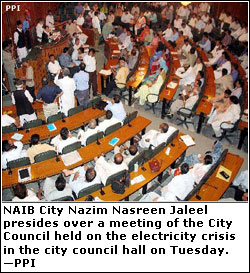 KARACHI, July 4: The City fathers finally woke up to the sufferings of their electorate when they gathered at an emergency session of the City Council here on Tuesday to debate the issue of the month-long power crisis.
The opposition members, giving voice to the frustrations and agonies of people in a city caught in a perpetual power crisis, mostly held the government responsible for the mismanagement in the power sector leading to the gravity of the present crisis. They also criticised KESC’s privatisation which, they said, left the power utility in utter organisational disarray.
The council’s emergency session was summoned by Naib Nazim Nasreen Jalil to discuss the current electricity situation that has resulted in unrest among the people and forced them to indulge in street agitation.
While appreciating the naib nazim’s move, the opposition members called for adopting a consensus resolution and suggesting a viable plan to solve the problem. They, however, regretted that a resolution on the issue submitted by them during the previous budget session was not allowed to be discussed.
Amid mounting onslaught from the opposition, members from the treasury benches tried to take refuge in history by tracing the roots of the present crisis to the 1994 deals the then government had concluded with IPPs.
But the opposition refused to absolve the Haq Parast councillors of their responsibility for the present crisis, saying that the Muttahida Qaumi Movement had been part of successive ruling coalitions during the last 15 years.
One of the members demanded resignation of the Federal Minister for Power, and suggested that the use of air-conditioners in the offices of the governor, chief minister and other government officials should be banned. This alone would help save 300 megawatts, he claimed.
Initiating the debate, treasury leader Asif Siddique maintained that the present crisis was the logical outcome of the policies pursued by the past governments, which had ignored power requirement of Karachi.
He particularly referred to the agreements with IPPs in 1994 under which the KESC was not allowed to generate power and asked to buy the same from Wapda.
He agreed that the KESC’s performance was not up to the mark after its privatisation because of ‘certain internal reasons’, and also admitted that Karachi was not being provided electricity according to its needs.
The treasury leader was of the view that certain elements were trying to take political mileage of the situation in their bid to put hurdles in the way of the ongoing development activity in the city and hinder the foreign investment. He also termed the disturbances in the city over power failures ‘a pre-planned conspiracy’.
Mr Siddique claimed that the Haq Parast leadership was playing its due role in overcoming the crisis, and pointed out that the higher authorities, including the president and prime minister, had been approached for a way out.
As a result of such efforts, he said, the president intervened and asked Wapda to provide 100 megawatts additional electricity to the KESC.
Opposition leader Saeed Ghani of the Awam Dost Group criticised the privatisation policy, and alleged that serious irregularities and bungling had been resorted to in the privatisation process and the deals pertaining to three major institutions – the Steel Mill, PTCL and KESC – where rules and regulations had also been violated.
He held the government responsible for the present crisis, saying that those who were representing Karachi at
the federal, provincial and city level, could not absolve themselves of this responsibility. Mr Ghani asked that if the deals concluded with IPPs were not correct, why the same had been retained by the successive governments.
The opposition leader said the assets of these organisations belonged to the state and no one, be it a general or a ruler, had the right to dispose them of.
He maintained that the present power crisis was the logical outcome of the mismanagement and defective policies of the government.
Leader of the Al-Khidmat Group Rafique Ahmed said that Karachi had been facing a crisis that was affecting every segment of its population. The load-shedding of long duration had even forced people to take to the streets, he pointed out.
He observed that KESC, as against the city’s requirement of 2,200-2,300 megawatts, produced only 1,200 megawatts at its own, and Wapda could not meet the huge shortfall of 1,000 megawatts. The situation aggravated further after KESC’s privatisation, which ultimately deepened the crisis, he added.
Mr Ahmed deplored that the KESC had been handed over to a party which appeared to be a manufacturing firm, and claimed that it had no concern with Karachiites’ miseries as it was interested only in selling its products.
He also opposed privatisation of national assets, and stressed the need for effective measures to enhance power generation and improve the transmission and distribution system.
Mr Abdul Jalil supported the views expressed by the treasury leader , saying that there were also certain technical reasons leading to the crisis.
He stressed the need for getting all faulty lines repaired as this was also one of the factors contributing to the present crisis.
The Haq Parast leader defended the privatisation policy, saying that private sector could run organisations in a
better way. He also criticised the 1994 deals with IPPs, indicating that under these agreements the KESC was restrained from generating more electricity.
An opposition member, Mr Saifuddin, blasted the treasury benches for “hiding the misdeeds of KESC instead of siding with the people on the issue. He termed the privatisation of KESC ‘a conspiracy against the people of Karachi’.
He called on the council to inquire and fix responsibility for the worst-ever power crisis.
Ms Nasreen Jalil, who was presiding over the first session, had to ask the members repeatedly to refrain from passing remarks against each other.
Opposition councillor Mr Abdul Razzak said the situation would not improve unless some drastic action was taken to narrow down the wide gap between supply and demand of electricity. He pointed out that 600 megawatts power was being consumed only in the use of air-conditioners. By keeping the air-conditioners of the offices of the governor, chief minister and other government departments, more than 300 megawatts could be conserved, he claimed. Dr Nikhat Sahfi suggested that steps be taken to curb the menace of ‘Kunda’ system, besides establishing more power plants.
Mr Sher Afghan and Ismail Brohi also took part in the debate and called for effective measures to overcome the crisis.
After a short break, the evening session commenced under the chairmanship of Mr Masood Mehmood. Ashraf Husain,
Imran Saeed, Mirza Afaq Beg, Naseem Khan, Saeed Abu Talib, Rukhsana Faisal, Mr Arif and Zahid Assad took part in the discussion.