



 0
0

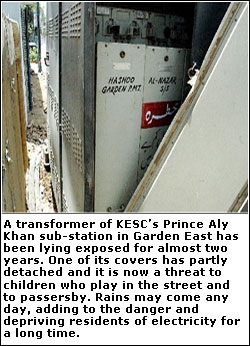 KARACHI, July 2: Improper planning and short-sightedness of the new management of the Karachi Electric Supply Corporation may deepen the power crisis, causing the citizens of Karachi more distress as senior officials in the power utility fear collapse the fragile transmission and distribution system in the forthcoming rainfall.
Though the federal government has directed the Water & Power Development Authority (Wapda) to increase power supply to the KESC from the present 550 megawatts to 700 megawatts, the distribution system is not strong enough to withstand the pressure.
The system cannot be strengthened in summer as the shutdowns of long duration could not be carried out in the hot and humid weather while people are already perturbed over the prolonged breakdowns and loadshedding and have even resorted to staging street protest and indulging in agitation to give vent to their anger.
It is the common impression among the people of this city that the employees of the KESC do not want to work under the new set-up as they are unwilling to take part in making the privatisation of the power utility a success. However, the employees, including engineers, strongly dispel the impression, saying that they were sincerely working for the smooth power supply to consumers. They believe that improper management and avoiding the pre-emptive measures taken ahead of summer every year to limit faults were the factors contributing to the persisting crisis.
Senior KESC officials said that at the onset of November every year, the KESC would devise a system improvement scheme on the basis of the past experiences to limit the breakdowns and faults in the ensuing summer. This used to be a patchwork to remove the trouble spots and bottlenecks in the electrical network and system as identified during the previous summer.
They said that the nature of such schemes was like the addition of 11kv feeders where needed, addition and reinforcement of distribution transformers, enhancing the size of 11kv linking cables, bringing into the ring the spur-fed distribution pole-mounted transformers (PMTs) and substations, besides, adding more power transformers at various grid stations and general preventive maintenance of transmission lines, overhead mains and substations. The cost of the preventive measures may vary from Rs200 million to Rs250 million.
The officials claimed that after the privatisation of KESC, no such planning was made and this was causing frequent breakdowns and faults that had now been going beyond its control. The contractor firm (M/s Siemens), responsible for management and operation in the KESC, had reportedly focused on restructuring and reorganising the administrative set-up, instead of giving importance to the fragile electrical system network, they claimed.
They maintained that no short-term or mid-term plans were drawn up to upgrade the electrical system before this summer. “The electrical system network may collapse in the forthcoming monsoon and faults may go beyond the control of KESC,” they apprehended.
The only solution to the current crisis is to increase the number of power transmission in those grid stations that are overloaded, and to raise the number of feeders with additional power transmission, so that power load could be divided and faults could be limited, according to the officials.
After the summer, a comprehensive plan to upgrade the system would have to be chalked out and the work on the plan would also have to be carried out on war-footing to meet the challenges of the next summer. Otherwise, the situation would be worse than it was in this summer, they concluded.





























