0
0

 IN the Indian politician’s lexicon, if there’s one word that appears scary, it is inflation. One is not talking about horrific inflation witnessed by some countries across the world – 2,000 per cent per annum in Argentina about 15 years ago, or 1,200 per cent, the current inflation rate in Zimbabwe.
Double-digit inflation rates can sound the death-knell for governments in India, and political parties (the Bharatiya Janata Party, for instance) have lost elections because of rising prices. The BJP lost elections in some northern states a few years ago, after spiraling onion prices brought tears to the eyes of consumers.
Last week, when Congress president Sonia Gandhi summoned a meeting of the party’s working committee to discuss the issue of price rise, it reflected the growing anxiety within the United Progressive Alliance (UPA) about the inflationary trend. This is not the first time that Gandhi took up the issue of inflation; a few weeks earlier, she had warned of the dangers of rising prices.
The left parties, who prop up the UPA government, have also protested about inflation. The Wholesale Price Index, a broad measure of inflation, rocketed to 5.24 per cent last month, the highest in over a year.
The Reserve Bank of India, the country’s central bank, which monitor’s inflation with a hawk’s eye, had last month raised the benchmark short-term reverse repo rate by 25 basis points to 5.75, which is the highest in about four years.
When RBI governor Y.V. Reddy unveiled his slack season credit policy in April, he refrained from raising interest rates, though he had raised it four times over the previous 15 months. Reddy claimed that the bank was closely monitoring the price situation, and said that the Indian economy had to still experience the full pass-through of the oil price hike.
But after last month’s hike in fuel prices – 9.2 per cent increase in petrol prices, and 6.6 per cent increase in diesel prices – the RBI did not wait for a further hike in rates by the US Federal Reserve Bank chairman; it went ahead with a 25 basis point hike, and the markets expect a further increase this month or next.
The markets have also been nervous, and the yield on 10-year government bonds has shattered four-year records. On June 23, it scaled 8.19 per cent, up from just 5.2 per cent about two years ago.
The RBI had earlier said that inflation within a range of 5.0 and 5.5 per cent was manageable, though deserving constant monitoring. But politicians are a more worrisome lot. With local television channels focussing on the price of tomatoes in Delhi’s ‘mandis,’ – it had shot up to Rs40 a kilo – ruling party politicians were busy with strategies, while opposition leaders were dusting their boots (or chappals) to take to the streets once again.
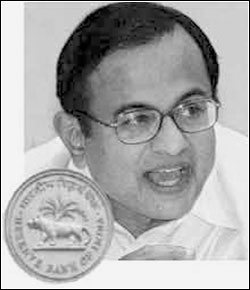
“I assure you we will not spare any steps to tame inflation,” reiterated finance minister P. Chidambaram. Sadly, not many politicians – either from the ruling alliance, or from the opposition – appeared to be convinced.
THE federal government last week also decided to allow free import of two key commodities – wheat and sugar, which were attracting duties of 50 per cent and 60 per cent respectively. Initially, the government decided to allow duty-free imports of wheat and sugar, but later changed its stance.
The finance ministry slashed duty on imported wheat from 50 per cent to five per cent, and the government also stitched up a deal to import 2.2 million tonnes of the grain. But traders do not see much sense in this policy. They point out that international prices of both wheat and sugar are as high as in India.
Wheat, for instance, sells for around $180 - $190 a tonne internationally, while in India, the current prices are in the range of $205. Importers do not see any room for profits, with a five per cent duty added on to it.
But the government obviously wants to flood the market with both wheat and sugar, to ensure that farmers release their crops. Many farmers are sitting on stocks of grains, hoping for even better prices.
In another measure to control domestic prices, the government also banned the export of pulses. But this again is unlikely to have much of an impact, as pulse exports from India are marginal.
Government sources maintain that inflation has started creeping up because of the hike in oil prices, triggered by a spurt in international price of crude. But the trucking industry, and its backers, claim that it is not just the hike in diesel prices that has seen transportation costs spiral.
According to the Associated Chambers of Commerce and Industry of India (Assocham), the biggest contributory factor in the sharp increase in transportation cost is not fuel price increase but forced reduction in carrying capacity of vehicles as a result of a Supreme Court ruling. This has led to 30-40 per cent reduction in carrying capacities of vehicles, claims Assocham.
The Supreme Court had ruled recently that the gross vehicle weight of commercial vehicles should not exceed the figures for which the vehicles were registered. Many state governments have been lenient and giving concessions to the powerful trucking industry, allowing vehicles to be over-loaded and hence endangering lives of other road-users.
According to Assocham, freight costs have shot up by 25 to 30 per cent following the apex court ruling, caused primarily because of a shortage of trucks. The trade body has sought a review of the court ruling, but it is unlikely to be accepted.
WAY back in the early 1970s, following the oil price shock, inflation in India shot up to 25 per cent. There were mass demonstrations across the country, and both the federal and state governments had a tough time controlling the situation.
The chief economic adviser of the government then was Manmohan Singh – who later rose to become the RBI governor, then the finance minister, and finally became the prime minister – who unveiled a series of steps to combat inflation.
Singh suggested a hike in interest rates, a sharp curb in government spending, and tightening of bank credit, among other measures.
The doctor’s prescription had a salutary effect on the economy, and India was able to lick the problem of inflation. However, as head of an unwieldy alliance, Dr Singh finds it difficult to implement those very sensible suggestions.
The UPA government is committed to expand public expenditure, even on schemes that have been rubbished as useless by Rajiv Gandhi, the former prime minister, and slain Congress leader (and husband of Sonia Gandhi).
The government unveiled an ambitious rural employment programme costing billions of rupees, was forced to give up its divestment programme, and now there are pressures on it to inject more funds to ‘revive’ sick state-owned companies.
Worse, the government is also being forced to come out with schemes like writing off debts of farmers in several states, or waiving interest on loans. Last week, Singh travelled to Vidarbha in central India, where 600 farmers have committed suicide over the last one-year.
Federal agriculture minister Sharad Pawar, whose Nationalist Congress Party also happens to be the biggest rival of the Congress in Maharashtra (though the two parties are allies, both in Delhi and in Mumbai), managed to extract promises for debt relief from Singh.
Finance Minister P. Chidambaram is determined to bring down the fiscal deficit to 3.8 per cent of the GDP in the current fiscal (from 4.1 per cent last year). But with the government being forced to fund populist schemes, it is unlikely that the targets will be met.