



 0
0

Living through a midsummer nightmare
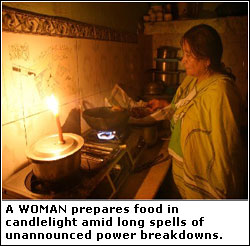 SEE what the traumatising electricity crisis in Karachi is currently doing. It is turning the meekest amongst us loud and angry. It is making the polite amongst us impolite. It is turning the quiet individuals into outspoken harsh sounding types. It is making the gentle amongst us to be bitter and critical of everything. Those who normally accept life with all its failures and frustrations are becoming irritable, impatient and forever complaining. As a people, we have become more tense. An inner anger is becoming open and evident, and the rage is making citizens take to the streets and turn destructive. We now have power riots in the city, reflective of localities where the electricity crisis is unbearable.
From April to June, we have suffered a power shortage that is mostly the result of neglect and inefficiency, which is being acknowledged by the privatised KESC in its public posture. It has described it as “political pressure” that created a set of circumstances for which an entire city is paying now.
Let us get to a major question that otherwise seems to be deliberately pushed into the background, or underplayed: or every concerned group involved perhaps trying to cover up. No heads to roll, no accountability, no transparency. Every management and individual is made to appear clean, by merely saying that there was political pressure at different times in the eighties and the nineties. For all that was done then, Karachiites are suffering and suffocating now. And there are no villains, no guilty, nobody to blame.
Very conveniently, we make it comfortable for all who ran the KESC systems, merely blame the systems. Yet, what of the men who ran the systems and made the most pompous claims that they were delivering, and that they would deliver, and take Karachi's electricity scenario out of trouble. Those promises were bogus? What happened to them? The year 2006 was meant to be a trouble free year…if we go by what was said by the managements of KESC prior to privatisation.
And what was the management before privatisation. It was tough and strong, and powerful, and yet steadily the KESC’s performances deteriorated with time. A quick look back and one cannot recall anyone at the top being held responsible. They kept blaming the consumers for kundas, and pilferage, and unpaid bills. Not only was this problem not tackled successfully, but the top management, the planners here and in Islamabad, stayed silent, or underplayed the gravity of the situation. And no one blamed them. And there is no one to be blamed even today. We are just blaming a past. There is a convenient misleading ambiguity. As if there is a design, a pattern what did the experts, engineers and technocrats do when the politicians were manipulating? Were they playing their good old familiar games of “saying yes”?
Citizens have had their lives messed up for the last three months and nobody knows what lies ahead. The forecast is grim, grave, and from what the KESC has been saying in its advertisements makes it certain that the trauma and torment will continue until October this year. It is a fearful proposition to say the least. The last three months have, in the despairing gloomy ultimate, not just thrown out of gear all schedules and work programmes, but hurt individuals, families, homes and work places in psychological terms. We are driven by the fear of electricity failures. And this is a strange, yet real fear.
And yet what has baffled and disappointed Karachiites is the fact that neither the Sindh Assembly in its budget session nor the City Council in its budget session had any mention of the power crisis that virtually destabilised the entire city. Not even those elected to the provincial assembly from Karachi focused on the load-shedding being carried out by the KESC which says that it cannot either overcome or carry out according to announced schedule. This reason reflects the kind of planning that has been done in the last 15 years or even more. Interestingly, the Shazia Marri-Ishwar Lal theme got more attention. One Karachiite was very upset about this lack of mention. He said, “The least that they could do was to have taken up this issue to show that they cared for the sentiments of the people who have been suffering, day and night, everyday, in the peak of summer with KESC failing to meet the demands of its consumers.”
The KESC has said that the present city power demand “is almost double of the production that KESC generating stations are providing (1250MW). The remaining 50 per cent power demand is met by importing electricity from Wapda and IPPs”. And the KESC has claimed that because it is unaware of “when at any given time, the power import from those two sources may decrease,” it cannot plan its load-shedding schedules. There is another claim that the KESC makes and which consumers find unacceptable. That its supply network is facing a threat from criminals. What some consumers have asked in disbelief is how it is possible that their major extra high tension lines, underground cables and other installations face threat from “unscrupulous elements and saboteurs.” Those lines are live so how do they manage.
What I find very worrying is that the KESC is facing a threat from saboteurs. Who are these saboteurs? As a citizen I consider it a matter of deepest anxiety that there are people who want to destabilise the city by subversion of this kind. Would the KESC spell out some details as to who is being suspected?
There is so much that comes to mind on this electricity crisis that we are currently facing. Will it get worse? Will angry frustrated consumers lose more patience in the days ahead? One consumer was upset at the fact that Karachiites have not shown a mature inclination to conserve electricity, which was expected of them. They have neither bothered as individuals nor as a society and KESC’s belated appeals to conserve electricity have been in vain. What this society has sadly valued more is its shopping, its window shopping. Neon signs and billboards glow, as does the world of marriage halls. Does not anyone feel the remotest sense of guilt at the sight of glitter and glow in the midst of a city crying out for normal supplies of electricity?
As I write, there are reports which indicate that the KESC is promising an improved situation. This is adding insult to injury. Credibility being rock bottom; no one believes such assurances or promises. And with the rains due as July has begun, it is a terrifying thought of what can happen to this city. A midsummer nightmare may bring hell.
And now terror-policing?
POLICE pickets set up across the metropolis are the norm once again. These have been put into action ostensibly to curb crime, but instead, policemen manning the pickets are proving to be the proverbial nuisance they have traditionally been. On Friday night, motorists complained of enduring long wait after being stopped and then harassed by the police. Meanwhile, armed robbers had a field day; they struck more than a dozen times and collected the loot at gunpoint in various parts of the city. What, you may ask, is going on. The public is being put in double jeopardy, so to speak; if the thieves and dacoits don’t get them, the police do.
The performance of the police cannot be gauged by the number of motorists they end up tormenting in the course of a day; nor is it to be gauged from the number of cases they register. The real test lies in the prevention of crime, the recovery of the looted or stolen items and the number of culprits nabbed. The latest round of picketing on city roads began on Thursday evening after the IGP expressed dissatisfaction over the rising crime wave in Lahore. The exercise has continued through the weekend, but it has made little difference to the number of reported incidents of crime. Petty thefts, say, those not involving robbery at gunpoint, have long ceased to be reported. What gets reported is high crime, entailing the drama and the trauma of an armed encounter with robbers.
Lahore, according to a report, is the most visited city by foreign as well as local tourists. The very sight of motorists being stopped on city roads at regular intervals is enough to panic the visitors who will only take back with them the impression of having been in a very unsafe city. How that is supposed to raise the country’s image is anyone’s guess. The rigmarole the police put through an average, unassuming citizen out in the street running an errand or going about his or her daily routine has to stop. This cannot stop until the colonial way of policing the city is changed.
The police reforms have been a non-starter. The force continues to be used by politicians and those with influence to subjugate their opponents, and to intimidate and harass the average road user. There was talk of setting up a more urbane and better trained metropolitan police force, but the project has not taken off the ground. The so-called fad of community-based policing, which was launched a few months ago with much pomp and ceremony, is also dead. Nor do we know under which law the picketing officers are allowed to carry out vehicle and body searches. There is a near-complete breakdown of law and order on our roads in the social context, which is what meets the eye and what rubs everyone the wrong way. These are the genuine impressions of disgust that an ordinary visitor to Lahore will now take back home with him.
Owing to the muggy weather, much of the city comes to life only after sunset these days. This is the time when people go out for shopping, to socialise, to eat out or even for a harmless stroll in a park. Go to the entertainment places, the theatres and the theme parks, and you will see that these, too, are thronged by the people at night. Unfortunately, this is also the time the police make their presence felt. If the aim of the ill-advised exercise is to instill awe and terror in the minds of the people, then it will probably fulfill its purpose. There is little else besides that this kind of terror-policing will achieve.
The ‘save Lahore movement’ put on another well-attended show at the Ali Auditorium on Friday. People from a wide cross section of society attended the citizens’ conference arranged to highlight the issue of faulty development priorities. The crowd was a healthy mix of informed and concerned citizens from all walks of life — from laymen to professionals — that cut through the economic divide. All present agreed that the city needed its trees and that more should be planted instead of uprooting thousands for making room for fast-driving personal vehicles of the rich few.
The argument of those who equate this kind of lopsided development for the few with the city’s development on the whole fell on its face in the presentations made by a number of informed town planners and architects. London and Tokyo, and closer home, Bombay, continue to attract foreign and local investment in spite of these cities’ much worse congestion and traffic problems. It is not the number of vehicles on the road, the width of urban roads and the number of residential areas turned into commercial slums that attract investment; it is the overall civic management that plays a more vital role in realising a city’s economic potential.
Development of civic infrastructure on a sustainable basis has been the missing link in the swelling of Lahore beyond its known boundaries, say, twenty years ago. If the LDA had not wasted its energies in pocketing huge sums in commercialising fees generated from once purely residential areas we might not have had the congestion problems that now stare the city in the face. But even these problems are not insurmountable in a city the size of Lahore, provided those wielding power and making decision can begin to think in terms of setting long-term development goals, and not just focus on getting elected in the next election for an ominous second term in power.
Conspicuous by its absence is a reliable public transport system. The plan of building an urban mass transit remains in the mid-1980s, when it was first conceived. The question to ask is whether the city really needs even that so far untenable mass transit system. The railway lines laid by the British through the city in three directions can well be utilised to get a mass transit system up and running in a matter of weeks. All you have to do is to set up more stations along the Sheikupura-Shahdara-Mudirke-Shadara-City-Jallo corridor and the City-Mughalpura-Dharanmpura-Cantonment-Raiwind corridor, provide urban rail coaches and you have a system in place. Over a period of time encroached railway land around the existing tracks should be reclaimed to lay down separate tracks for the urban rail. Feeder bus services branching out to adjacent suburbs from local rail stations will complete the job.
On the road front, no new major arteries have been built to link the developing urban sprawl in the south of the city; because every piece of land was plotted up and sold to private developers who built sprawling new housing societies which are not even linked with one another. For instance, to go to Raiwind Road located at a stone’s throw from the newly developed Valentia Society, you have to get back into the congested Wapda Town, drive all the way to the Jauhar Town hospital chowk and then take the south-bound Jinnah Avenue. Alternatively, try getting into Tech Society from Canal View Society, and you know the rigour that involves.
Why? Because the LDA was only interested in selling off huge chunks of land to private developers and not in town planning. It is tough as it is on the citizens; they should not be made to pay the additional environmental price for civic bodies’ inertia by compromising the few trees they have the fortune of beholding along the canal. — OBSERVER



























