Coping with calamities
PRESIDENT Pervez Musharraf’s call for an international early warning system for natural disasters comes nearly nine months after the devastating earthquake that struck Pakistan and Azad Kashmir and killed nearly 100,000 people, besides rendering 2.3 million men, women and children homeless. The tragedy occurred 10 months after the world witnessed what indeed was one of the modern times’ worst natural disasters — the tsunami that ravaged vast areas on the Indian Ocean littoral and killed 230,000 people. Both the tsunami and Pakistan’s Oct 8 earthquake wrought havoc because temblors cannot be predicted well in advance. Storms can be forecast, and they can be equally devastating as the disaster wrought by Hurricane Katrina in the US shows. The real issue is dealing with the effects of a calamity that may strike with or without warning. The international community’s response to the Oct 8 disaster was quick and overwhelming. This was in sharp contrast to our official machinery’s failure to provide relief to the sufferers quickly. There were many factors that militated against quick relief: one of them was the landslides that had blocked access to a number of disaster sites. But this was only one reason; the other, and perhaps greater, reason was the absence of a national disaster management agency. It was not until December last year that Prime Minister Shaukat Aziz announced the establishment of a Federal Disaster Relief Management Agency (Fedrema).
International warnings or help can be no substitute for Pakistan’s own relief mechanism. International agencies — and there are quite a few of them operating under the UN umbrella and outside it — cannot help if the national effort is tardy. We know now that the humanitarian disaster that struck New Orleans in the wake of Hurricane Katrina stemmed basically from the state and federal relief agencies’ failure to act in time, for they waited too long before moving in with supplies and rescue teams. Fedrema now must be made a truly modern relief agency that will be quick to move to disaster sites to save lives and mitigate survivors’ suffering. It is true that earthquakes cannot be predicted, but calamities take various forms — storms, floods, air and rail accidents, fires and other disasters. Fedrema must be ready to move with speed in all cases, and this it can do only if it has a network of branches in the form of trauma centres in all the provinces and disaster-prone areas — like the Malakand division, which occasionally is hit by earthquakes, or the Sindh and Balochistan coasts which often suffer the fury of Arabian Sea cyclones. The biggest issue is Fedrema’s utility during normal times. It cannot have a large staff doing nothing. The solution lies in having a mechanism that will enable Fedrema headquarters with a small staff to coordinate its efforts with Edhi Trust, NGOs and the many relief agencies run by non-political religious organisations. Pakistan is blessed with charity organisations staffed by highly dedicated volunteers, and they can be used in emergencies provided Fedrema develops a mechanism that is able to capitalise on the pool of volunteers available all the time. Incidentally, one does not know how the National Volunteer Movement is progressing. The president announced its formation last November with a view to involving youths above 18 in the task of reconstruction in Azad Kashmir. If the NVM idea has proved rewarding in the rehabilitation task, it should be extended to the entire country for use in emergencies.
US supreme court’s verdict
NOW that the US supreme court has ruled that the military tribunals at Guantanamo are illegal under both American law and the Geneva Conventions, it makes sense to close down the notorious detention centre for suspected Islamic militants, and transfer the prisoners’ cases to federal courts. Besides, the purpose for which the prison was established has not been achieved. The US has obtained hardly any intelligence of value from the prisoners detained there and has found very little evidence against the suspects to prosecute them for crimes relating to the on-going war on terror. Only 10 of the approximately 450 prisoners who remain in Guantanamo have been formally charged. Some 310 prisoners have either been released or handed over to authorities in their own countries to face possible trial there. But even with scant proof of their culpability, the Bush administration had created a legal vacuum for the detainees by not treating them under the Geneva Conventions and thus denying them access to legal aid. This and the licence given to their jailers to employ harsh methods of interrogation against them have tainted Washington’s human rights record. The prisoners have responded to the excesses by increasingly resorting to riots, hunger strikes, even suicide.
The supreme court’s decision should change all that, unless, of course, the Bush administration tries to circumvent it as the president’s supporters in the senate are planning to do. But any attempt to bypass the verdict would not be advisable. The damage inflicted by Guantanamo on America’s reputation as an upholder of freedom, democracy and justice has been considerable. By continuing to defy its own laws, the US administration will confirm the general impression that it has now reached a point of no-return, and that even its own judicial institutions lack the right to keep it from flouting all rules of just behaviour. This is not the message Washington should be sending out to a tense global community that is already questioning America’s unilateral military actions and the moral authority that it has assumed to judge between right and wrong.
Karachi police under threat
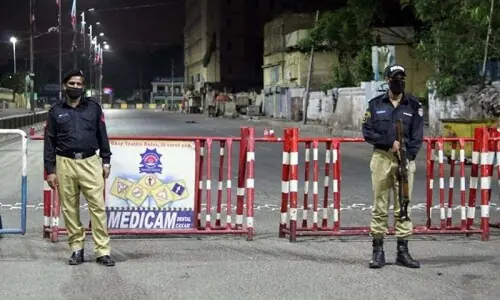
THAT the police who are meant to provide security are, instead, being targeted in a spate of killings just goes to show how fragile the law and order situation in Karachi is. This can be gauged from Saturday’s report that 10 police officers have been killed in the month of June, with five having been gunned down in the last eight days of the month. The latest to have been targeted was a constable who was heading for work on his motorcycle when he was shot in the head on Friday. A day earlier, an ASI was also shot in the head while he was on his motorcycle returning from work. On June 23, two sub-inspectors were shot in a similar manner. All this seems to be the work of an organised gang of criminals out to settle scores with the police. Who these killers are and the possible motive behind targeting that many police officials remain shrouded in mystery. Even police authorities seem clueless about the latest killing spree. Some believe that the targeted killings could be the work of gangs wanting to take revenge for the arrest of notorious criminal Rehman Dakait, arrested last month in Quetta. Some also believe that it could be the work of a group wanting to target officers involved in the notorious ‘Karachi Operation’ some years ago, although this claim has been denied by the police since the officers so far killed had no role in that operation.
The police have formed a task team to look into this matter and ascertain the motive as well as the elements behind these killings. One hopes that every effort will be made to unravel the truth behind the spate of killings, arrest the persons responsible for these and bring them to justice instead of eliminating them in fake ‘police encounters’.
The budgetary charade in parliament
BUDGET 2006-7 came and went, passed by parliament in a record 17 days, with a great deal of sound and fury, most of it having brought little relief to the inflation-hit incomes of the Pakistani consumer. The government ignored the basic issues confronting the silent majority and instead focused its energies on silencing the opposition in parliament by repeatedly accusing it of criticising the recent budget for the sake of criticism.
The facts, however, reveal a picture that is actually worse than what the opposition has been able to convey through its limited resources. First of all, it is a little disingenuous to say that parliament had any role in the budgetary proposals, as a democratic parliament would in India, where the whole process lasts 75 days. But that is a little quibble compared to other issues. This time, in complete defiance of parliamentary practice, and Article 171 of the Constitution, the budget was presented without a preceding Auditor General’s Report for any department.
While many of us repeatedly asked for an explanation from the largest cabinet in the history of Pakistan, at no point was it answered by the treasury, and at no point did the Speaker of the National Assembly press the government for an answer. He preferred instead to have our microphones turned off and allowed treasury shouting to drown out dissenting voices, saying on record that it spoils the atmosphere in parliament to raise these issues.
Secondly, for the first time again, parliament was given no adequate answer when one of the largest departments of the interior ministry, Nadra, went suddenly missing from the Demands for Grants and Appropriation document, which basically lists in detail each ministry’s granted expenditures, revised spending and next year’s demand for funds. When this was queried on the seventh day of the budget session, the deputy speaker at least directed the finance minister, Omar Ayub, to provide an answer, but none came. Ayub was at least embarrassed to mumble that Nadra had become self-reliant, which, of course, he knew as well as anyone else, was a non-response.
When it was pointed out that Nadra’s expenditures can be detected all over the budget documents under other heads, like military pensions and cabinet expenses, no answer was given again. The fact that one of the largest public dealing departments of government had suddenly become self-reliant was not enough to stop proceedings or commit to an inquiry, but also that when Nadra’s misappropriations in the last Auditer-General’s reports worth several billions of rupees were brought up, no inquiry was promised by the Speaker or the relevant minister.
Thirdly, parliament was given no credible answer as to why the defence budget had climbed to Rs 250 billion officially, when if one includes pensions and other heads like garrison and cantonment expenditures, the real figure comes to Rs 312 billion, especially when the sound PPP policy of peace with India was being pursued.
But most importantly, even when parliament debated and discussed this budget as best as it could, most of it remained still outside its purview, as the bulk represented charged or fixed expenditures which were non-negotiable. For a Rs 1.3 trillion budget, parliament was presented a statement of Authorised Expenditure for 2006-7 worth Rs 3.4 trillion on the last day, which included a domestic debt retirement figure of Rs 1.7 trillion. This last amount is larger than the announced total budget of Rs 1.3 trillion for the budget, and represents a large proportion of the fixed or charged expenditure of Rs 2.1 trillion on the Federal Consolidated Fund.
This huge figure was explained by the finance ministry as a traditional accounting procedure where the total private debt of Rs 1.7 trillion was shown under charged expenditure whereas the budgeted figure of Rs 1.3 trillion included only the one-third of domestic debt that needed retirement this year. If this is the case, then my question about the total foreign debt being represented as Rs 56 billion with foreign debt retirement as Rs 48.7 billion should also be clarified as total debt incurred by Pakistan or the percentage needing retirement this year.
Because of all the contradictions in the budget documents, it would have been better if the regime had not continued to leave the Federal Bureau of Statistics without a director for the last three years. This is one of the key places where statistics are fudged, and base years changed in order to project high GDP.
No answer was given to the question about the integrity of statistics being undermined and how the new per capita figure of $ 847 was inflated by artificially lowering the population growth rate to 1.2 per cent, (since per capita is calculated by dividing GDP by the total population). But problems with the population growth rate suddenly going down from the 2.6 per cent, when all independent estimates project it at as much higher than the new official figure, were also never explained.
Lastly, this budget represented one of the largest deviations from this regime’s own stated goals of reducing fiscal expansion and indebtedness. One of the biggest problems facing ordinary people is the price of essential commodities and daily household goods. In the face of rising poverty and unemployment, what we have is an economy that is being run on a set of glaring paradoxes, which include low income and high consumption fuelled by consumer financing; low revenue and high public expenditure; and low deposit rates and high lending rates with a banking spread of 7.75 per cent. Instead of protecting the growing number of poor people, the government has chosen to reward an importers’ mafia through its subsidies and celebrated a growth plan that will only make the rich richer and the poor poorer.
The other problem is that given that deficits are inflationary, no structural attempt was made to address the massive fiscal deficit at Rs 373 billion. The ballooning current account deficit and the alarming trade deficit all point to a very dangerous trend where Pakistan’s reserves can become meaningless in the face of sudden devaluations driving a collapse along Mexican lines, where the economy sank in a matter of days despite dollar reserves.
In fact, the current $13 billion forex reserves, which accrued due to September 11 aid inflows and the kerb buying of $ 18 billion by the State Bank, cannot buy Pakistan more than six months of imports if push comes to a shove.
One of the biggest canards making the round is about the end of government borrowing to sustain its expenses. In fact, the government claimed last year that the begging bowl had been broken by repaying debt and ending aid dependence. So can it explain the new World Bank loan worth $ 6.5 billion that it is congratulating itself on? Or the four billion dollars coming in from the ADB and $ 400 million sought from Japan.?
The fact of the matter is that Pakistan is now securely in the grip of a debt cycle never witnessed before. The military-led regime is taking loans from the commercial market at much higher interest rates than the IMF ever charged. If one studies the fine print in the Economic Survey, it is clear that even for this year external debt and liabilities have gone up to $36. 557 billion for the first nine months of this fiscal year, showing a rise of 0.723 billion. And none of these rises ever went through parliament, as the Fiscal Responsibility Law required.
Because of this profligacy in government borrowing, foreign debt servicing has also gone up from Rs 45 billion to Rs 48 .7 billion. So all foreign debt trends in absolute terms show an upward graph. Domestic borrowing for this year (as opposed to the Rs 1.7 trillion total domestic debt incurred) has also gone up to Rs 58.8 billion from last year’s budgeted figure of Rs 34.1 billion, which itself represents a huge jump in government borrowing at commercial rates.
This year’s supplementary budget document, presented a week after the official budget, provides over-spending estimates to the tune of Rs 217 billion, and in tiny point size at the bottom of the debt page admits the growing burden of debt servicing due to borrowing in market treasury bills at high interest rates with a total appropriation of Rs 10 billion under the head servicing domestic debt.
As for the trumpeting on foreign direct investment, privatization remains the only major source of foreign investment for this government, but all of it has been non-transparent and controversial. In any other country, the Supreme Court’s decision to overturn the Steel Mill privatisation as irregular would have prompted the downfall of an accountable government. But not in Pakistan, where the NAB is authorised to spend Rs 21 lakh a day to pursue political opponents of the regime while ignoring corrupt practices in government. What is problematic is that for the first time in the history of Pakistan, privatisation proceeds are being spent on meeting deficits in current expenditure.
Last year’s non-transparent sale of Pakistan’s assets generated Rs 90 billion, which was used to finance two billion rupees worth of bullet-proof Mercedez’ and Rs 776 million on servicing VVIP aircraft. No elected government could afford to use privatisation proceeds like this. An accountable government would have to use the income to retire public debt, not fund junkets and domestic VVIP movement costs, which alone cost the nation Rs 1.2 billion this year.
Although there is need for the state to spend on its officials and for a few limousines to ferry top officials, this kind of spending has never been seen before.
The writer is a member of the National Assembly>