0
0

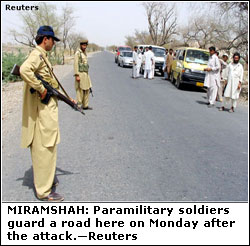 MIRAMSHAH (North Waziristan), June 26: Five paramilitary soldiers and a Khasaddar of the Levies force were killed, while 26 others were injured when a suicide bomber rammed his explosive-laden car into a checkpost some 10 km east of here on Monday, security officials said.
However, a foreign news agency has quoted officials as saying that seven soldiers were killed and 20 others injured in the suicide attack.
The suicide attack was carried out at Khajori checkpost on the main Miramshah-Bannu road in the North Waziristan Agency.
The checkpost was jointly manned by the personnel of the Frontier Corps and Levies force. The lone suicide bomber also died in the deadly attack.
An official of the political administration said that one personnel of the Levies force, identified as Mohammad Ziaud Din, was among the dead, while three others were wounded.
The injured Khasaddars were Subaidar Nawab Khan, Qamer Zaman and Shah Zaman, who were shifted to the agency headquarters hospital in Miramshah.
Security officials said that the car rammed into the checkpost at about 3:30pm, killing five soldiers and one Khasaddar on the spot, while 26 others were wounded. They said that many soldiers were seriously injured.
The suicide attack occurred just a day after Abdullah Farhad, a purported spokesman for the militants in North Waziristan Agency, announced one month’s conditional ceasefire.
This is the third suicide bombing in the North Waziristan and its surrounding areas in a month.
A suicide bomber had smashed his explosive-laden car into a military convoy in the Frontier Region of Bannu, adjacent to the North Waziristan, on June 2, killing five soldiers and wounding seven others.
In the latest attack a white colour car coming from Razmak to Mirali drove into the security forces at Khajuri checkpost before exploding into pieces.
Witnesses said that security forces immediately cordoned off the area and blocked the Bannu-Miramshah road for traffic.
Helicopters were rushed from the army base in Miramshah and a garrison in Bannu to collect and shift the bodies and wounded to Peshawar.
In an intriguing twist to the development in the troubled region, the militant spokesman first denied involvement and later retracted to claim the responsibility for the attack.
Abdullah Farhad in his first call to the BBC Urdu Service said that the attack was the handiwork of ‘elements within the government’ opposed to the ceasefire.
He insisted that the militants continued to abide by the month-long ceasefire announced on Sunday.
However, two hours later, he called the Urdu Service again to claim the responsibility for the suicide bombing.
He claimed that an explosive-laden car accompanying militants riding in other cars was used to target the checkpost when the security forces stopped and started checking the vehicles.
But in the same breath, he went on to say that the ceasefire would remain in force, notwithstanding the suicide bombing.
Government officials in Peshawar were, however, shocked by the incident and wondered whether the spokesman who had announced the ceasefire had really spoken for the militants in the North Waziristan.
“There is the question of credibility and we don’t know whether this guy speaks for the militants,” one official said. “It means that there is something terribly wrong there,” he said.