0
0

Waziristan: a ceasefire offer?
THE news from turbulent Waziristan, if correct, will be widely welcomed. The militants who have kept the Pakistan Army embroiled in hostilities in the region have reportedly offered a ceasefire, though doubt has been cast on its credibility by the suicide attack in Miramshah on Monday. Even otherwise there are many hurdles in the way to enduring peace. But it is clear that no political solution is possible while a war is being fought in the region. The matter should now be taken up by the grand jirga that is being put together by Governor Ali Mohammad Jan Aurakzai. The spokesman who claims to speak for the militants said that the ceasefire would be temporary — only for a month — and was conditional. It is important that the military aspect of the situation is taken up on a priority basis. This will give time for a political dialogue to start and, hopefully, resolve all the disputes that have alienated the tribals. The rifts in the ranks of the militants could pose a major problem for peace and slow down the pace of negotiations.
Some of the demands made by the militants are of a military nature, such as the withdrawal of the armed forces, release of captives and the dismantling of new checkposts. Problems can be expected in meeting these demands in view of the fact that the conflict is a part of Pakistan’s war against terrorism being fought in a wider context. It may, however, be more advisable if the negotiations are not conducted exclusively by the army commanders and the militant leaders. If political/tribal leaders are involved in the talks, the chances of success will be brighter. The need of the hour is not strong arm methods but diplomacy and a political process of give-and-take. There are, however, some issues on which the government would do well to reach an agreement with the tribal leadership and the militants. The foreigners who have entered Pakistan to fight their “jihad” from our soil cannot be tolerated. Nor should the Taliban on this side of the Durand Line expect Pakistan to turn a blind eye to their military training camps on our soil from where they launch attacks on Afghanistan. This affects Islamabad’s relations with Kabul. One hopes that the grand jirga will persuade the tribals in Waziristan not to shelter the foreigners and the ceasefire should apply to all military activity in the area, including trans-border hostilities.
It is time for a reorientation in Pakistan’s policies as well. One doesn’t have to go into the history of Pakistan’s role in the Afghan “jihad” since 1979 when the Soviets invaded Afghanistan. Even though the entire geo-strategic situation and the pattern of international politics have changed, some elements in Pakistan’s armed forces have yet to see the wisdom of changing their stance. Their policies have been to encourage extremism in the tribal areas by whipping up a frenzy of religious fanaticism. The authorities will not only have to withdraw the support they have been extending to some sections of the extremists, they will also have to deliver on their promise of injecting development funds in the region and setting up industries to provide employment to the people. Multi-million rupee development packages have been announced from time to time for Fata — Rs6.2 billion has been allocated for 2006-07. It is time the government focused on the economic dimension of the Fata crisis rather than perceiving it primarily as a military problem.
Exploring other energy sources
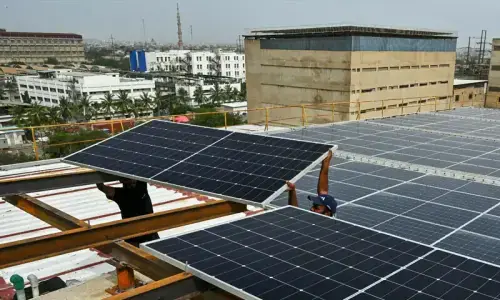
IT was good to hear President Musharraf say that he wanted the country to make the best use of alternative sources of energy, for it shows that he realises the consequences of relying on expensive forms of power. As things stand, Pakistan’s energy needs are rising by 10 to 12 per cent a year which makes it necessary to increase the energy capacity by exploring alternative sources like wind and solar power. Not only will this reduce the country’s dependence on oil and gas for power, it will also address the high demand for electricity. It is said that by 2012, the country will need an additional 5,000 MW of electricity. Given that major cities continue to face electricity shortfalls every year, it is hard to imagine how this shortfall as well as the rising demand can be met unless alternative sources of energy are explored.
There is some hope though: if properly implemented, the National Energy Security Plan can increase power production through renewable sources of energy by 10 per cent by the year 2015. The Alternative Energy Development Board too seems to be making some progress in this regard. In April it issued 34 letters of intent to investors involving a $22 billion outlay in the wind energy field. In May last year it connected 100 homes in a village near Islamabad with solar energy. It launched two 50 MW wind power generation projects in Gharo-Keti in Sindh which were supposed to be completed in June this year. These seemingly small initiatives may go a long way if they are completed on time and not allowed to be neglected by inept administrative functionaries. The country’s climate is ideal for generating solar energy and its coastal areas are suitable for windmill power generation. Both are economically viable options that will benefit the country.
New flare-up in Gaza
MORE Palestinian civilians are likely to be killed since Tel Aviv has vowed to step up attacks on Gaza following two Israeli soldiers’ death in a Palestinian militants’ raid on Sunday. There is an international outcry over the recent Israeli raids which missed their targets and instead killed Palestinian civilians. About 14 civilians were killed in raids by Israel last week, and those dead included children and a pregnant woman. Yet the Israeli Air Force chief says air strikes will continue and insists that “in the current circumstances, it (an air strike) is the most efficient tactic against terrorists”. Israeli officials say the army has been asked to prepare itself for “a harsh response” to the militants’ raid across the Gaza border into Israel. The current flare-up follows the Israeli massacre of civilian picnickers on a Gaza beach earlier this month. This forced Hamas to break the unilateral ceasefire it had observed for 16 months. The raid by the militants on Sunday and the Israeli strike are logical consequences of the international community’s failure to revive the peace process.
Both Israel and Hamas are following a hard line. Israel insists that Hamas must first accept the existence of Israel; Hamas refuses to do so. The US and the European community, instead of pressuring both, have chosen to single out Hamas. They have cut off all non-humanitarian financial aid to the Palestinian Authority in the hope of seeing an end to the Hamas regime. Disappointing also is Friday’s US Senate resolution aimed at isolating Hamas. This is a short-sighted policy. As an elected government, Hamas needs understanding rather than hostility from those who otherwise insist that their aim is to “spread democracy” in the Middle East. Throttling an elected government is no way to promote democracy. All the violence in the holy land will disappear if its root cause is addressed — the need for Israel to withdraw from the occupied territories to pave the way for the emergence of an independent Palestinian state with Al Quds as its capital.
Mending fences with Washington
FORGET transatlantic squabbles over the US-led Iraq war and the accompanying tough talk by European Union leaders on making the 25-nation bloc a “counterweight” to the United States. EU and US officials now talk glowingly of forging a “strategic relationship” between the two sides and say it’s time to let bygones be bygones.
“When we work together we can accomplish big things... the world needs us to work together,” US President George W. Bush told reporters at summit talks with the EU in Vienna last week. “What is past is past,” he added.
The US leader’s charm offensive certainly made an impact on some in Europe. Austrian Chancellor Wolfgang Schuessel spoke glowingly of Europe’s debt to America in the aftermath of the Second World War. European Commission President Jose Manuel Barroso said the EU and the US were together headed for bigger and better things.
Mending tattered transatlantic fences is not going to be that easy, however. While EU leaders appear just as anxious as President Bush to put relations on a new footing and the meeting in Vienna resulted in a dense 16-page joint declaration extolling transatlantic cooperation on a range of foreign policy, trade and climate change issues, there is a major obstacle facing policymakers on both sides of the Atlantic.
Quite simply, a vast majority of ordinary Europeans remains virulently anti-American. It cannot be ignored: President Bush is deeply unpopular in Europe. A recent public opinion poll showed that an overwhelming majority of Europeans think America is the greatest threat to global security. Much to Washington’s dismay, the US image in Europe has continued to deteriorate, despite a concerted effort by the Bush administration to turn things around by adopting a much more conciliatory stance in dealing with key EU allies, especially Germany and France.
Typifying the animosity many Europeans feel towards President Bush, the EU-US summit in Vienna was marked by angry street protests, with demonstrators shouting anti-American slogans and burning the American flag.
A look at the banners illustrated that ill will towards the US President is not only due to the Iraq war but also the US practice of rendition, where terror suspects have allegedly been kidnapped from European nations or transferred via EU airports and airspace for interrogation in other countries.
The US detention camp at Guantanamo Bay is a cause for particularly serious concern among a huge number of Europeans, with many EU politicians warning that the US is not only in serious breach of human rights but is also undermining the sight against global terrorism.
While there is no doubting European public hostility towards Washington, EU policymakers are more ambiguous in their attitudes towards the US.
In briefings leading up to the summit in Vienna, EU officials insisted that the new focus on both sides of the Atlantic is on working hand in hand to defuse global tensions and flashpoints. But many also made clear they remain wary of being placed once again in the US shadow.
Repairing tattered transatlantic ties has been a long haul effort. While President Bush’s visit to Brussels in February last year signalled the formal end of several months of hostility and often frosty exchanges between the two sides over the Iraq war, officials on both sides of the Atlantic had been working hard for at least one year before that to get the relationship back on track.
In contrast to his criticism of Europe during the Iraq conflict — which was opposed by Germany, France and other European states — Mr Bush used the Brussels meeting last year to appeal for a normalisation of ties between the two sides.
Few EU diplomats, however, have any illusions about the reasons for the US change of heart towards Europe. They argue that having ousted Saddam Hussein, US policymakers soon realised that stabilising Iraq would require European help, both in the form of financial assistance and more troop contributions.
Changed circumstances in Europe — including the election victory last autumn of German Chancellor Angela Merkel who put improved relations with the US on top of her agenda — have also helped ease transatlantic tensions.
The failure last year of the EU’s drive to win approval of a new constitution — following its rejection by French and Dutch voters — has certainly dealt a tough blow to the bloc’s self-confidence. Also, while the EU has spent the last few years developing an independent foreign and security policy, the limits of Europe as a solo act have become obvious.
True, the EU has been able to launch a military mission in Congo — but only after several months of internal debate and German hesitation at being asked to lead the operation.
Most significantly, while the EU’s efforts to seek a diplomatic solution in the nuclear crisis with Iran have won international plaudits, it has also become abundantly clear that to be credible, Europe’s international initiatives must have strong US backing.
EU diplomats recognise that it was America’s recent decision to join multilateral talks with Tehran — provided there was a verifiable suspension of uranium enrichment — that has made Iran sit up and take serious notice of a new European offer of incentives.
Although the US has so far focused more on possible sanctions against Iran and the EU more on positive incentives, both suspect that Tehran is trying to develop nuclear weapons. And both say that if Iran does not come back to the negotiating table soon, the issue will be taken to the UN Security Council for further action, including possible economic and diplomatic sanctions.
While the temptation to take an independent foreign policy stance may not have gone away in some European capitals, most of the bloc’s members now recognise that joint transatlantic initiatives are more likely to produce results than a go-it-alone policy by either Europe or America.
The EU’s foreign policy emphasis is on being effective, said a senior EU diplomat ahead of the Vienna meeting, adding that in today’s complex world, “that means working with the US.”
In Vienna itself, President Bush went out of his way to make friends and influence people.
Queried by European reporters on American foreign policy, the US leader insisted he was “tough but compassionate” in dealing with the outside world. EU diplomats said the description also fitted his own cool-headed but determined performance at the meeting.
The US was tough on terror but providing massive amounts of aid to poor nations, Mr Bush told reporters. But he admitted that Washington must work harder to explain its policies to critics in Europe and elsewhere.
The president also insisted firmly that his decisions — on controversial issues like holding detainees without trial at the Guantanamo Bay detention centre — were made “in the best interest of our country and the world.” Faced with difficult choices, “leadership requires making hard choices based on principles,” the US president lectured reporters.
Mr Bush said he was determined not to forget the security lessons learned after the 9/11, terrorist attacks on the US, saying while they were a mere “moment” for Europeans, they had led to a sea-change in Americans’ way of thinking.
“It is absurd for people to think we are more dangerous than Iran,” said the US leader, referring to a recent survey in which Europeans said US involvement in Iraq was a worse problem than Iran and its nuclear programme.
After what EU diplomats said had been a “sincere debate” with EU leaders over demands for the closing down of the Guantanamo Bay prison camps, Mr Bush also skilfully fielded questions on the issue from European reporters. The US president said he shared European concerns about the camp and wanted to send all detainees back to their home countries. But he made no concessions on EU calls for immediate action.
EU diplomats said transatlantic differences over the issue remained, with the EU opposed to any US moves to hold military trials for the prisoners. In addition, unlike the US, the EU does not see the struggle against global terrorism as a “war,” said an EU diplomat.
Significantly for the EU, Mr Bush also threw his weight behind a new aid fund for Palestinians which will bypass the Hamas-led government. However, there were no promises that Washington would put money into the new financial facility.
Commenting on the US president’s diplomatic performance in Vienna, EU officials said the US leader had obviously decided it was time to “move towards Europe’s way of doing things” on the foreign policy stage. In contrast to the past, the transatlantic relationship was progressively becoming less one-sided and more balanced, they said.
The EU has also voiced growing concerns over US economic protectionism following a US move to block the acquisition of US ports by Dubai Ports World. In addition, Brussels is demanding that the US must extend its visa-waiver programme to all new EU members from central and eastern Europe, saying that until it does so, America will not have fully recognised the realities of an enlarged Europe.
The current respite in transatlantic tensions, therefore, remains a fragile affair. The EU is determined never again to kowtow to Washington and says the new relationship must be based on an equal partnership. Most importantly, while the EU knows it has more clout when it works with rather than against America, European leaders know they have to tread a careful path to the White House if they are to avoid alienating their public opinion.