



 0
0

Trivial news is easier to digest
RICHARD Nixon was impeached for tapping the telephones of his political rivals, not for committing war crimes in Vietnam. Bill Clinton bombed innocent people in Sudan and Afghanistan at will and forced thousands of Iraqi children to die of starvation and sickness. But he was singled out of all the things for sexual misconduct with a young White House intern.
Trivialisation of journalism is an old and handy tool used by influential people who have reasons to distract our attention from the main story of the day. The Reader’s Digest has triggered a pointlessly acrimonious debate in Mumbai and elsewhere by describing India’s financial hub as the rudest city on earth. Mumbai’s various facets, rude and caring, have been described by veteran lyricists in popular film songs and we don’t need a flimsy Digest poll to sort this one out.
‘Zara hat ke zara bach ke, ye hai Bombay meri jaan’ (Watch out, be careful, this is Bombay sweetheart) was a delectable advice to the newcomer to the city. That was from a 1950s movie. Then a caring almost socialist twang of Sahir Ludhianvi’s lament is captured on the cruel footpaths of Bombay in the song that also turns upside down Allama Iqbal’s lofty vision of a free India: Chin-o-Arab hamara, Hindostan hamara, rehne ko ghar nahi hai, sara jehan hamara. Contemporary director Saeed Mirza thought otherwise though. Amchi Hai Mumbai tumchi Mumbai, jiyo maze se karo naka ghai. (Mumbai belongs to you and to me, let’s live here happily, and if possible take it easy).
Mumbai today is represented by its politico-corporate business captains, avaricious, cut-throat stock brokers, self-absorbed movie stars, myriad kinds of workers daily piling on to the world’s largest slum, and by a total consolidation of an overtly anti-Muslim but covertly anti-communist fascist force called the Shiv Sena. There are people in Mumbai who risk their life and limb to fight this fascism on a daily basis. There are people in Mumbai who collude with it to keep out of trouble. Whether those who fight fascism are rude is as irrelevant as a possible meeting with a Shiv Sena acolyte who may have a polite demeanour.
The Wall Street Journal once described the Digest as “the top publishing success since the Bible.” Over 27 million copies are brought out in 19 languages monthly. It has a shadier side too. Those who have disliked Reader’s Digest will do well to read the “American Dreamers,” a 1997 book from former Digest managing editor Peter Canning. Among other things, Canning details how, in the 1940s and 50s, the State Department and CIA fed content to the Digest and helped its international editions thrive. He also notes the magazine’s numerous pro-Vietnam War editorials, and the way Nixon speeches found their way into the magazine under the byline “The Editors.” Further, Canning dishes a good deal of dirt about founders Dewitt and Lila Wallace’s odd sex lives, and he digs into the story behind the sex discrimination suit filed against the Digest in 1976, among the largest ever, in which 2,600 female employees were awarded more than $1.5 million.
With its overwhelmingly conservative, even reactionary slant the Digest cannot be a source material on any issue objectively. Even its three-point test that it purports to have carried out in 35 countries to assess the citizens of their biggest cities do not come across as an earnest desire to present a truthful picture. In each location the Digest conducted the three tests it walked into public buildings 20 times behind people to see if they would hold the door open for us. Then its reporters bought small items from 20 stores and recorded whether the sales assistants said thank you. And finally there was this enactment in which the reporters dropped a folder full of papers in 20 busy locations to see if anyone would help pick them up.
“Last in our rankings was Mumbai, where courtesy in stores was particularly lacking,” says an explanation to the survey. “When our female reporter bought a pair of plastic hair clips at a convenience store, sales assistant Shivlal Kumavat turned his back on her as soon as she had paid. Asked why, the 31-year-old was unapologetic. “Madam, I am not an educated guy. I hand goods over to the customers, and that’s it.”
In a government-run supermarket, a young female employee lied, according to the Digest, that she hadn’t seen what had happened when asked why she didn’t help our reporter pick up his papers. Another worker stepped on them. “That’s nothing,” said the store’s security guard. “In Mumbai, they’ll step over a person who has fallen in the street.” All this is obviously a lot of exaggeration, not too different from the Digest verdict that describes New York as the world’s most polite city. Going by the nightmare stories of some Indian movie-makers who were shooting there recently but got into serious police trouble the Digest’s conclusions test the credibility of the survey. New York may have its charms as a major city of the world, but getting visitors often strip-searched at its airports does not quite make it the politest place on earth.
Former Prime Minister V.P. Singh’s 75th birthday on Sunday was an occasion for bringing together top leaders to probe a Third Front yet again. While Lok Janshakti Party chief and Union minister Ram Vilas Paswan was hosting a dinner, Left parties got together to co-host a bash too. Paswan invited Uttar Pradesh Chief Minister Mulayam Singh Yadav. V.P. Singh, known as a crusader against corruption, is seen as a force behind a third alternative.
jawednaqvi@gmail.com
Be prepared for rains
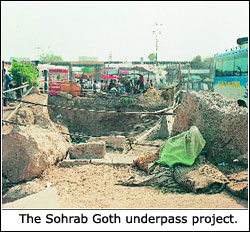 The seasonal rains may not be coming soon, but contingency plans are being rolled out by the civic agencies to face the situations arising from them. The city government, its 18 towns, the six cantonment boards, Defence Housing Authority, Karachi Water and Sewerage Board, Karachi Electricity Supply Corporation and even the traffic police have chalked out, what they call, elaborate plans to take the bull by the horns.
The agencies have set up complaint centres with well-publicised telephone numbers. They have alerted their staff and assigned officials special tasks. And their machinery is being serviced and overhauled to be ready by the time it is needed.
Mercifully, rain is a rare phenomenon in Karachi. But if it does come even to a moderate extent, experience shows, all planning will be washed away. And with so many roads dug up, grounds hollowed for underpasses and flyovers being built simultaneously, there will be a mess the city has never experienced before.
The weather is hot and humid these days. The day it turns too hot to bear, people naturally hope for rain. But those who have an idea what rain means to Karachi dread it as birds fear a scarecrow. Generally, Karachi’s weather is less harsh than that of cities such as Multan, Lahore, Peshawar, Rawalpindi and Faisalabad. For instance, when it is soaring up to 44 degrees Celsius elsewhere in the country, it may be around 37 degrees in Karachi, barring a few days when it shoots up past 40 degrees Celsius. Some people from other areas may, however, moan that Lahore’s 40 degrees is okay but Karachi’s 36 is beyond one’s endurance as it makes you perspire profusely if you are not in an air-conditioned room or car.
During the last rainy season, a little improvement was seen from the days when roads such as the main Clifton Road, the Korangi Road passing through the DHA, stretches of the roads around the big hotels and the Governor’s House, etc, would turn into deep running streams, making the traffic almost impassable. Probably, there won’t be insurmountable problems on roads that are not dug up. But only a few roads are left where work is not under way.
The city government’s claim that 15 per cent of drains have been cleared of garbage shows that how much work is yet to be done. Many open drains are still brimming with trash and if a sustained downpour occurs, these drains will spew all kinds of dirt onto the streets. Despite all its preparations, the city government and its towns may find their efforts inadequate given the challenge rains might pose.
Roads around the sites of flyovers are already in a mess. Ripped up and left to raise clouds of dust with protruding pieces of stone threatening to damage tyres of passing vehicles, imagine the scene when piles of earth soak up rain.
The KESC says it has also made arrangements to meet eventualities arising from rains. It is the KESC that suffers the most in rain and in turn it makes people suffer more than at the hands of any other utility. The first drops of rain may make its system go haywire, sending a chain reaction of power outages across the city.
Many people, particularly pedestrians, fall victim to snapping overhead cables or are electrocuted otherwise. Rains overload the air with humidity and when there is no electricity, people get steamed indoors.
Now, the KESC claims to have made a contingency plan to meet the situation. People have witnessed that there hasn’t been any improvement in the KESC’s performance since its privatisation. The situation rather seems to be getting worse with every passing day — the hotter the day the worse. So they don’t expect any special treatment by the KESC during rains.
Experience shows that all complaint cells with their telephone numbers and manpower just add to the agony in a moment of distress. The KESC, too, has its complaint centres and staff and you can see how they work.
It is true that rains cannot be prevented. But the authorities can take measures to mitigate suffering cloudbursts may cause. Only if the civic agencies could coordinate, a lot will fall into place.
The maids from southern Punjab
Masies (maidservants) from southern and central Punjab have judiciously provided the missing link in the urban domestic regime. Any housewife or working woman, both from the posh and middle-income group areas, now consider them an integral part of the household.
Barring those who are employed fulltime in affluent homes, most of the Masies prefer part-time jobs in more than one household. They do a variety of odd jobs including cooking, dish washing, cleaning and dusting. On an average, they work for about three to four hours and earn from Rs1,500 to Rs2,500 per month, depending on the nature of job.
The interesting feature of the job is that it hinges entirely on a love-hate relationship. Baji, as they call the housewife, is seldom satisfied with their routine work. Masi is scolded daily on more than one account. Dutiful among them would not react and toe the line of the employer. Some of them are, however, defiant and do not stomach the ill-treatment of Baji.
However, the love-hate relationship between Bajis and Masies has now become an integral part of urban society. Each one is dependent on the other.
— Karachian
email: karachi_notebook@hotmail.com



























