



 0
0

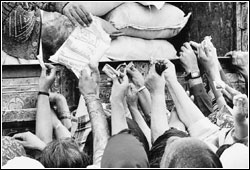 THE tussle between sugarcane producers and mills, for the last couple of years, has adversely impacted consumers. The government has not succeeded in overcoming the problem. The rift has led to a mistrust between the mills and the government. The government has not been able to persuade mill-owners to release their stock.
The likely gap between the requirement and the availability (production plus carryover stocks particularly in the private sector) was not correctly assessed , for the authorities do not have the mechanism to accurately estimate cane and sugar production.
Other factors which contributed to the current situation are: Absence of clarity of the government to implement the so-termed ‘indicative price’ policy; it perhaps does not realize the implications of a ‘free-market’ policy advocated by the international aid agencies under local environment and the cartelization; all this has resulted into a continued sugar crisis.
To investigate its causes, the National Accountability Bureau (NAB) and the Central Board of Revenue (CBR) had to abandon their efforts because of a pressure from the higher authorities.
To find a workable solution, it is necessary to analyse problems and complaints of stakeholders - mainly of growers and mill owners, and efforts should be made to solve these. Cane growers’ grievances are:
i) Mills do not start ‘crushing’ cane according to the Sugar Factories Control Act 1950 which stipulates that it should begin in the second week of October, or so. Mills usually commence the process late, at times as late as by the end of November or early December.
ii) Mills don’t issue ‘indents’ in time while growers have to struggle hard to get these indents.
iii) Growers have to wait for hours, for the whole day or beyond, even if they take the produce to mills on time. Remaining away for long hours is troublesome as they have to tend to their livestock for feed and water. There also is a security concern for family and residence.
iv) Farmers complain of the common under-weighing practice.
v) Unwarranted deductions made from the weighed produce are disadvantageous for sellers.
vi) There is an inordinate delay in cane payments. At times such delays extend beyond the crushing season and quite often these are affected in the following season and even thereafter.
vii) The funds created by levying percentage on the sale from farmers are not used for research, development and on the improvement of market infrastructure.
viii) There is a tendency among mill owners of not purchasing the produce directly from growers but through the middleman, for which they pay in cash but at a discounted rate.
ix) Crushing also continues late i.e., by the end of February or the beginning of March. The land occupied by sugarcane becomes available for wheat late which impacts its per hectare yield, as well.
The complaints of mill owners against cane growers are as follows:
i) Varieties grown by farmers have low recovery in relation to weightage, e.g., variety CO1148, commonly grown by farmers. The price paid to sellers is not related to the sucrose content as they pay the support (or indicative price) even if sugar content is lower than the base – 7.5 per cent.
ii) Cane brought to mills is not properly ‘stripped’ and dry leaves are left with the sticks. This not only adds to weight but also creates problem during the crushing process.
iii) The material used for binding canes into bundles cause problem during the crushing process.
iv) With an increasing tendency of farmers for ‘gur’ making, the supply of sugarcane to mills is adversely affected. The permission to allow ‘gur’ exports adds to the problem.
In may view, the sugar crisis can be averted if the following recommendations are considered:
i) Should sugarcane cultivation be encouraged or not, as this is a high irrigation demanding crop? The policy in this respect should be clearly stated.
ii) Would the government like to have a support (or indicative) price programme for cane? If so, how would it be implemented? At present, no clear procedure seems to have been laid down.
iii) In case the support (or indicative) price programme is to be implemented, the government should be prepared to buy sugar from mills at a predetermined price if the market price goes below this level.
Such a price would be based on the fixed price of cane which the mills buy from farmers. (This exercise can be conveniently done by APCom as it did so some year years back). Such a course of action was in force in the 1980’s. The government may incur losses in some years and earn profits in others, depending on the market situation. But in longer run, losses and profits would equalize. This will safeguard the interests of grower, mills and the consumer.
iv) The experience of ‘free-market’ mechanism as advocated by international aid organizations have not worked under our local conditions. The examples of wheat, cotton and sugarcane prove this. In fact, the occurrence of such failures adversely affects the popularity of a government.
v) As in the past, there should be a ‘Sugar Board’. The minister of food and agriculture should be the Chairman and the minister of industries/commerce as co-chairman. The provincial governments and all stakeholders should be the members of this Board. It should at least meet twice a year and lay down the policies which should be accepted at all government levels, to resolve the issue that any of the stakeholders brings up in the Board.
vi) The government should set up a Committee which should meet as frequently as required, to get an idea of the size of the crop which can help it to plan export/import programme. This Committee should be headed by an independent person, whether from public or private sector, who does not have any role in cane or sugar production, but in any case a minister/minister of state or secretary of the relevant ministries should not head this Committee to avoid any bias..
vii) The farmer should be paid according to the quality of cane, measured in terms of sucrose content. ‘Core-sampler’ system can be adopted which at one time was taken-up by the Thatta Sugar Mill and Abadgar Sugar Mill. But as mills did not get the same profit as they used to get prior to the adoption of such a system, they gave it up. The Kamalia Sugar Mills was also keen to initiate the adoption of this method of determining the price, but following the example of the Thatha Sugar Mills, it gave up the idea. Many countries of the world are using this method for payment to farmers, successfully.
viii) Despite the government announcement that no new sugar mills will be set up in the country, particularly in cotton growing areas, the influential people are reported to be setting up four new mills in Punjab - one in the D.G. Khan district. As the existing mills are operating on less than 50 per cent of their capacity, there is no justification in allowing new mills. This proposal has to be seen in the light of water shortages, the country is to face in the years to come.






























