0
0

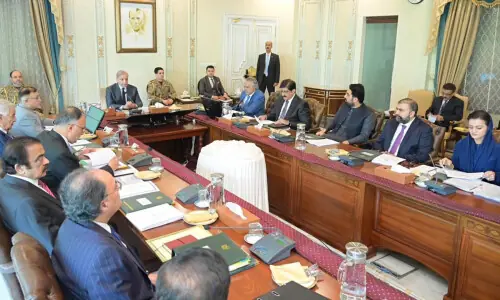
ISLAMABAD, June 24: An All-Party Conference held here on Saturday expressed concern over the deteriorating law and order situation in Karachi besides calling for the removal of the Arbab-led Sindh government for “doing nothing” to curb the MQM’s excesses and sacking provincial governor who, it was alleged, was patronising crimes and criminals.
The conference, convened by the Jamaat Islami, was held under the JI chief Qazi Hussain Ahmed and was attended by representatives of almost all opposition parties, including leader of the opposition in the National Assembly Maulana Fazlur Rahman, PPP Parliamentarian’s secretary-general Raja Parvaiz Ashraf, PML-N’s information secretary Ahsan Iqbal and a number of legislators belonging to the religious alliance.
Briefing newsmen at the end of the meeting, the MMA chief said that all parties had agreed to a on one-point agenda of launching an anti-government campaign, adding that a deadline would be worked out soon.
Leaders of the JI’s Karachi chapter also attended the meeting.
A joint declaration adopted by the conference accused General Musharraf of deliberately trying to eliminate religious, national and political leaders in Karachi through what they termed a terrorist organisation in a bid to prolong his rule.
The declaration alleged that a campaign had been unleashed to malign national leaders, the ideology of Pakistan and the constitution under the protection of the Sindh government.
It said Karachi was being ruled by “terrorists, murderers and extortionists”, adding that all communities felt that there life, property and honour was insecure.
Citing murders of Mufti Nizamuddin Shamzai, Maulana Yousuf Ludhianvi, Mufti Mohammad Jamil, Allama Mukhtar Qadri, Hafiz Mohammad Taqi, Dr Ibne Hasan and Hakim Mohammad Saeed, the declaration said that so far 25,000 people, including youths, religious scholars belonging to various sects, political workers, intellectuals, journalists, teachers, students, doctors and industrialists had fallen victims at the hands of “armed terrorists and extortionists”.
It said that the MQM had won elections under official patronage in 2002, adding that the party had been imposed upon the city despite its being a minority group. A man, allegedly involved in serious crimes and an absconder, had been brought back to become the Sindh governor, unleashing a new era of lawlessness, murder and terrorism.
Citing official figures, it said that as many as 657 people had been slain in four years, adding that law enforcers were also not immune from the reign of terror as dozens of policemen personnel of army and rangers had been killed.
The declaration said while all this was done under the nose of Sindh governor, the chief minister was the province’s chief executive in the name only. People living in slums were being evicted and their property demolished. Terrorism, it said, “enjoyed full protection of police and administration”, adding that so much so, police stations in Karachi had been turned into “MQM’s unit offices”.
It regretted that the electronic and print media had become completely hostage in the hands of MQM, adding that journalists were facing life threats for not publishing news reports “according to their taste”.
The conference called for extraditing Altaf Hussain through Interpol, disclosing the real culprits behind the Nishtar park tragedy, putting an end to terrorism in educational institutions, arresting the murderers of ulema, political leaders and workers belonging to all schools of thought and all political parties should be allowed to freely take part in political activities and eliminating the so-called ‘no-go areas’.