



 0
0

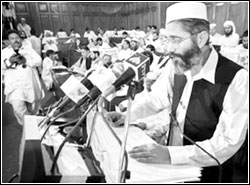 CREATING two thousand new jobs for inducting as many lady health workers under the national programme for family planning and primary healthcare, the NWFP government’s annual development programme for 2006-07 is an agenda with a mix of conventional wisdom and ambitious targets.
The clergy-led provincial government has projected a record ADP of Rs26.63 billion for the next year, exceeding budgeted amount of Rs21 billion for 2005-06 and, some Rs3 billion more than the revised estimates.
The development expenditure at the end of the first nine months of the current year stood at slightly over Rs8.1 billion.
The revised estimates of development expenditure, finalised on June 15, came as a big surprise to many. The provincial finance managers have come out with a staggering figure of over Rs23 billion as estimated development expenditure for the whole year.
In certain cases, according to official documents, expenditure was more than the funds released by the government.
This left many to question the credibility of the government’s final figures which rose by over Rs15 billion in the fourth quarter.
On their part, officials have defended the same, taking a stand that all line departments and project executing agencies had not provided consolidated figures of their respective development expenditures for the first nine months. Thus, substantial amount of expenditure could not be accounted for while preparing consolidated figure for the period.
But the correctness of the government’s claim can be ascertained only when final estimates are compiled. On the basis of NWFP government’s past two years’ performance, one can safely say that the revised estimates might not be much different than the last year’s ADP’s revised estimates—a shortfall in the targeted spending.
However, development would become costlier affair in the next financial year. Contracts for construction works awarded to private contractors, were raised significantly in December last year in fulfilment of contractors long standing demand.
The new composite scheduled rates (CSR), to be applicable for new construction works only, happen to be 70 per cent higher than the old rates, which were put in place in 1999. In this way, if the over-all size of ADP has grown substantially.
Justifying increase in CSRs, officials said that the upward of revision of the official rates were long over due since prices of construction material particularly prices of cement, steel, bricks, etc rose significantly during the last few years.
Conceding that the new CSRs would dry up sizeable development funds, provincial minister for finance, planning and development Siraj-ul-Haq, told this scribe that increase in CSRs involved financial implication of about Rs6 billion for the next year.
Hence, substantial part of the additional funds to be received by the province under the interim National Finance Commission award would be consumed by higher construction cost. Setting objectives of the new development outlay, the government has committed to continue focusing on improving the social sectors with a major chunk of over Rs5 billion going to the education and health sectors, whereas industrial sector would also be accorded priority to create jobs in the private sector to bring down unemployment.
Two new industrial zones would be established in the province one each at Mardan and Karak districts. Polytechnic colleges and vocational centres will be set up in Kohistan, Chitral, Karak, Shangla, Malakand and Dir upper districts, whereas, technical centres for women will be established in Mansehra, Peshawar, Haripur and Tank districts.
Similarly, in the irrigation sector, the government intends to conduct pre-feasibility studies of building of 15 dams, in addition to conducting feasibility studies for the construction of 20 small dams – 10 each under the federal and provincial governments’ programme, whereas, detailed designing of eight small dams would be carried out.
Substantial amount of funds would go to regional development and road sector in continuation with the official policy to concentrate more on the Malakand region and southern districts of the province – the stronghold of the component parties governing the NWFP.
Work on 61 projects of provincial roads will be completed in 19 districts, whereas, 300 km of roads will be built in various parts of the province in addition to completing 19 bridges in six districts.
The development outlay entails a locally funded component of Rs18.95 billion and foreign funded development projects of Rs7.68 billion.
The locally funded component involves a total of 1006 development projects of which 236 projects are new and the rest forms the portfolio of the on-going development projects.
Of the Rs18.95 billion total investment earmarked for the locally funded component of the ADP, a total sum of Rs13.889 billion has been allocated for the on-going schemes, whereas, a total amount of Rs5.06 billion would go to the new schemes.
Major investment would be made in the schools and literacy, higher education, health, regional development and roads sectors. Out of the Rs2.754 billion earmarked for the schools and literacy sector, a substantial amount would be utilized to construct boundary walls of some 2000 schools. About 2000 schools will now have latrines and proper drinking water facilities, whereas, over 210 new primary schools for girls would be established in line with the government’s policy to increase students enrolment to about 70 per cent.
It also envisages setting up some 3000 adult literacy centres, one each cadet college at Swat and Charsadda and giving Rs1000 allowance to teachers posted in remote areas of the province where girls students would also be given Rs200 honorarium per person per month.
With total allocation of Rs2.172 billion for the health sector, 115 nurses will be recruited, child immunization coverage will be increased up to 42 per cent, immunization for expectant mothers will be increased up to 75 per cent. The programme includes construction work of 12 district headquarter hospitals and six regional rural health facilities will be completed, whereas, 19 civil dispensaries and rural health centres will be up graded.
However, protection of environment still appears to be low priority on the government’s agenda. A paltry allocation of Rs19 million has been earmarked for the environment sector.
District governments would get Rs963.393 million to support their respective annual development programmes.
Though the provincial government’s share under the federal divisible pool of the National Finance Commission would grow substantially, with some Rs14 billion more in 2006-07 as compared to the outgoing year, no share of additional funds would be passed on to the district governments for development.
Continuing with its policy to involve members of the provincial assembly in identifying and executing specific development schemes in their respective constituencies, the government had allocated Rs1.24 billion under the Tameer-e-Sarhad Programme.
Each one of the 124 members of the provincial assembly would be provided Rs10 million each to plan and execute development works in their respective constituencies.
Similarly, under the Rs7.68 billion foreign funded component of the ADP major funding would go to regional development followed by roads, schools and literacy.
Out of the Rs7.68 billion allocation for the foreign aided projects, provincial government would raise a sum of Rs1.337 billion through its own resources as ‘counter part funds’.
Compared with the outgoing financial year, an increase of over Rs800 million has been made under the funds earmarked for the foreign aided projects.
Against the Rs6.87 billion earmarked for foreign funded projects in 2005-06, a negligible amount of Rs1.45 billion could be spent during the first nine months.






























