0
0

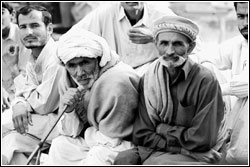 PAKISTAN inherited a socio-economic agrarian structure in the fragmented form in 1947. Since then no serious reforms or efforts were made for the uplift of small farmers or for rationalising the land ownership structure.
The situation today is basically no different from the past. Land revenue, produce sharing system and a series of exorbitant taxes starting from the field to market, are burden on cultivators. The outcome is a huge rural debt problem and rising poverty.
Farm labourers, blacksmiths, carpenters, potters, barbers, washer men etc., receive fixed amount of grain from the farm produce or now cash, for the services they render to farmers.
The cultivator or the tenant of landowners generally pays half of the produce to landlord - irrespective of natural calamities that hit him most.
Normally, farm gate prices are 20-30 per cent lower than the prices prevailing in local markets. In the price of a value-added product, the share of a cultivator is nominal.
Rural farmers do not have easy access to education and health services. Transport and communication infrastructure is poor. Due to the lack of diverse economic activities, employment opportunities remain very restricted for them as labour absorbing industries are concentrated in cities and towns.
The agrarian structures and socio-economic patterns, inherited by the country, have seen no change since the British Raj. Jagirdars, feudal lords, tribal sardars, big land-owners and elite castes and races still form the dominant class owning bulk of the land. This class is still dominant, using cultivators, tenants and mureeds as their vote bank. It avails all facilities and services offered under various programmes to farmers by the governments.
There is a bias towards industrial growth. The landlords and industrialists create impediments in the way of effective reforms as they consider it against their interests. A farmer-friendly policy is almost absent except at rhetoric level.
For decades, the economic growth has been staggering but as a result, there is a significant increase in cultivable land and usable water quantum. With the introduction of high yielding crop varieties and animal breeds and new production technologies, farm yields have increased by 3-4 times.
The accessibility to agriculture credit, seed and fertilizers has improved considerably but at an exorbitant rate which is beyond the reach of small farmers. Due to these developments, there has been a significant growth of six per cent in the GDP over decades. The impact of this economic growth has not filtered down to the poor rural masses.
The poverty level in rural areas has increased to 38 per cent and there is large scale shifting of rural population and resources to urban areas. The plight of small farmers has changed but for worst which is evident from the continuous rise in poverty level, decline in dietary standards, poor access to education and health services, lack of essential infrastructure or cheap energy and basic inputs for adopting modern technologies. The quality of life is poor for most of the farming communities.
A steep decline is visible in productivity level with a sharp rise in land value, more so with the construction of roads and residential colonies which do not link farms to markets and industrial areas but to big towns for rapid movement of population.
Suggestions for consideration of the concerned authorities in public and private sectors for improving the situation are as follows:
* A national policy is necessary to achieve sustainable agricultural growth which could also ensure trickling down of the benefits to the grassroots level.
* Socio-economic reforms for efficient use of land and water resource need to be enforced. There should be cultivator ownership for growers to take decisions about the crop and modern technologies to be used.
Absentee landlordism should be abolished. Valuable land and water resources, particularly fertile soils, should not be reduced and wasted by establishing fashionable residential colonies.
* Off-farm economic activities, particularly agri-business should be diversified. Agro-based industries should be established in production areas to create employment opportunities and develop field-to-market infrastructure.
* Farmers should be motivated and trained to form associations, groups and cooperative bodies for profitable participation and minimizing dependence on the intermediaries.
* Food is a strong weapon during peace and war. For socio-political stability, food security should be on top of the agenda. To achieve food sufficiency on sustainable basis in view of the increasing demographic pressures and environmental problems, the governments should provide input subsidies and price support to food growers instead of import subsidies.
* Agriculture should be commercialized and linked with the market. Value addition of raw material should be promoted for import substitution and export promotion.
* Apart from simplifying loaning procedures and extending crops and livestock insurance facilities to farmers, an efficient system for timely and regular supply of inputs such as seed, fertilizers and agro-chemicals at reasonable prices should be ensured in the private sector with effective quality control measures. Agricultural input stores should be opened in rural areas on the pattern of utility stores.
* In barani areas, the livestock production should be a dominant feature. For better harvesting of rain run-off and flood water, small dams should be constructed with community participation.
* An ‘agricultural crisis fund’ should be established by the governments with the assistance of international agencies. This will facilitate timely assistance to the affected farmers.
* Private sector should be involved in research and extension activities for sustaining their competitiveness and credibility and a fruitful future.
The dream of economic prosperity and socio-political stability cannot be achieved without improving the capabilities and overhauling the land ownership system and the agrarian structure.
The writer is former director-general of agriculture.