



 0
0

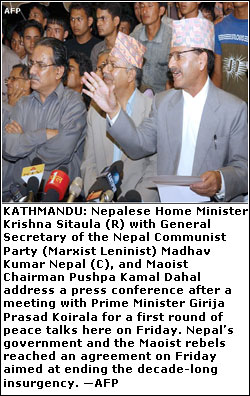 KATHMANDU, June 16: Nepal’s government and the country’s Maoist rebels said on Friday they had reached an agreement aimed at ending a decade-long insurgency after a day of unprecedented meetings between the two sides. “We have reached an eight-point understanding to get the country out of the current crisis,” Home Minister Krishna Prasad Sitaula said.
Prime Minister Girija Prasad Koirala and elusive Maoist chief Prachanda held a first round of face-to-face talks Friday to try to end the insurgency that has crippled the Himalayan nation.
“We’ve agreed to dissolve the parliament and the Nepal Communist Party Maoist People’s government, and on the framing of an interim constitution and the forming of an interim government,” said a joint statement signed by Prachanda and leaders of the seven-party alliance now running the country.
The two sides also agreed to hold elections for a body to redraft Nepal’s constitution, a key demand of the Maoists who also want to scrap the monarchy.
“A democratic republic is our minimum demand and we will go to the Nepali people with this demand during the constituent assembly elections,” Prachanda said following the meeting at the prime minister’s Kathmandu residence.
Both sides also agreed to request UN monitoring of arms during the polls.
“For free and fair constituent assembly elections both sides have agreed to request the United Nations to monitor the management of arms and soldiers (on both sides),” the joint statement said.
Prachanda said parliament should be dissolved in a month and that the constituent assembly elections should be held before April 2007, but there was no government confirmation of this timetable.
Prior to the announcement, a Western diplomat welcomed news of the high-level meeting, but said that arms issues should be discussed promptly.
“We are pretty optimistic, but arms management has to be raised,” the diplomat said on condition of anonymity.
“They are all pushing for early (constituent assembly) elections, and you have to have (arms) decommissioning before the elections, so it’s not too early to make a commitment to disarmament,” the diplomat said.
Friday’s meeting was historic, said Kapil Shrestha, a political science professor at Nepal’s Tribhuvan University.
“Now it will be difficult for the Maoists to return to the jungle as they have come too far from their earlier position,” Shrestha said.
“This shows that both the government and the Maoists are sincere and serious enough to establish peace in the country,” he said.
Koirala, 84, was due to fly to Bangkok for medical treatment on Saturday.
Prachanda, whose name means “the fierce one”, disappeared a decade ago to wage a rebellion that has claimed more than 12,500 lives since 1996.
But the rebels, who entered into a loose alliance with the seven-party coalition last year, have observed a ceasefire with the interim government that came to power in April after mass protests forced Gyanendra to end 14 months of direct rule and reopen parliament.
Nepal’s newly-reinstated parliament adjourned Thursday for 18 days in an effort to boost the peace process.
Parliament reconvened for the first time in four years in April but the rebels have been calling for the dissolution of the house and the establishment of a new interim government in which they too will be represented.
The current peace initiative is the third since Nepal’s Maoist insurgency erupted. Two previous attempts to hammer out a peace deal failed and the impoverished nation was plunged back into conflict. —AFP





























