



 0
0

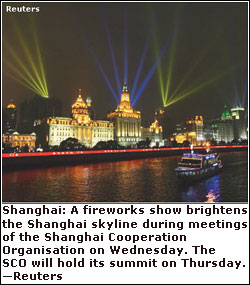 MOSCOW, June 14: A new Central Asian security group led by Russia and China aims to strengthen Eurasian stability but is open to dialogue with the United States or any other country outside the region, President Vladimir Putin said in a newspaper article published on Wednesday.
Writing in the government daily Rossiiskaya Gazeta, Putin said the Shanghai Cooperation Organisation (SCO), a club founded a decade ago, was setting ‘an excellent example of even-handed partnership in the Eurasian space’ while enhancing the region’s security and stability.
Putin’s article appeared a day before he and Chinese President Hu Jintao were scheduled to meet in Shanghai as part of a summit of leaders of the six SCO member countries as well as planned attendance by Iranian President Mahmoud Ahmadinejad and heads of other states with observer status.
“We are acquiring experience in working together,” Putin said of the group’s members. “This will ensure the growth of authority of the organisation, whose member states’ population comprises nearly half of the people on Earth.”
The United States, which is not a member of the SCO, has shown signs of increasing unease about the group’s composition and purpose — notably its decision to include Iran as an observer — but Putin said the SCO’s aims were peaceful and it was always ready to talk with outsiders.
“I underscore that the SCO is open for dialogue, prepared for joint work for the sake of peace, stability and development,” Putin said.
The SCO annual leaders’ summit was scheduled to take place on Thursday in Shanghai, bringing together the presidents of original member states China, Russia, Kazakhstan, Kyrgyzstan and Tajikistan along with Uzbekistan, which joined in 2001.
The leaders of Iran, Pakistan and Mongolia will also attend, with their nations granted observer status in 2004, as will Afghan President Hamid Karzai as an official ‘guest’.
India, also an observer nation, will send its petroleum minister.
According to one source in Moscow, the United States embassy in Beijing recently sent a message to the SCO secretariat complaining at Iran’s inclusion in the group and voicing concern that the club was becoming a vehicle to thwart US interests in Central Asia.
Another senior Russian official, Deputy Foreign Minister Alexander Alekseyev, moved to assuage US concerns over the direction of the SCO, saying in a newspaper interview that the bloc did not plan to become a Nato-like military alliance with Russia and China at the core.
Although tightening defence cooperation among SCO member states was part of the organisation’s plans, ‘this interaction will not be aimed against any other states or international organisations’, Alekseyev told the opposition daily Novye Izvestia.
“It would be mistaken to see in these plans a sign of transformation of the organisation into a military-political alliance like Nato,” he added.
Putin’s special adviser on SCO affairs, Vitaly Vorobyev, offered a similar assurance.
“The structure, aims, tasks and basic documents of the SCO are all open to anyone,” Vorobyev said in an interview with the centrist daily Izvestia.
“They contain nothing, in my view, that suggests even the possibility of this organisation to take on the traits of a military-political bloc,” he added.
Officials said a number of multilateral agreements were due to be signed at the summit in areas ranging from cooperation in fighting terrorism to combined projects in education.—AFP




























