0
0

KARACHI, June 6: A promised allocation of about Rs120 billion for the next fiscal year in the federal budget documents released on Monday and an indicated carryover surplus cushion of about Rs20 billion from the 2005-06 provincial budget gives all the room to the Sindh government to promise milk and honey, a better tomorrow and a beginning of the end of a long period of poverty and deprivation to 35 million people of the province in its next budget to be announced on June 15.
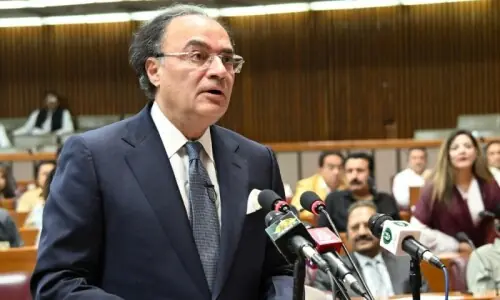
Whosoever presents the Sindh budget on June 15 on the floor of the Sindh Assembly is expected to replay the populist tones of young Minister of State for Finance Umar Ayub Khan’s budget speech on Monday. M.A. Jalil is an adviser to the chief minister on finance and development and not an elected member of the assembly. He will not be able to give a budget speech on the floor of the house. Likely choice is Syed Sardar Ahmad of the Muttahida Qaumi Movement who is now minister of excise and taxation.
He was finance minister of Sindh and presented budgets on two previous occasions. His budget speeches last June and in 2004 were articulation of unending complaints against Islamabad with reference to the National Finance Commission award or federal government’s accounting of Sindh’s debt servicing.
The Sindh government, Mr Sardar alleged in his last budget speech, had paid much more than it borrowed from Islamabad and still carried a liability. This situation, it was alleged, was because of 17 and 18 per cent interest rate on federal loans and Islamabad’s accounting system which adjusted a very small amount of principal and focused more on interests.
Like three other provinces, Sindh gains on two counts from its share in the federal divisible pool. Under the amended NFC formula given by President Pervez Musharraf, after the four provinces and federal govern ment failed to achieve a consensus formula, the share of the provinces has increased to 41.50 per cent of the pool in the coming year. It will go on increasing by one percentage point every year and will be 46.25 per cent in 2010-11.
Second reason for increase in the share comes from improvement in the collection of tax revenue by the Central Board of Revenue and recovery of oil and gas related levies.
In the fiscal year 2005-06, the federal budget initially indicated transfer of Rs86.40 billion to Sindh. This included Rs56.89 billion from the divisible pool and Rs29.51 billion direct transfers from the collection of oil and gas related levies.
But at the end of the day, Sindh’s share in federal funds has increased by Rs8.75 billion to Rs95.14 billion as against initially indicated Rs86.40 billion. From the federal divisible pool, Sindh’ share increased to Rs57.99 billion from Rs56.89 billion and direct transfers of oil and gas related levies swelled to Rs37.14 billion from Rs29.51 billion.
In its budget documents, the Sindh government made a few entries of huge block amounts which have remained unspent. With this financial engineering, the Sindh government has managed to plug about Rs6 billion operational shortfall in its current revenue budget, invest in Rs24 billion unfunded annual development outlay and also make a saving of Rs20 billion or so.
The federal budget documents released on Monday reveal that Sindh’s share in the federal divisible tax pool has increased to Rs82.07 billion from its upward revised share of Rs57.99 billion in the current fiscal year. It is an increase of Rs24 billion. Sindh’s share in direct transfers of oil and gas related levies also shows a small rise to Rs37.90 billion next fiscal year from Rs37.14 billion this year.
With a promised allocation of Rs120 billion, a carryover stock of Rs20 billion funds in banks and an expected collection of about Rs20 billion provincial and local taxes collection, Sindh has now at its disposal about Rs160 billion.
In line with federal government’s record development investment plan of Rs415 billion, Sindh planners are expected to put in about Rs32 to Rs34 billion in the development outlay in 2006-07. ‘White Revolution’ will also be Sindh government’s slogan, and ambitious programme of livestock farming and dairy products are being prepared. Two to three milk plants are expected to come up in the province in near future.
There are ample funds at the disposal, but the Sindh government lacks a cohesive team to take up the good governance job in the province. There is an unending mistrust in the coalition partners on sharing of development funds and allocation of jobs. The coalition political partners are said to be demanding share in development funds and quotas in jobs something unheard of in the past.
A recent World Bank report has taken notice of bad governance, worsening law and order and a delivery of service in health, education and other areas which is far from satisfactory. Only in the last seven to eight months, the MQM threatened to quit the government on three occasions and it was the highest level intervention that saved the coalition.