0
0

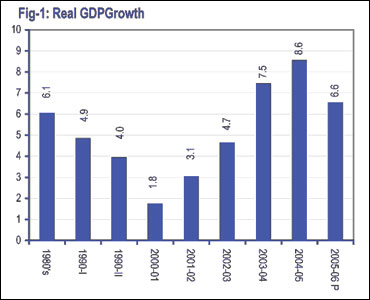 ISLAMABAD, June 4: A lower than expected industrial and agricultural production in 2005-06 marred Pakistan’s real gross domestic product growth rate, which remained at 6.6 per cent, missing the year’s target of seven per cent remaining much below previous year’s growth rate of 8.6 per cent, according to the Economic Survey launched here on Sunday.
The services sector, with 52 per cent share in overall economy, however, rescued the sluggish economic growth by posting a robust increase of 8.8 per cent, much higher than the 6.8 per cent target.
The survey said foreign direct investment increased by over 238 per cent, attracting $3.1 billion against $891.5 billion during the same period last year while the country’s foreign exchange reserves swelled to over $13 billion or equivalent to over six-month coverage of imports.
According to the survey, issued by Dr Salman Shah, Adviser to the Prime Minister on Finance, here on Sunday, the public debt to GDP ratio declined by almost 30 per cent to 54 per cent in 2005-06 against 85 per cent in 1999-2000, while as a percentage of GDP, it declined from 61.4 per cent to 54.7 per cent, recording a 6.7 per cent decline in a single year.
Dr Shah said 2005-06 was another year of solid economic growth despite two major shocks — an unprecedented surge in oil prices and last year’s devastating earthquake.
He agreed that the services sector’s growth was mainly boosted by growth in the banking sector through a large gap between higher interest rates and low return on deposits but said it was necessary for the government’s development agenda. The banking and insurance sector grew by a mammoth 23 per cent against a target of 6.7 per cent.
“Three or four years of strong economic growth has positioned Pakistan among the fastest (growing) economies in the Asian region like, China, India and Brazil,” said Dr Salman Shah.
AGRICULTURE: “The performance of agricultural sector remained weak this year as major crops registered a negative growth of 3.6 per cent,” said the economic survey. “This decline was on the back of poor showing of major crops and forestry, and weaker perform ance of minor crops and fishery.”
The sector, with about 23 per cent share in the GDP, grew by a nominal 2.5 per cent against a target of 4.8 per cent for the current year and against 6.7 per cent farm growth achieved last year.
Major corps registered a decline of 3.6 per cent as production of two of the four major crops — cotton and sugarcane — was significantly lower than past year. Livestock performed well as the sector grew by 8 per cent on the back of substantial increase in cattle population and milk.
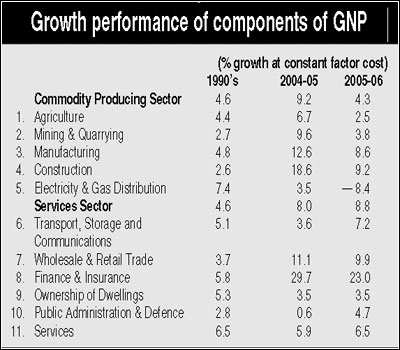 INDUSTRY: The depressing performance of industrial sector, with a GDP share of about 18 per cent, was broad-based during the current year except for the construction and small-scale and household sector that grew by leaps and bounds and was supported by consumer finance. The construction sector also posted an higher growth rate of 9.2 per cent during the current year against last year’s extraordinary growth of 18.6 per cent.
SERVICES SECTOR: The services sector registered convincing and broad based growth of 8.8 per cent during the current year, against a target of 6.8 per cent and last year’s increase of 7.9 per cent.
Transport and communication sector grew by 7.1 per cent against a target of 5.8 per cent and last year’s growth of 3.5 per cent. Similarly, the wholesale and retail trade rose by 10 per cent against a budgeted target of 9.3 per cent but lower than last year’s growth of 12 per cent.
PER CAPITA REAL GDP: Per capita income in dollar terms registered an increase of 14.1 per cent over the last year, rising from $742 to $847.
FOREIGN DIRECT INVESTMENT: The country attracted $3.1 billion of FDI against $891.5 million during the same period last year, showing an increase of 238.7 per cent. Over 90 per cent of FDI has come into power, telecom, chemicals, pharmaceutical and fertiliser, oil and gas and banking and finance sectors.
INVESTMENT: The gross fixed capital formation or domestic fixed investment grew by 30.7 per cent against a rise of 28.6 per cent last year. Private sector investment grew by 31.6 per cent against 29.1 per cent last year.
National savings as per cent age of GDP stood at 16.4 per cent this year, slightly lower than last year’s 16.5 per cent growth. Domestic savings stood at 14.4 per cent of GDP this year, nominally lower than 14.5 per cent.
INFLATION: For the first ten months of the current year, the inflation as measured by the consumer price index (CPI) declined to eight per cent from 9.3 per cent last year. Food price inflation average at seven per cent against 12.8 per cent last year.
The overall fiscal deficit that had reduced to 2.3 per cent in 2003-04 has increased to 4.2 per cent during the outgoing financial year as against the target of 3.8 per cent of the GDP.
REMITTANCES: Against the full year target of $4 billion, workers’ remittances totalled $3.63 billion during the first 10 months of the current fiscal year against $3.4 billion in the same period last year. It is likely that workers remittances may touch $4.4 billion in 2005-06.
TRADE DEFICIT: Exports in nine months of the year rose by 18.6 per cent to $12 billion while imports grew by 43.2 per cent to $20.7 billion, leaving a trade deficit of $8.6 billion.
CURRENT ACCOUNT DEFICIT: The current account deficit, excluding official transfers, stood at $4.7 billion in first nine months of the year against just $1.18 billion last year, showing an increase of 300 per cent.
PUBLIC DEBT: The public debt to GDP ratio, which was 85 per cent in 1999-2000, declined sharply to 54.7 per cent in 2005-06 — almost 30 percentage points reduction in debt burden.
During the year, public debt as per cent age of GDP declined from 61.4 per cent to 54.7 per cent — a 6.7 per cent decline in a single year is one of the stellar events of the current year.
Public debt was 448.9 per cent of the total revenue last year but declined to 414.9 per cent this year, a decline of 34 per cent age points. The overall stock of public debt, however, increased from 35.8 billion last year to $36.557 billion, excluding earthquake-related loans, which have not yet started coming in.