0
0

KARACHI, May 30: Expressing their serious concern over the constantly deepening power crisis, which is also aggravating numerous other problems like water shortage and declining industrial activities, leaders of various political parties and people from a cross section of the society have called upon the higher authorities to intervene immediately to provide people of Sindh some relief.
Hours-long breakdowns, in addition to the loadshedding of unbearably long spells several a times in 24 hours in many cases, has virtually paralysed routine life in Karachi and added to the miseries of citizens across the province. Among the worst sufferers are patients in serious condition, elderly people, women and small children. For the students preparing for the ongoing examinations, the situation is posing a big threat to their whole career.
Muttahida Qaumi Movement chief Altaf Hussain has urged President Musharraf and Prime Minister Shaukat Aziz to take crisis very seriously. “It deserves immediate intervention”, he said in a statement faxed from the MQM’s London Secretariat.
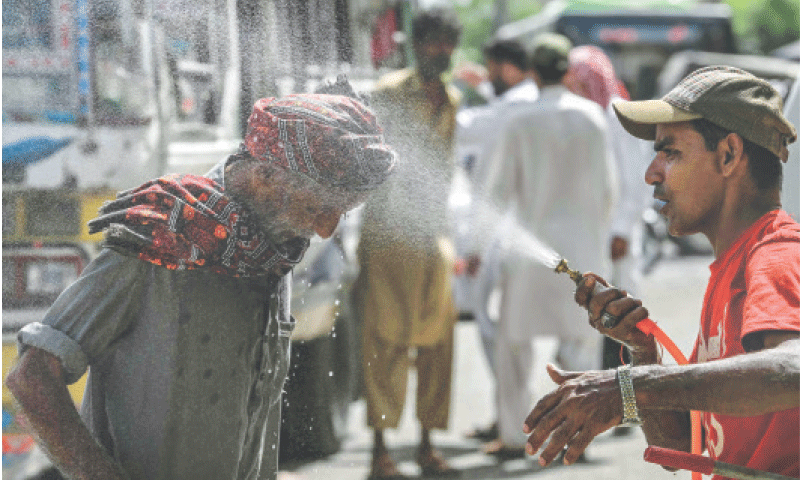
He pointed out that in Karachi, the crisis was getting deeper and deeper with every passing day. Coupled with the scheduled loadshedding on a daily basis, the unannounced suspension of power supply runs into many hours, up to 12 or 16 hours in some cases. This has also been affecting water supply situation, whereas students taking their examinations are facing hardship in preparing for their papers. The situation is all the more troublesome due to the prevailing harsh summer.
Mr Hussain said that despite the grave situation, the KESC authorities were paying no heed to people’s miseries and taking no step to improve the situation.
Besides people of Karachi, citizens of other areas of Sindh were facing the power and water crisis, he added.
PPP legislators Sher Mohammad Baloch, Manzoor Wassan and Nafisa Raja, in a joint statement, expressed their surprise over the statement of Prime Minister Shaukat Aziz who had advised the KESC to do away with the loadshedding. They claimed that in a situation where the government had failed to provide any basic facility to citizens, the exhausting loadshedding had made common man’s life even more miserable.
They pointed out that on the one hand, students appearing in their intermediate examinations were being made to suffer, and on the other, patients in hospitals, including those undergoing surgeries, were facing great trouble.
“The government, by imposing different taxes and surcharges, is also continuing to increase power tariff,” they deplored.
They said that in most parts of Karachi, power would go off at around 9am and be restored only after 12 hours. The disruption in power supply due to the breakdowns, loadshedding and voltage fluctuation was also causing damage to the electrical and electronic appliances, besides aggravating the water shortage problem in the city.
They wondered that neither the power generation capacity was being enhanced, nor was any measures taken to improve the existing power distribution system. “The prime minister, as well as the federal and provincial cabinets, are continuing to befool people by repeating the statement that there would be no more loadshedding in Karachi and other parts of Sindh.”
According to them, the poor performance of the KESC and the government has pushed Karachi into the power crisis. They observed that the government had lost control of every institution.
They recalled that the PPP government, led by Ms Benazir Bhutto, completely eliminated loadshedding without sacking any KESC worker.
Muttahida Majlis-i-Amal legislators Nasrullah Khan Shaji, Hameedullah Khan and Yunus Barai said that loadshedding and prolonged breakdowns had created water crisis in many parts of the city as in certain areas, water was not reaching at all.
They said that after the KESC’s privatisation, people of Karachi were faced with the dual crisis of power and water shortage. They deplored that despite the tall claims by the federal minister for water and power loadshedding was continuing in its full severity across the province.
The legislators said that the KESC was not ready to make any investment to overcome the crisis.
They reiterated the MMA’s stand that privatisation of the KESC was bound to multiply the hardships being faced by consumers, and said that it had proved correct.
The experiment of privatisation of national institutions had failed, they remarked, and demanded that measures be taken to ensure a smooth and uninterrupted power supply to Karachi and other parts of Sindh. They demanded that power generation capacity be enhanced keeping in view the estimate that the requirement in Karachi would increase ten times over the next few years.