0
0

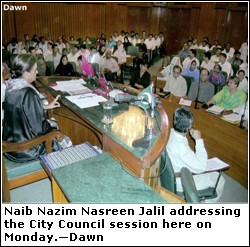 KARACHI, May 29: The City Council Karachi has expressed its grave concern over the power crisis that has been prevailing in the city for more than a month. A resolution adopted by the council at its session, chaired by Naib Nazim Nasreen Jalil, on Monday noted that at a time when thousands of students were taking their annual examinations, the loadshedding and breakdowns were causing immense hardship to them and affecting their studies badly, thus creating risk for their future career.
The council also took a serious note of the fallout of persisting loadshedding on the city’s water supply system.
It regretted that the KESC had never paid due attention and prepared to plan to ensure an uninterrupted power supply to households and industries in Karachi, which generated 68 per cent of the country’s revenue. In this context, it pointed out that the national economy depended greatly on the city’s industrial activity.
The council also noted that the city’s power requirement was 2,250 megawatts but the KESC’s power generating capacity stood at 1,300 megawatts. “We are being compelled to acquire electricity from Wapda and the private sector at a higher rate,” the council said, pointing out that the requirement was increasing by seven per cent per annum.
It urged the Sindh government to approach the federal authorities with the request that Wapda be directed to supply 300 megawatt electricity through Hubco to Karachi.
It also called for steps to enforce a time-schedule for shops under Shops Act to conserve power. The council appealed to people to consume electricity prudently to help ease the crisis.
Through another resolution, the City Council condemned retrenchment of more than 1,000 employees of the Muslim Commercial Bank, and termed it ‘highly illegal act’. It urged the bank management to reinstate the affected workers.
It expressed the view that the MCB was a financially sound institution earning an annual profit of around Rs8.92 billion. It noted that the bank’s profit over the last 10 years had been estimated at Rs20 billion while it had written off loans amounting to Rs10 billion. Recently, the bank distributed bonus amounting to millions of rupees among it executives and high-ranking officials.
The council expressed concern that the ordinary employees were being given Rs200-500 as annual increment while the officials of higher grades were being paid Rs5,000-25,000 besides other facilities and privileges.
It deplored retrenchment of poor workers while the high-ranking officials maintaining a lavish life were spending millions of rupees on foreign trips.
The council held the bank’s management responsible for adding to the unemployment in the country.