0
0

Hope on nuclear conflict?
SENSE seems to be dawning on all sides on the Iranian nuclear crisis. Until Thursday President George Bush had not spoken in positive terms about the letter Mr Mahmoud Ahmedinejad had written to him earlier this month. The fact that the Iranian president had chosen to write to his American counterpart was an indication of flexibility on Tehran’s part based obviously on an expectation of reciprocity from Washington on a conflict potentially dangerous for the whole of the Middle East. Addressing a joint press conference with British Prime Minister Tony Blair at the White House, President Bush said Mr Ahmedinejad’s letter was “interesting” but that the Iranian leader had not addressed the real question — whether Tehran intended to go ahead with its nuclear weapons programme. Mr Bush then offered “an enhanced package” of incentives provided Iran stopped its nuclear programme “for the good of the world”. He did not specify what those incentives were, and there is no doubt that the Europeans would be very much in the picture about what the US has to offer to Tehran. But the warning given by Mr Bush was grim. He said “we’re serious” and that if Iran wanted to be “isolated from the world, we will work to ...achieve that”.
There are several indications that the deadlock stemming from the hard lines the two sides have adopted seems to be giving way to an understanding, though there are many hurdles still in the way. The first of the indications is Mr Mohammad ElBaradei’s statement in Washington that Iran is likely to agree to uranium enrichment outside its territory “for a number of years”. Speaking to reporters after a meeting with Ms Condoleezza Rice, the chief of the International Atomic Energy Agency said that as far as he knew, Tehran had agreed to uranium enrichment “as part of the international consortium outside of Iran”. On her part the American secretary of state said that “good progress” had been made at the London talks, where five powers — the five permanent members of the Security Council — plus Germany have been seized of the matter.
Without doubt the progress in talks would not have been possible without the flexibility shown by Iran. All sane minds would thus hope that the London talks will continue to proceed on positive lines and that sooner or later a solution acceptable to all sides will be found. The alternative to a negotiated settlement is too dangerous to contemplate. An attack on Iranian nuclear installations by America or Israel could set the entire Middle East on fire with consequences that will hurt the “moderate” Muslim states first. Any upheaval in the wake of an attack on Iran will destabilise most Middle Eastern countries and possibly a number of them will go Iraq’s way. The ultimate gainers will be extremists.
As Iran’s neighbour, Pakistan wishes to see a peaceful solution of the conflict. After a meeting with Iran’s First Vice-President Parviz Davoudi, President Pervez Musharraf said that Iran had every right to use nuclear energy under necessary IAEA safeguards. Let us also hear a very useful warning by Mr ElBaradei. Speaking at Johns Hopkins University, the IAEA chief said that those possessing arsenals of nuclear weapons had set examples which encouraged other states to go nuclear. The point is of special relevance in the regional context where US military and economic aid has helped Israel acquire nuclear weapons estimated to number up to 400.
Targeting gas installations
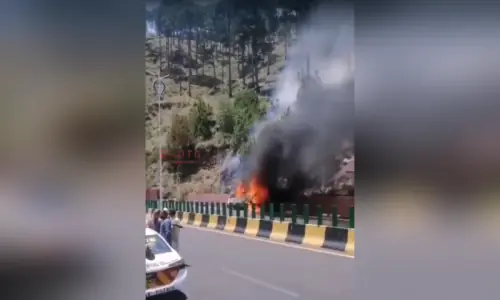
JUST when one thought it couldn’t get any worse, two pipelines in Sui were blown up on Friday and a fire erupted as a result, causing much damage to the grid station and nearby shops. The act of sabotage is a disturbing reminder that the strife in Balochistan continues unabated. For more than a year now, the province has witnessed frequent acts of violence and subversion. Gas installations, power supply lines and railway tracks have been routinely attacked and bombs detonated in various parts of the province, killing innocent people. It is the disruption of the person’s everyday life that is worrisome and which demands the government’s immediate attention. That Balochistan remains the poorest province in the country and major socio-economic development efforts are needed to improve the lot of the people there goes without saying. But the few tribal sardars who have taken to insurgency in the name of political autonomy and a larger share in gas and other mineral royalties are not helping the cause.
The government’s attempts to engage the Baloch leadership in a political dialogue provided only a temporary respite before the violence resurfaced. Recommendations made by two parliamentary committees on autonomy and development have not been implemented, so the popular grievances continue to intensify. In March, the prime minister announced a financial package that would provide for 30,000 jobs for the Baloch besides increased funding for various uplift schemes. This is but a small step in the right direction provided it is followed by other actions designed to step up the province’s development in which the Baloch feel they are the main beneficiaries. By targeting installations supplying gas to other parts of the country, saboteurs believe that their grievances will be taken serious note of. Unfortunately, the continued use of such methods has only alienated them from the people who were once sympathetic to their cause. No gain can come from resorting to terrorist methods. But by the same token, strong-arm tactics by the government will not solve the problem either. A genuine political dialogue with all segments of Baloch opinion is the only way to finding a peaceful resolution to the crisis.
A crippling strike
SATURDAY’s strike in Karachi was a success since virtually all opposition parties, including the ARD and MMA, supported it. However, those who gave the call for the strike should let the people know what precisely they have gained by shutting down a city of over 10 million people, with its busy airport, railway stations, docks, factories, hospitals and industrial and commercial establishments. The purported aim of the strike was to protest against the government’s failure to arrest suspects involved in last month’s Nishtar Park disaster. The government’s failure is obvious, but did the strike bring the success of the investigation of the crime any closer? The opposition parties might have scored a propaganda victory over the government, but have they considered the price the people had to pay? Most shops were, no doubt, closed, but all government offices and private firms remained open. The result was that, in the absence of public transport, people had to walk for miles in the heat of May to reach their places of work.
Hospitals worked with fewer doctors and paramedical staff, and patients who needed to be rushed to hospitals for emergency care had to stay home or request some motorists for a lift. Petrol pumps, too, chose to close down, adding to the people’s hardships. While countless man-hours were lost in work, and production losses must run into billions of rupees, one can see that the worst victims were daily-wage earners. Masons, carpenters, labourers and others had to go without a day’s earning, while all examination schedules went topsy-turvy, causing anguish to students and their parents. One wonders why our political parties consider punishing the common people as the best way of scoring a political point. There are better and more humane ways of sending a message to the government on any issue.
The price of legalism ad nauseam
FOR quite some time the people of Pakistan have been treated to what can only be described as an uninhibited indulgence in legalism, which, according to Oxford Dictionary, means “attribution of great importance to the law or formulated rule; strict adherence to the letter rather than the spirit of law”. Even a couple of issues of our daily publications will provide Dr Fowler’s successors sufficient examples to illustrate this definition.
The worst display of legalism at the moment is found in the controversy over the proposition that in the last days of their tenure the existing assemblies (national as well as provincial, as members of both constitute, together with members of the Senate, the electoral college for the election of the head of state) should re-elect President Musharraf for a fresh term in office. This debate has arisen largely because of the change made in Article 224 of the Constitution vide the LFO of 2002.
Previously the article provided for election of a new national (or a provincial) Assembly “within 60 days preceding the day on which the term of the assembly is due to expire.” The LFO amendment provides for election of an assembly within 60 days following the expiry of its term. The reason advanced for the change was that it did not appear fair to curtail the assemblies’ term. However, no change was made in Article 41(4) which says: “Election to the office of the President shall be held not earlier than 60 days and not later than 30 days before the expiration of the term of the President in office.” Curtailment of the president’s term did not matter
Had Article 224 not been amended, election to the National Assembly (and provincial assemblies) would have been held around September 15 or 20, 2007, and the new assemblies could have elected a president around October 10, 2007. The change in Article 224 means that the president should be elected between September 15 and October 15, of 2007, while the assemblies are to be elected between November 15, 2007, and January 15, 2008. The wisdom of the amendment to Article 224 can now be properly appreciated.
Lawyers on both sides of the divide are arguing for and against the president’s election by assemblies that will expire soon after electing him. The establishment presumably hopes, on the strength of precedent perhaps, that if the matter is taken to court its reading of the law will be upheld. Assuming, for the sake of argument, that the president’s election by assemblies at the fag end of their tenure is legally permissible, it does not follow that this path is politically correct and democratically justifiable.
The elections that are due next year are no routine affair. The people, regardless of their allegiance to different schools of thought, wish and hope that these elections will put the state back on democratic rails. Pakistan’s friends and patrons abroad have said the same thing in clear terms. The time for getting away with the facade of an elected government without democratic substance has apparently passed. Pakistan has to convince the world opinion as well as the people at home that the coming general election and the election of the head of state are going to be held in a completely above-board manner so that the state is no longer plagued by a crisis of legitimacy.
The situation thus calls for a course of action that does not invite suspicion of contempt for democratic norms. It will be necessary to resist the advice to rely on legalistic sophistry. Indeed, in a situation such as the one that Pakistan faces today settlement of political issues by recourse to legalism amounts to an abuse of law and democracy both. There are many reasons why what is legally permissible cannot always be defended as politically legitimate.
1) Law and justice/equity are not interchangeable concepts. The value of law is determined by the nature of the lawmaker’s authority. In feudal/monarchical/authoritarian states, where the person at the top can wield unfettered powers to make laws, law is farther removed from justice/equity than anywhere else. Such law is rarely confused with justice.
2) In Pakistan all laws do not contribute to justice. Some laws often deliver injustice. Out of a long list one may mention Sec. 109 CrPC, the Zina Ordinance, most of the sections in the PPC chapter on Offences Relating to Religion, the Anti-terrorism Act and, of course, the law of ruler’s “necessity” which is often wrongly labelled as law of ‘state necessity.’ What this means is that until we are able to eliminate the gap between law and justice/equity matters involving political and social justice should not be decided under laws of doubtful validity.
3) Whatever the reasons and whosoever may be responsible, for it, the fact is that in Pakistan neither the lawmakers nor its interpreters enjoy requisite credit with the people. That justice must not only be done but must also seem to have been done holds more true in the political/social domain than in the criminal arena. Governor-General Ghulam Mohammad might have won his case thanks to legalism but nobody has accepted his dismissal of Prime Minister Khawaja Nazimuddin and the dissolution of the Constituent Assembly as politically correct or just.
Ditto for the Nusrat Bhutto case and most of the verdicts on petitions challenging deviations from the Constitution or premature dissolutions of the National Assembly. What the future historians will say about laws made by the country’s absolute rulers or today’s accountability processes can be predicted with certainty.
4) Even sound and non-controversial laws can be interpreted broadly as well as narrowly. It may be necessary to insist on a strict/narrow interpretation of legal texts while dealing with hardened criminals, but where public good and people’s rights are at stake it should be possible to prefer a broader interpretation to legal hair-splitting.
It is sometimes said that political philandering is quickly forgotten by a people whose lack of memory has often been confirmed. Maybe true, but equally true is the fact that time forgives neither the perpetrators of political mischief nor even its victims. If the present generation of Pakistanis is still paying for the sins of those who alienated East Bengal or compromised Pakistan’s case on Kashmir through ill-conceived military adventures, or indeed for the shortsightedness of the last Mughals, it should not be difficult to imagine how heavy will be the bills for today’s political wrongs that will be laid at the doors of our grandchildren and their grandchildren.
Is there no way out of the legal logjam they say Pakistan is in at the moment? Whatever the holders of fat and high-priced briefs may say, a simple way out is available. The prime minister can advise the president to dissolve the National Assembly in June 2007 and the chief ministers can do likewise. In that case new national and provincial assemblies should be in place much before the final date for the president’s election (October 15, 2007).
Even if a new president cannot be elected by November 15, when the present presidential term is said to be due to expire, the Constitution allows a president to continue in office until his successor takes over and a new president can be elected within 30 days of a general election (Article 44(i) and Article 41(4)).
This course will be politically correct (whether the elections will be fair is another matter) and legally in order.
Nobody will be hurt except for the legislators who will lose their perks for six months — by no means an unbearable burden. A legislator who has failed over four and a half years to provide for a short period of lay-off might be dismissed as incompetent and ineligible for re-election.
(To be concluded)
Digital incompetence
IT’S NOT as though identity theft is a new worry. Last year companies such as Time Warner Inc. and Citigroup Inc. were in the news for losing computer tapes with sensitive personal information.
The Bush administration has created something called the President’s Identity Theft Task Force. Virtually every discussion of this subject makes a basic point: Although some data theft is inevitable in a digital society, institutions that collect people’s names, birthdays and Social Security numbers must at least try to avoid losing them. Don’t ship unencrypted computer tapes by UPS and then say you’re sorry if the parcel goes astray. Don’t let employees take sensitive files home, where they may be lost or stolen.
This may sound obvious, but it apparently must be said again in the wake of the news from the Department of Veterans Affairs. Yesterday the department’s boss, R. James Nicholson, announced that every living veteran is at risk of identity theft after an employee took a data file containing names, birthdays and Social Security numbers home, where it was stolen.
Mr Nicholson says that the employee was not authorized to take this information home, but his department clearly failed to do enough to enforce its own guidelines.
It now promises to restrict access to sensitive data to those who need it and to conduct background checks on those who do. It’s extraordinary that this approach did not prevail already.
Some 26.5 million veterans risk being defrauded. If they are lucky, the thief may not realize the value of the stolen file.
—The Washington Post