0
0

 A HEFTY Rs30 billion public sector development outlay, a few cosmetic relief measures for the general public, a promise of jobs in thousands and a full dose of rhetoric on public welfare, are some of the conspicuous features of Sindh budget 2006-07 under the preparation by a coalition government.
The coalition itself looking uncomfortable for quite long and about to split apart a few weeks ago, was recently saved by an intervention at the highest level.
And the coming budget is being formulated with an eye on next year’s general election which is bringing its own pressures and priorities.
Sheer compulsion of election has brought the coalition partners together to cobble an ambitious development programme and to implement it in right earnest. The budget will reflect a change in attitude of the Sindh government. New priorities for development will be set at the provincial and district levels.
”Poverty alleviation in rural areas will be taken head on”, a senior officer said, with focus on livestock farming, dairy production and a fast track rural infrastructure programme. Special programmes are being prepared for small cities and towns other than Karachi, Hyderabad, Sukkur and Larkana.
Setting up a microfinance bank, a new agro marketing arrangement, a new school enrolment programme and rural healthcare system, are some of the features of the programme.
Unlike previous years, when former finance minister Syed Sardar Ahmad was a bit hard on Islamabad in his budget speeches on debt servicing, resource distribution and other budgetary issues, the coalition partners of the provincial government have now decided to shower all praises on General Pervez Musharraf’s leadership and the federal government.
The coalition leadership and the senior bureaucrats agree that improved tax collection by the Central Board of Revenue in last few years has enhanced the share of the provinces in the divisible pool— even within previous arrangement.
As one of the bureaucrats explained the total CBR collection in five years—1995-96 to 1999-00— was Rs1,496 billion showing an average annual growth of six per cent. In the last five years(2001-05) the total tax collection went up to Rs2,349 billion- an average 11 per cent annual growth. Obviously, the share of the provinces also increased.
This increased flow of funds encouraged Sindh to raise its development outlay from Rs5 billion in 2001 to Rs24 billion in the current fiscal year. Now, both the politicians and bureaucrats are confident of managing about Rs30 billion development programme in next year’s budget.
“We invested more than Rs50 billion in development in the province in the last three years’’, an official said adding that the planners are now enthusiastic for even more ambitious development programmes in the coming years.
“People will see in coming days the impact of this investment on development”, the officer said.
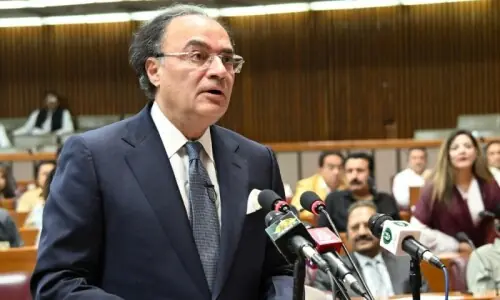
Who will present Sindh’s budget in June next is a question that is being frequently asked. Mr Jalil, advisor to the chief minister on finance and development is not a member of the assembly and can not deliver a speech on the floor of the house. Either the chief minister will himself present the budget or else he may ask Syed Sardar Ahmad to do the job. The name of Nadir Akmal Leghari is also being mentioned.
Sindh budget suffers from huge operational deficit in the current revenue budget with a big unfunded development programme. How this shortfall and development funds are met is not explained. One can see the 05-06 budget.
Last year in June, the budget document showed an operational shortfall of Rs6 billion in Sindh’s finances. Total revenue expenditure was estimated at around Rs119 billion and total resources availability was pitched at about Rs113 billion. With this indicated shortfall of Rs6 billion, the Sindh government had pledged a development investment of Rs24 billion.
As the year 2005-06 comes to close, the Sindh government is beginning 2006-07 with a hefty cash balance in billions of rupees after meeting revenue shortfall of Rs6 billion and investing Rs24 billion. Officials estimate that the Sindh government has now a cushion of Rs15 to Rs20 billion.
How this miracle has happened is partly explained by the increasing flow of funds from Islamabad because of improvement in CBR’s tax collection and partly by the mysterious financial engineering being done by the economic managers of the provincial government. But it is a puzzle that involves a huge amount of Rs50 billion.
The 05-06 budget documents indicated a flow of about Rs93 billion funds from Islamabad on account of NFC share, straight transfers and grants against abolition of local taxes. Officials say that this flow has exceeded the original estimate.
Now that President Musharaf has increased share of provinces in the federal divisible pool with an additional allocation of subvention, the budget planners are more than happy. With a cushion of about Rs15-Rs20 billion already in hand and a substantial increase in funds, the they have been encouraged to go for ambitious medium-term planning to cover the backlog in education, health care, road infrastructure etc.
A medium-term rolling development plan spread over next three years is being considered an effective and pragmatic strategy to go ahead in various fields. The district governments are being put on board to do the grassroots level schemes.
Political leadership is striving to coordinate and co-operate at the provincial and district levels and to overcome differences within with coalition. Various factions of PML are not happy over their major partner’s demand for funds in the rural areas by their assembly members. There is also a sharp division on provision of jobs. Instead of merit being made the only criterion, the coalition partners want job quota allocations for their respective parties/groups.
With elections in sight, the provincial government wants to begin offering jobs on a big scale from the next fiscal year. The government jobs are much in demand in the rural areas while in major urban centres like Karachi and Hyderabad, the option is for private jobs.
Sindh has now about 460,000 employees and a big part of the budget goes towards salaries and other establishment cost. Any increase in prices of petroleum products and electricity tariffs pushes up the establishment cost.
All said and done, Sindh’s book keeping and accounting system needs a hard look. The accounts of provincial finance department need to be reconciled with that of line department and the accountant general.
Recently, the Accountant General and Controller General estimated a deferred liability on Sindh government of an amount of Rs23.42 billion in respect of provident fund of the employees. The general provident fund is a mandatory contribution towards a fund by a government employee on which the government pays interest at the rates decided by the federal government from time to time. Punjab government’s liability in this respect by end June 2003 was found to be only Rs15.46 billion.
Now Punjab’s employees are almost twice that of Sindh and its provident fund should have been bigger than that of Sindh. There are about 900,000 employees in Punjab as against 460,000 in Sindh. The government is now considering to set up a committee to investigate the issue. There is also a proposal to institute a special separate provident fund account that should be managed separately.