



 0
0

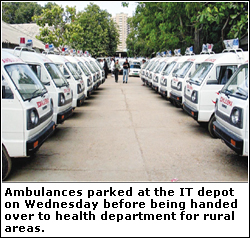 KARACHI, May 17: The Sindh government is in the process of tabling a bill titled, ‘Compulsory Services in Rural and Remote Areas’, in the provincial assembly to ensure that all professionals and manpower on the pay roll of the Sindh health department do serve at its facilities in rural areas.
This was announced by Health Secretary Prof Naushad Shaikh at a ceremony held here on Wednesday to hand over keys of 111 ambulances to relevant officials for the public sector health care facilities in 21 districts of Sindh.
Sindh Governor Dr Ishratul Ibad, who was chief guest at the ceremony, said the law, which was very much needed, would be supplemented by necessary measures to enable professionals to work in the remote areas.
“A programme has been materialised and is being streamlined to make available the facility of tele-medicine, helping the surgeons and allied professionals assigned responsibilities in rural areas, to remain updated regarding developments and make adequate of the same,” the governor said.
Dr Ibad said the government fully acknowledged that quality health care and education were people’s basic rights and a responsibility of the state. Hence, all measures were being adopted to fulfill the obligation.
This includes meaningful collaboration with NGOs, besides optimum utilization of the funds available with the government.
The governor said the provincial health department was exposed to serious difficulties. However, during the past few years, serious attempts were made to get them addressed efficiently and enable general public to benefit from the health facilities.
“We are focusing on rural and urban centres equally,” the governor categorically stated, adding that besides developing the required infrastructure, a foolproof mechanism was being developed to ensure round-the-clock availability of professionals at all health-care units being run by the health department.
He pointed out that attention was also being paid to the availability of professionals at all levels, and for the purpose not only standard of training and quality of education was being improved at the government-run units, but the Higher Education Commission was also concentrating on the issue.
“Transparency has been maintained all such schemes,” the governor said. The HEC had significantly improved the university education level across the country, he added.
Sindh Health Secretary Prof Naushad Shaikh, speaking on the occasion, said that besides decisions and policies to improve the performance of public sector organizations, stringent laws were being formulated to address people’s complaints against private sector health care facilities.
Regarding the fleet of 111 ambulances, he said that in the fiscal 2004-2005, an amount of Rs53 million was allocated for the procurement of ambulances for the health department hospitals.
During that fiscal, 31 big and 16 small ambulances had been purchased but these happened to be highly sophisticated vehicles spare parts of which were not available locally. Therefore, it was decided to replace the fleet with 111 small ambulances.
Prof Shaikh said 10 more ambulances had been purchased for health care units located in the arid zones. Health Minister Shabbir Qaimkhani referred to the recently announced revised service structure for paramedics, and said it would benefit 26,000 employees of health department.
The service structure for nurses was also under review and would be announces soon, he added. Under the new arrangement, he said, nurses would be inducted in grade-16 directly, instead of grade-14 and nursing superintendent in grade-18 with chances for further promotions.
Manager for the Enhanced HIV/Aids Programme Dr Salma Kauser Ali, District Health Officer Karachi Dr Khalid Shaikh, DHOs of other 20 districts and senior officials of the health department were present on the occasion.—APP





























