0
0

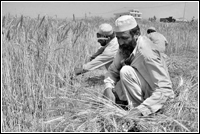 FARMERS in Sindh, growing wheat in current Kharif season, like umpteen earlier months, are once again confronting hassles especially at the time of disposing of their produce at procurement centres (PCs), set up by the government to purchase wheat at Rs415 per maund (40kg), despite the Food Departments’ endeavours to streamline the system and minimise their difficulties during current wheat procurement drive.
Growers are lured to sell their commodity to the PCs because government offers them around Rs90 per 100kg bag more than the going rate in the market. To escape the fiscal bite during these soaring production cost and high cost of living, they naturally choose not to sell the commodity in the open market.
Compelled by depleting financial resources, the growers are prepared to suffer the slings, strewn in their way, from obtaining bardana (gunny bag pack) from the officials in charge of PCs, to transporting the commodity under hidden concessions, to getting it accepted and to obtaining the payment from the banks.
Big feudal lords, public representatives and others, wielding authority, power, influence and connections, lay their hands on the bulk of bardana.
The quantity of bardana, being more than their personnel needs, is distributed among their cronies and their constituents to solidify their social status. Food inspectors, petty officials in the government hierarchy and officials of the PCs, are unable to face their brunt and contest their inflated claims for bardana.
The remaining lot is left over at the mercy of the official in charge of the PCs, whose staff distributes bardana for multifarious considerations as per prescribed procedure. However, some bete noire sells it for a price for obvious reasons. The result is that small landholders and poor peasants, who are the spinal column of the agricultural economy, are left high and dry, waiting for crumbs, if thrown in their way.
The hapless growers, who are unable to secure bardana, run into thousands in entire wheat belt in Sindh. Ultimately they fall prey, as sitting ducks, to the factors, which wait in their wings to ensnare the former in their dragnet, allowing them minimum margin to bargain the price. The price offered is as low as Rs45 short of the government rate. The loss of this two digit amount - peanuts for the affluent but big sum for the poor is colossal.
It is in fact the profit, which he loses to commission agents, who operate in the market with skewed stance. The cost of production of wheat in un-irrigated kutcha belt, watered by diesel engines, is so high that the government fixed price hardly covers their cost of production, if the produce per acre falls low due to unfavourable weather conditions, unwieldy wild growth of weeds and lately surfacing termite menace in the fields.
Cultivation of wheat requires additional inputs of pesticides to insulate it from the attack of crop worms, unwieldy weeds and wild growth of plants. Pesticides, being very costly, enhance production cost so high, that production leaves a minor margin of profit that hardly covers production cost, if the yield is under 20 maunds per acre.
Repeated cultivation of wheat on the same piece of land also reduces yield, unless the same piece is allowed to stay fallow for a year or the grasses are grown on the same piece.
The consequent effect of this entire unpleasant sale of wheat to the factors ends up in adding untold miseries for the farming community, beefing up already swelling poverty line, while the government in its happier moments never tires of, flaunting autarky, achieved in staple grain solely alluding it to its sound agricultural policies.
Growers in some instances also expose themselves to self-inflicted travails, when they land their produce on the premises of the PCs which are inferior in quality despite warnings, issued time and again by food inspectors.
It is at this stage that the mafia raises its head and plays its role to fish in the troubled waters. The mafia, thriving in the person of labour employed to lift the load and stack it in the shades, unleash hints to the confused and confounded grower, that their defective wheat will be cleared but for a lower price.
The government in this way stands robbed when the grain gains entry into the shade surreptitiously in easy instalments. The growers, who otherwise will have to suffer loss, paying for the extra cartage and accepting reduced price for a low quality of wheat, agree to share the differential between government and the market price for defective wheat. This occurs, despite repeated lecturing by some duty conscious and efficient food inspectors to growers.
In some PCs, the transport mafia has emerged in the person of labour, enlisted to stack the filled in gunny bags from the trolleys to the shades. Those growers unaware of the abominable arrangement or those having their own transport fall easy prey to labour’s machinations. Their grain otherwise passable is rejected exposing them to a situation, where they fall easy prey to their butchering. But those, who hire labours’ tractor trolleys, find their commodity facility entering the shade even though defective.
The government will have to pay attention to the eradication of this mafia, which is solely responsible for the procurement of defective wheat in the depositories. This is not only bringing bad name to the good work done by the Food Department, but also indirectly promoting sale of inferior grain to the masses at normal rate.
Obtaining voucher from the PCs for the cleared grain and securing its payment from the banks is a diligently planned procedure. The nuts and bolts of the procedures, inserted in the system, mostly appear to be properly in place to check withdrawals with malicious intentions. Except for those growers, who are naive and gullible enough not to find an account holder, who could facilitate encashment of their vouchers, all others encounter no hassle in laying their hands on the funds for the sale of wheat.
The secretary food, who is already ably administering the procurement drive quite competently, must apply his mind to ensure supply of bardana to whosever accesses the PCs for the purpose as per laid down procedure.
The government must also devise a mechanism discouraging unscrupulous elements securing bardana by thousand bags and then distributing the same among their cronies, when the gap between the market price and the government rate is substantially wider. One of the solutions could be to constitute committees comprising respectable village headmen for each PC to check bulk withdrawals to feudal and other influence-wielding growers.
If the issuing of bulk bardana is controlled, the trickle down effect of the bardana to small growers and tillers of the soil is bound to occur ensuring appropriate return to them who are undeniably the main pillars of the agricultural economy. Similarly surfacing of transport mafia within the PCs also needs to be looked into. Its emergence is bringing bad name to the otherwise well organized and oiled drive of the Department.