The League culture
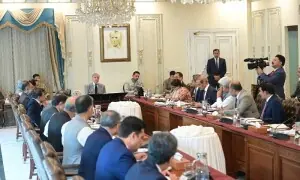
THERE has been some criticism in the past few days from opposition political parties and in the media about President Musharraf’s involvement with the affairs of the Pakistan Muslim League, the ruling party. The president, who is supposed to be neutral and above party politics, has been asked to settle disagreements within the PML as well as differences between the PML and its allies. He has done so readily. There is hardly anything new in this. The president has been actively backing the PML ever since he had it cobbled together. No other relationship has been so enduring in Pakistan’s political history than the one between the Muslim League and the establishment. No other party has had so many of its stalwarts ready to compromise with every military and dictatorial regime. No other party has been as eagerly willing to cooperate as the PML with a military ruler when he has felt the need to acquire political legitimacy and a civilian face. In many ways the League’s history tells us why we have failed to evolve a workable and democratic political culture in the country.
It is even more unfortunate that other political parties too have failed to learn from the mistakes of the PML. Their leaders have been content to run them autocratically and without any sense of accountability. Many of the politicians now posing as democrats have themselves never hesitated to seek the support of the military in having their opponents persecuted and dislodged from power. No politician of any stature has ever expressed remorse about his or her past deeds and most of them have readily and frequently switched sides without a twinge of conscience. The hypocritical pro-democracy posturing of our leaders and politicians can fill anyone with despair and force him to consider opting out of the system altogether.
Is there any hope that we will ever be able to break out of this vicious circle? The next elections — whose schedule now appears to have become very much the president’s prerogative rather than of his own government’s or the election commissioner’s — have already become controversial. More and more the establishment seems unmindful of the demand from all sides for an even playing field for every party. Twisting the electoral process to suit the needs of the executive has led to disastrous results. Influencing the bureaucracy and the intelligence services to produce ‘positive’ results has contributed to the disaster. If the next elections are similarly manipulated, it does not require the wisdom of a seer to predict that the last chance to establish a functioning democracy will be scuttled, and much else with it. There is time yet to pull back from the brink and let the electoral process follow a constitutional path under a caretaker government capable of ensuring the fairness and impartiality of the electoral exercise. The election commission should be respected as a sovereign body answerable to parliament; and once an election schedule has been announced, if the election commissioner finds that he cannot prevent executive interference and pre-poll rigging or ensure that the exercise is fully transparent, he should withdraw from his office. The country cannot simply afford another fixed election. The Muslim League style of governance must end.
Increase in health budget
THAT the health sector is going to get an increase of two billion rupees in next year’s budget is reassuring, even though it has been long overdue. The increase in funds can be used to address some of the challenges this neglected sector continues to face. Plagued by a host of problems, the state of public hospitals in the country is pitiable as the staff is unable to treat even the most basic of illnesses for lack of equipment and medical supplies. There is virtually no health care in the rural sector and where there is a semblance of a hospital, there is a dire shortage of doctors who are simply not willing to be posted in rural areas to serve them. This is despite official efforts in some provinces to make it mandatory for newly graduated doctors to work one year in the rural areas. Earlier efforts to put in place a system of accountability whereby wasteful expenditure in the health sector could be checked have also not worked. No matter how well-intentioned such efforts were, they failed to make an impact and the state of the health-care system remains dismal, irrespective of what the health minister may say. Funding is, of course, very important and it is good that the health budget has been increased to Rs 10.5 billion over the last three years. But the vast rural hinterland still remains virtually uncovered by a health-care system, so that people there have to depend on quacks or travel long distances to cities and towns for medical care.
A breath of fresh air comes in the form of two upcoming medical towers that will be built at Pims in Islamabad and JPMC in Karachi as well as trauma centres and a helicopter medical service. But the real challenge lies in addressing the virtually obsolete health-care centres in the rural areas. A realistic strategy needs to be adopted in this regard which will address how to upgrade the existing hospitals with basic equipment and laboratory facilities so that they can effectively treat patients. Doctors and nurses need to be given proper incentives for serving in the rural areas where they are desperately needed.
Time to shut Guantanamo
PRESIDENT George Bush appears to have been overruled by his own administration. Following his remarks to a German television channel last week that he was in favour of shutting the notorious prison camp at Guantanamo Bay, the State Department has categorically said that the detention centre would not be closed down any time soon. Rejecting British Attorney-General Lord Goldsmith’s observation that the prison was a “symbol ... of injustice” and should therefore be sealed, the State Department maintained that the prison contained “dangerous people”, who, if released, could end up “committing acts of terrorism”. That Britain, which so far has been among Washington’s staunchest supporters in the war on terror, should be seen to publicly digress with America’s treatment of suspected militants at Guantanamo shows how fast the Bush administration is losing international credibility on this count.
Ever since the first batch of 20 prisoners arrived at Guantanamo in January 2002 there has been confusion about their legal status and that of hundreds of others who were brought here later. Although termed “enemy combatants” by Washington, many were held indefinitely without being formally charged. Routine torture and harsh interrogation methods were employed in contravention of the Geneva Conventions. With life made hell for the 500 or so inmates who remain there, it is no surprise that there have been several cases of attempted suicide and hunger strike among the prisoners. It is high time America, instead of utterly disregarding its own judicial norms and practices, took measures to end the atrocities being perpetrated on Guantanamo inmates and provided them ready access to legal aid and free and fair trials under the watchful eye of international monitors. Also, the fact that the harsh treatment meted out to prisoners has left them emotionally and physically scarred for life must not go unnoticed, and Washington should be made to pay compensation to them.
Reviving confidence in the EU’s future
PITY Jose Manuel Barroso. With most European leaders embroiled in either domestic scandals, cabinet reshuffles or reform angst, Barroso, as head of the European Union’s executive commission, has been handed the almost impossible task of trying to revive the bloc’s flagging fortunes following last year’s crushing rejection of a new EU treaty by French and Dutch voters.
The former Portuguese premier tried his best this week to take up the challenge by tabling a series of initiatives which he said would help lift the “cloud of pessimism” that has settled over Europe.
Among other things, Barroso insisted that instead of acrimonious finger-pointing, European leaders should keep their promises and start delivering on past EU pledges. Don’t just blame the EU for everything that goes wrong nationally, pleaded Barroso, also point to the benefits and good news coming out of Brussels.
The commission chief’s call for less words, more action certainly got some coverage by weary Brussels-based reporters, desperate to get their hands on an EU story with more oomph than explaining the complexities of rising eurozone budget deficits. “A little less conversation, a little more action,” was how one Barroso aide summed up his boss’s “Elvis Presley strategy” referring to a hit by the late king of rock and roll.
But comparisons to Elvis are unfair. While Elvis fans rock on in Europe, Barroso’s complex blueprint — written by Brussels bureaucrats with a penchant for difficult-to-translate EU jargon — is unlikely to win the support of disenchanted ordinary Europeans who continue to see the EU as remote and cut off from their daily problems.
Perhaps even more damagingly for Barroso, most of Europe’s beleaguered leaders are likely to pay little attention to more commission complaints over their failure to promote Europe.
A quick survey of Europe’s political scene shows quite clearly that at least for the moment, most European heads of government have other, much bigger fish to fry.
Barroso’s close friend and pro-free market ally Britain’s Tony Blair is grappling with falling public support and repeated demands from within his Labour Party that after nine years in office, he must name a date to hand over the office to his likely successor, finance minister Gordon Brown.
The British prime minister has refused to set a date for his departure but promised to give his successor ample time to settle in before the next national election due by 2010.
French politics are equally shambolic, with Prime Minister Dominique de Villepin refusing to bow to increasing pressure from his political opponents following accusations that he ran a smear campaign against French Interior Minister and political rival Nicolas Sarkozy in an investigation into alleged corruption.
Villepin, at a meeting with the equally embattled Blair, insisted recently that he would weather the storm: “We’re all familiar with the hazards of the political life, but when you have determination and commitment you can overcome every difficulty,” he said.
But the socialist opposition in France has tabled a vote of no-confidence in French President Jacques Chirac, accusing him of “doing nothing” to stop the government crisis. The French president, has so far defended his premier over the scandal and said he will not listen to “rumours and slander.”
However, this is Villepin’s third major crisis, following youth riots in November and massive protests against his labour reform proposals earlier this year.
As such, Chirac’s support for the premier — especially in view of next year’s presidential elections in France — may start to waver over the coming weeks.
The outlook appears to be brighter in Italy following the approval of a new president — 80-year old Giorgio Napolitano — which in turn clears the way for Romano Prodi to take office next week as prime minister.
As a former commission president, Prodi should in principle be a keen supporter of Barroso’s new “wake-up Europe” agenda. But the future Italian premier will be too busy trying to manage his unruly coalition — and dealing with Silvio Berlusconi who is still seething with anger following his election defeat — to have much time for EU affairs.
This brings us to Germany’s Chancellor Angela Merkel. The perky leader of Europe’s largest economy certainly appears ready to play the role of EU saviour and has prompted many EU policymakers, including Barroso, to rub their hands with glee at her pro-Europe agenda. The German presidency of the EU in the first half of 2007 will signal a new dawn for Europe, say enthusiastic Berlin-watchers at the commission.
Merkel, however, is slowly but surely toning down her initial ideas about Europe’s future and especially the vexed question of what to do about the defeated EU constitution. In a recent speech outlining her priorities, the German chancellor was cautious about further EU eastward expansion and said she did not want to take “hasty action” on the EU treaty. Instead, the focus of the German EU presidency will be on the hardly visionary issues of research and innovation, slashing bureaucracy — and the bloc’s anxieties about energy security.
That leaves Barroso struggling to keep the EU torch alight by unveiling a so-called “citizens agenda” designed to prove to critics that while he may not have “vision” about Europe’s future, he does have an “action plan” to jolt the bloc back to life.
Stating the obvious, the commission chief said that given the lack of EU-wide agreement on what to do with the EU constitution, governments must take “extra time” to tackle the EU’s constitutional crisis.
But while pushing the pause button on the treaty, Barroso insisted that the bloc should forge ahead with plans for closer police and anti-terror cooperation and efforts to break down internal barriers to integration. The commission must be given new powers to tackle key security issues, including terrorism and organised crime, he said, adding: “Should we wait for another terrorist attack before we change the rules?”
Barroso also urged EU leaders to do more to convince often sceptical public opinion on the need for further enlargement which he described as “one of the most important successes of the EU.” Such a discussion on future EU expansion must cover questions about the bloc’s “absorption capacity” so that enlargement was not just the result of “bureaucratic decisions but democratic decisions,” he said.
Barroso announced that the Commission would launch a new initiative to draw public attention to the benefits of the bloc’s frontier-free single market. Running through the proposals, however, were repeated accusations that national governments and leaders were not doing enough to promote the ideals and goals of the EU. The commission chief noted wryly that national leaders took credit for EU policies that were successful and blamed Brussels when things went wrong.
To win public approval, EU governments should focus on turning their pro-EU rhetoric into reality, Barroso demanded, adding that this could be achieved if the 25 EU leaders next year issued a “solemn declaration” to deliver on past promises.
“I am challenging leaders to commit themselves to their collective decision to live together in Europe,” Barroso said, adding that such a declaration should include not only a commitment to principles but “also the capacity and the means to deliver them.”
The commission chief said such a statement would not replace efforts to secure ratification of the EU draft treaty but would give policymakers time to revive flagging public confidence in the Union. EU governments remain deeply divided on how to proceed with the constitution, with some like Estonia and Finland continuing to ratify what many now see as a moribund treaty but others, including France, Britain and the Netherlands, sceptical about consulting their public on the question.
Many months of hard work lie ahead, with EU foreign ministers set to discuss the future of the constitution and the challenge of reviving Europe at a meeting in Vienna at the end of May and then EU leaders tackling the same issue at a summit in Brussels in June.
Although discussions will be tough and acrimonious, EU leaders will probably use the 50th anniversary next year of the EU’s founding Treaty of Rome to issue what Barroso wants: a new declaration underlining their commitment to the EU and further European integration.
But putting those vows into practice is likely to remain an uphill struggle. As a result, Barroso and his team of fervent EU-enthusiasts are likely to remain the sole EU torch-bearers for the coming months.