



 0
0

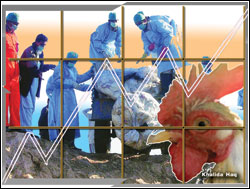 NOW it is more than three months that the bird flu virus continues to cause both panic among consumers and mass killing of chickens in parts of the NWFP and areas near the federal capital.
The fears are that the notorious H5N1, which did visit some factory farms, may mutate and start attacking humans. But these are mere fears; nothing of the sorts has so far happened.
However, what has actually happened has been overshadowed by the health concerns gripping the population. And it is a sad development: Pakistan’s small poultry farms are heading towards liquidation but not the big factory farms which are to be protected.
Leaders of the poultry association have rightly appealed to both the government and the people to “save the poultry industry”, saying it is safe to eat chicken if it is properly cooked. They are not wrong as far as scientific opinion is concerned.
But the fear of bird flu is too strong. Over 20,000 or more chickens are being culled every month in all the backyard or small farms located near the infected sites as required by the World Health Organisation guidelines.
Loss in terms of declining sales comes to about Rs3 billion per month. The poultry industry employs 0.3 million workforce, produces 450,000 metric tones of poultry meat which is about 27 per cent of total meat consumption in the country.
Pakistan is not alone in this misery. Many countries in parts of Asia are experiencing it. India has suffered the agony more badly than Pakistan. In one district alone, 300,000 birds in 300 villages were culled in March, throwing thousands of farm owners out of business.
In February, when bird flu broke out in Egypt the government quickly moved to destroy its multi-billion dollar poultry industry and instead decided to import frozen meat to make up for the shortfall.
“The world is moving towards big farms because they can be controlled under veterinarian supervision… The time has come to get rid of the idea of breeding chickens on the roofs of houses,” said Egypt’s Prime Minister Ahmed Nazif.
His government immediately embarked on a cleansing operation and nearly culled all the backyard and rooftop poultry and banned live bird markets, where 80 per cent of the country’s poultry is sold. Egypt’s response was erratic based on misinformation. No doubt, some backyard and rooftop flocks have been infected, but far more birds are dying in factory farms.
Pakistan cannot remain immune from the effects of what is shaping up as a global response to the threat of the virus. Today’s power politics ensure that the consequences for the poor should be completely overshadowed by the theoretical concerns over a possible human pandemic.
Such consequences are of least concern to governments and the international agencies pursuing the global strategy to control bird flu. Today, WHO, which has always genuinely addressed public health concerns of people in every country without any bias in the past, has become more sensitive to the interests of pharmaceutical corporations and the ambitions of collaborating scientists.
According to the latest study done on bird flu by Grain, an eminent research organisation, the password for WHO’s database of bird flu sequence data, the most important in the world, is available to only 15 laboratories worldwide. This sequence data is extremely valuable in the global race for bird flu vaccines and diagnostics – a market that could prove crucial if a human pandemic breaks out.
Some scientists and governments are now publicly demanding that the WHO make the data public. But it refuses to do so saying that this would discourage countries and some of its collaborating labs from submitting data, because they want to retain rights over the information.
Although the WHO doesn’t name, the study says, it’s clear that the US is a major obstacle. The US Centre for Disease Control (CDC), one of four WHO “Collaborating Centres” on influenza and the nerve centre of the US government’s global influenza surveillance programme, refuses to make most of its sequence data public for it thinks it can jeopardise its vaccine R&D partnerships with private companies.
The fact is that a few major labs in the industrialised countries are gaining control over vital genomic information through their privileged position in the international bird flu effort, with the WHO facilitating this process.
The Grain study says that the WHO has no authority over its collaborating laboratories and unless there are clear agreements, there’s nothing to prevent these labs from cutting exclusive deals with pharmaceutical corporations, which could generate serious drug access problems for developing countries if a human-to-human transmissible strain of the bird flu virus emerges.
Meanwhile, the Food and Agriculture Organisation (FAO), a UN agency, has taken a complete U-turn in its poultry production policies. After years of promoting small-scale poultry farming, the FAO now wants to put it out of business. Its technical advisor on bird flu to Vietnam recently said that from both public health and business point of view, the country should shift from family poultry farms to large-scale factory farms.
Samuel Jutzi, the FAO’s Director of Animal Production and Health, recently surprised everybody by claiming that small farms were behind the spread of bird flu and described large factory farms as “highly protected”.
When asked if this meant the end of small-scale poultry farming, Jutzi said: “This type of production will become very marginal. High quality poultry, raised in the open air and grain-fed, will become a niche product.” The FAO message is clear: the large-scale factory poultry farming, controlled by a small number of transnational corporations, is now the way to go.
It is in this backdrop that one has to grasp the implications of an agreement signed by the FAO with Pakistan government in February for a project under which an amount of $390,000 is to be made available by the former for apparently emergency assistance to control bird flu outbreaks. Part of it will be used to beef up diagnostic facilities.
Although the objectives of the project are not clear, these cannot be different from its new thinking — dismantling small or backyard farms and promoting big farms owned by multinational companies. This may come as a shock to many small farmers in Pakistan as they face the truth.
Afghanistan is a case in point. The FAO, along with USAID and the Bangladeshi NGO BRAC, launched a programme there in 1999 to build up a domestic poultry industry.
Under the programme, 16,000 family farms shifted from native poultry breeds and local feed sources to an imported high-yielding variety and commercial feeds. Many of the farmers even took out loans to build new chicken coops.
The FAO helped create mid-sized commercial poultry farms around the major cities by providing funding , technical training and introducing crossbred chickens from Pakistan. So, Afghanistan’s small and backyard poultry producers are now integrated into the global poultry industry and also integrated into the global bird flu crisis as well, when the H5N1 virus broke out there.
The FAO’s mantra is that it first convinces small farmers the world over to abandon their traditional ways and adopt modern practices, which increases their exposure to bird flu, and then tells the world that such farms need to be shut down to make way for the big factory farms of the future.
Much of the funds for global bird flu efforts were centralised in January at a conference in Beijing where around 30 donors pledged $1.86 billion. More than 80 per cent of those funds are earmarked for WHO, FAO and the World Organisation for Animal Health (OIE). An additional $500 million has been committed by the World Bank.
Among the donors, the US is the world’s biggest spender on bird flu, even though the H5N1 strain has yet to reach the country. It pledged $334 million at the Beijing event. Washington money is flowing everywhere and giving a boost to its corporations in the process, particularly those of the health sector.
According to the Grain study, this power structure at the top translates downwards through the national emergency responses. Funds are offered to the developing countries on condition that the governments follow the guidelines laid out by WHO and FAO, which include controversial measures like culling, drug stockpiling and long-term restructuring of the poultry industry.
In certain cases, foreign experts participate directly in the national decision-making process, as in Tanzania where USAID sits on the two government committees responsible for developing and executing the country’s bird flu emergency preparedness plan.






























