0
0

 WITH just four weeks to the next year budget, disputes over resource distribution and financing of development projects among the provinces and between the centre and its federating units have again cropped up.
Reason: The provinces want maximum funds to meet high expectations for the development of their constituencies on the eve of the elections, while the centre seeks to finance mega infrastructure projects in the regional context by pulling out of the provincial responsibilities.
The federal government contends that the provincial share of the federal divisible pool has increased from 42.7 per cent to 45.83 per cent under the interim National Finance Commission (NFC) award (and subsequent one per cent increase every year in future) and hence the provinces should learn to finance their own development programmes.
The prime minister recently told an inter-provincial meeting that financial resources of the provinces have been substantially increased, which would enable them to commence more development projects for the welfare of the people.
Then what is the centre’s development agenda and priorities for the next year and the years ahead?:
“The federal government will continue to focus on development of mega infrastructure projects, including dams, trans-border gas pipelines, electricity transmission lines, national highways and railways, North-South trade corridor, airports and seaports, with special emphasis on projects pertaining to clean drinking water, education and primary health care of the people all across the country”, says Prime Minister Shaukat Aziz.
While there would be no substantial allocations in the next year’s PSDP to start any major water storage project, the federal cabinet has recently decided to provide funds “for acquiring land for the five major dams, including Kalabagh Dam”.
For the next year, the centre has made projections for resource availability. As a result, the provinces are pretty clear by now what they are going to get next year out of the net proceeds of the federal divisible pool under the revised NFC declared by the President, in the absence of a consensus, and the sectors they would have to finance from their own resources.
The next year’s FDP size has been estimated at about Rs700 billion. The four provinces would get about Rs321 billion on the basis of 45.83 per cent provincial share. This does not include estimated deductions of collection charges and direct fiscal transfers to the district governments under 2.5 per cent general sales tax in lieu of abolished octroi and zila tax (OZT).
Under the NFC, Punjab has a share of 57.36 per cent, followed by 23.71 per cent of Sindh, 13.82 per cent of NWFP and 5.11 per cent of Balochistan.
The provincial share for next year under the previous NFC award, some provinces said, would have been about Rs15-20 billion lower than estimates under the interim award.
In the nutshell, the provinces have gained nothing to finance their respective development needs and meet current expenditure at a time the public expectations are very high given the fact that next year will be the election year.
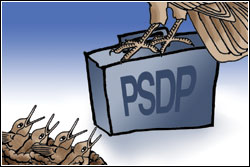
On February 22 this year, the Public Investment Authorization Section of the federal government informed the provinces that, “in view of an increase in the share of provinces from the federal divisible pool in the new NFC award, no provincial nature of project will be financed/co-financed from the Public Sector Development Programme (PSDP) from the next financial year (2006-07)”.
This meant that provinces will no longer receive funds from the PSDP from the next financial year.
They were, however, informed that “ongoing commitments to finance/sharing of cost of provincial projects from the PSDP will continue”. Instructions have also been issued to the provinces to prepare their development budgets without seeking any resources from the federal PSDP.
The decision came following a number of provincial requests received by various ministries for financing and sharing of the cost of provincial projects through PSDP. In many cases, the federation used to provide matching grants for certain projects.
Not only the financing and co-financing of provincial programmes has come to an end, the federal government has decided to transfer four major responsibilities to the provinces and substantially increase the size of the PSDP for next year to gain maximum public support by funding major infrastructure projects.
As a result, the centre has also decided to fully empower the provincial governments to take full charge of health, education, agriculture and industry sectors through their own resources. These obligations originally belonged to the provinces under the constitution but were partially taken over by the centre in the past for political reasons. Some of these responsibilities were included in the federal legislative list and concurrent list for specific purposes.
From now on, the centre would not finance social sector schemes relating to health, education, agriculture and industry in the provincial annual development plans (ADPs). However, national programmes in these sectors like nutrition programme, education for all and anti-polio campaigns would continue and get full funding from the centre.
The federation normally used to provide about 20-25 per cent of its PSDP funding (about Rs68 billion during current year) to the provincial programmes which it has decided to discontinue. However, the provincial share under the interim NFC Award would increase by about Rs52 billion next year.
These sources said the government was aiming at increasing the size of next year’s PSDP by diverting these additional funds to programmes that attract public support and develop infrastructure for regional trade.
Since, next year is going to be the election year, the emphasis would be on providing maximum funds for gas connections, clean drinking water, electricity to all and other social sectors like nutrition, water and sanitation, environment and housing.
The government has got additional fiscal space as a result of foreign funding for the earthquake rehabilitation activities and it could be easily dovetailed with the normal development process.
The provinces, on the other hand, have protested over non-financing of their projects from the PSDP and have sought reversal of this decision. They argue that this decision was unilaterally taken by a meeting of the central development working party (CDWP) in late January this year which did not enjoy such a legal and constitutional authority.
Balochistan has also made a formal request for arbitration of its dispute with Sindh over gas development surcharge and oil and gas royalties. Similarly, the NWFP has asked the federal government to increase the size of its hydro profit as an interim arrangement till the arbitration tribunal headed by Justice Ajmal Mian comes out with a final award.
During a recent meeting of the Executive Committee of the National Economic Council, the two larger provinces - Punjab and Sindh - protested over the centre’s decision not to finance or co-finance provincial development schemes and demanded its reversal.
The federal government on the other hand contends that provincial chief ministers had themselves offered not to seek funds for provincial projects if their share from the Federal Divisible Pool was increased.
The Federation claims that provincial share in the NFC has increased by Rs51 billion while federal financing in the provincial projects during the current year was to the tune of Rs68 billion. The provincial government has written to the federal government that it would not be able to present its next year’s budget owing to higher expenditure on law and order, interest payments and drought.
Balochistan’s overdraft has already increased to Rs16.5 billion during the current fiscal year and its interest payments are going up. Additionally, the Asian Development Bank (ADB) would not be releasing its second tranche of the Provincial Resource Management Programme (PRMP) that would further squeeze Balochistan’s financial situation.
The federal government is expected to come under criticism over these issues during the forthcoming meetings of the Annual Plan Coordination Committee (APCC) and National Economic Council (NEC) scheduled for later this month and early next month respectively to finalise development budget for the next year.
It seems the frictions between the federation and its units over sharing of resources have not subsided over the last six years. All inter-provincial issues are resolved on an ad hoc basis under the centralised authority in Rawalpindi. The inter-provincial financial matters need a lot more attention.
There is a need to create harmonise provincial and national development through distribution of resources on an equitable basis without creating sense of deprivation in any part of the country.