0
0

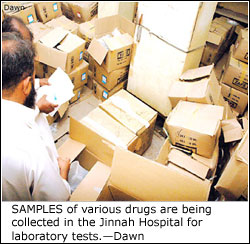 KARACHI, May 2: Reports of adverse effects of some locally produced intravenous injections in a number of patients at Jinnah Postgraduate Medical Centre have raised alarm among health practitioners, officials and patients.
The office of the Federal Inspector of Drugs at Karachi on Tuesday started collecting samples of medicines in question from different wards and stores of the JPMC.
An official privy to investigation said it would take analysts over a week to finalise their finding.
JPMC sources said a number of patients had ‘suffered considerably’ after they were administered some drips and injections. The cases were identified in the last week of April.
“As I have been told some 10 to 15 patients developed allergies and fever, believed to be reactions of some injections and drips administered to them in about five departments, including surgery, gynaecology and emergencies,” said JPMC Director-General Prof Mashoor Alam.
He said the adverse effects were checked immediately through some additional medication and finally the reaction problem was controlled.
In reply to a question, he said the matter had been reported to the federal health ministry. Also, he said, a standing committee on purchase at JPMC was looking into the matter which would furnish its report in two days.
He said the doctors at the hospital had been told not to use the medicines in questions, including a drip produced in two batches.
The DG said a host of medicines were purchased on the yearly basis through tenders and manufacturers or their agents supplied those items from time to time in accordance with the requirement of the hospital.
He said the hospital did not have storage facility for the entire purchase.
A federal government drug inspector, Najmus Saquib, said the process of investigation and sampling, initiated under the authority of the federal health ministry on April 29, was likely to take some more time as samples would be sent to two laboratories at Islamabad and Karachi for confirmation of claims.
“We are collecting a number of products being used in different departments,” he said, adding that there was a possibility that medicines were manufactured by more than one firm. He said manufacturers were also being told to provide details of their supplies to other hospitals and outlets.
It is learnt that manufacturers of drips Ringer Lactate and injection Metronidazole, which were included the list of alleged spurious medicines, were also in touch with the JPMC doctors and office of the federal drug inspector.
While doctors mentioned formation of some fungus and jelly-like substances in the medicines in question, suppliers believed that contamination could have resulted from poor handling.
Patients and medicine-sellers, however, insisted that officials should reveal the names of those medicines and their batch numbers.
A drugstore owner said that at least the manufacturers should voluntarily withdraw the medicines in question from different outlets and pharmacies till authorities reached a decision in the matter.
Meanwhile, the Sindh health department has directed all executive district officers (Health) in the province not to use the suspected medicines.
Talking to Dawn, Health Secretary Dr Naushad A. Shaikh said the medicines feared to be unfit for consumption included Dextrose water (5 per cent glucose), Dextrose Saline, Ringer Lactate and Metronidazole.
Drug inspectors of Sindh health department have also been told to survey hospitals and ascertain whether those drugs were in use there or not, he added.