0
0

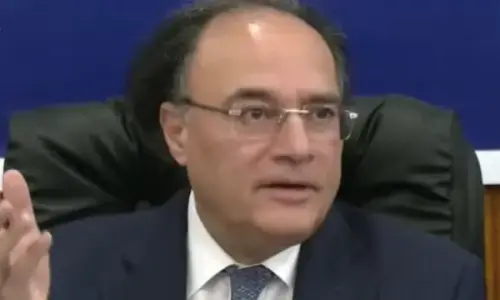
ISLAMABAD, May 1: Prime Minister Shaukat Aziz said here on Monday that Pakistan neither had any aggressive designs against anyone nor its 160 million people were interested in the arms race, adding that its defence expenditures were gradually decreasing.
Speaking and responding to queries by visiting delegates of the South Asia Free Media Association (SAFMA) at the Prime Minister’s House, the premier said Pakistan believed and pursued policy of minimum credible deterrence necessary for defence of its sovereignty.
He said in our case social sector development expenditures were growing rapidly and we have passed a landmark fiscal responsibility law which guarantees increased spending on education, health and infrastructure sectors.
He said Pakistan was willing to open up its trade links with India as it was open to the world market but it desired resolution of disputes, especially the issue of Kashmir, go in tandem with the ongoing process of normalisation in other spheres.
To a query about export tariff barriers, Mr Aziz said Indian trade and industry was engaged in questing on a way out but everything was ultimately linked with overall conflict reduction. “We need to find a level playing field when it comes to bilateral trade between the two countries,” he said.
About Iran he said that Pakistan did not support nuclear proliferation nor favoured that Iran should go nuclear but it believed that Iran has all the right to use civil nuclear facility for development of its energy sector.
FOREIGN POLICY: Mr Aziz said Pakistan was pursuing a policy of peaceful co-existence with all its neighbours.
He said India and Pakistan had taken a number of confidence building measures.
He asserted that President Pervez Musharraf’s and former Indian premier Vajpayee’s initiative had greatly helped resolve their conflict as a result of which one million Indian troops deployed on the borders were withdrawn.
He stressed that Pakistan-India relations were central to the overall atmosphere of the entire South Asia region.
Mr Aziz said Pakistan was eager to involve India in the Iran-Pakistan-India (IPI) pipeline and also wanted to enter other energy procurement agreements with the Central Asian Republics.
When asked whether Pakistan could play a mediatory role in the ongoing LTTE-Sri Lanka government conflict, he said Pakistan had good relations with Sri Lanka but it could not interfere in its internal affairs.
He said Pakistan had highly cordial and close relations with China in areas of defence, construction, trade and economics which it was working to increase.
The prime minister called upon the leadership of Saarc to show courage and flexibility to make it a vibrant and energetic body which would be able to help turn South Asia into a region of peace, stability and prosperity.
He said Pakistan was ready to work with member countries to re-energise Saarc which was working far below its potential, and added that its members even differed on holding regular meetings.
He called for upgrading the Saarc secretariat by appointing a secretary-general of the level of a cabinet member for which the World Bank and other international monitory bodies were ready to provide funds.
He said we need to strengthen Saarc in the larger interest of the peoples of its member countries, and added that for doing so their differences on certain matters should be kept aside.
PAKISTAN’S ECONOMY: He claimed that Pakistan had come out of the danger of being declared a failed state hovering over it seven years ago by introducing economic reforms which put it among the top 10 nations of Asia. He said latest surveys have revealed about reduction of poverty in Pakistan while its annual GDP growth remains between 6 and 8 per cent and per capita income is expected to reach $800.
He said economic reforms, including policy of deregulation, privatisation and transparency, had earned the country bigger foreign direct investment opportunities which have climbed to $3 billion this year.
PAKISTAN’S IMAGE ABROAD: Responding to a query, the prime minister said the image of Pakistan had improved as far as its economic, political and foreign policy was concerned.
However, he admitted that following 9/11 and 7/7 the linkage of Islam with acts of terrorism had somewhat created problems which the leadership was conscious of and efforts were being made to project the true face of Islam, which preached peace and inter-faith harmony.
AFGHANISTAN: Premier Aziz said Pakistan believed a strong and peaceful Afghanistan was in its own interest and had been extending all cooperation to achieve this objective.
He said that Pakistan had hosted the largest Afghan refugee population and hoped that the remaining refugees would also leave for their homes soon.
TERRORISM: He said Pakistan was in the frontline of the international war on terrorism and had a substantial role to play towards elimination of terrorism over the years.