



 0
0

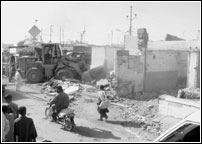 SEVERAL low income groups have been evicted from their abodes in Karachi in the recent past. A recent case has been the demolition operations at Juma Goth. The incident has been given various colours by the various stakeholder groups. The pro-poor civil society organizations severely criticized the event.
Meanwhile, residents at Lyari Expressway and the Hasan Aulia village have been struggling to prove their rights to land through title deeds issued before indepenence. Such events demonstrate the declining capacity of the government in managing its land affairs transparently. Under the rising tide of political patronage, informal access to land and housing has become quite common.
Developed land in the existing schemes is very expensive and at present, few locations are available for ready occupancy. Surjani Town, Metroville-3, some parts of Shah Latif Town and Scheme No 33 are prominent amongst them.
On an average, a plot of 80 sq. yards costs between Rs250,000— 350,000. This payment has to be made within a negotiated period which usually does not exceed six months. For the lower income groups with meagre savings and virtually no asset base, it is not possible to make use of this option.
Besides, the cost of land is only a part of required investment. Cost of construction and infrastructure is about the same value. Altogether, it may take a bare minimum of Rs0.7 million per unit to obtain a house in planned localities.
And the stretch of time does not exceed beyond 1-2 years depending upon the urgency of the respective household. No subsidy of any kind is available in this case. Rising cost of construction material is making the housing options inaccessible, even for the middle income groups.
The land supply schemes in Taiser Town and a few other locations repeat the same mistakes due to which earlier schemes could not succeed. The land was given out through computer ballot in which a large number of front-men of the professional investors also participated.
Applications when even accepted, the probability of winning an allotment was low against those who filed more than one applications. The time lag between allotment and possession of plot is substantial.
The genuine households in need of shelter usually require land immediately in order to construct a house with all the available means. In the formal schemes, time gap between the announcement and the physical possession of the land may take as long as five years. Development, infrastructure and documentation charges add to the cost of plot, rendering it more expensive.
Besides, the provision of the connection of any service does not guarantee its supply. For instance, the majority of small plot category settlements in Surjani Town do not receive a drop of water from the sanctioned water connections and they obtain supplies through alternative means. With the passage of time, the sate land reserves have fallen down.
As long as the KDA existed, about 5000 small sized plots used to be supplied per annum. Much of this land remained undeveloped for speculation. According to Karachi Development Plan 2000, the approved vacant land was as high as 16.9 per cent of the total land use. Despite this formal sector anomaly, the net annual demand of small sized plots is over 30,000 units. It may be kept in mind that due to backlog, the figure is on an exponential rise.
In the absence of the non-availability of formal options, the poor live in ‘katchchi abadis’. Almost 15.9 per cent of the net land in Karachi was grabbed by organized mafias and the illegal sub-division of state land.
The intensifying urban sprawl has expanded the low density low rise developments far and wide. It is the middle and lower middle income groups that reside in such unauthorised colonies.
The creation of informal settlements cannot be done without a direct political patronage of the concerned power brokers. Activists of the political party in the regime, state officials, law enforcement personnel and religio-political elements are dominant categories.
In desperation, the most needy are found to squat along the nullahs, railway tracks, creeks and corridors of infrastructure such as high tension wires.
During the anti-encroachment drives, they are removed from even these locations. However, due to weak monitoring of land development, settlers return with the connivance of concerned officials.
Across the developed and developing world, rental housing is a common alternative for housing the less privileged. The state provides subsidy to make adequate housing available to a maximum number. With the advent of the market economy, subsidies have decreased.
However, through intelligent combination of situational needs and financial packages, the public housing or mass housing options have been kept alive. Inputs of philanthropists and corporate donors is also instrumental in improving housing for low income groups.
In our context, rental housing option is extremely underdeveloped. The legislative cover, largely converged in the Sindh Rented Premises Ordinance 1979, favours the tenants as against the property owners. Administrative indifference, long litigation in case of disputes, lack of respect for contextual arrangements, damages to property and use of muscle power are the few reasons which have kept housing strategies undeveloped.
According to the directives of State Bank of Pakistan, banking credit cannot be extended for the purchase of land. This measure has been adopted to curb speculation and control the spiralling real estate market. This leaves the needy in a grave dilemma. Due to lack of mortgage options, the poor cannot obtain credit under any other procedure. The other possibility is through informal money lenders who charge compound interest.
At best, those possessing jewellery or other valuables, sell it away or try to raise capital with credit contributions from family friends and relations. Frustrations, loss of self-esteem and confidence and vulnerability to crime can emanate from the absence of this essential requirement.
There are worthwhile solutions that can be applied to address these issues. Incremental housing development is one option which eliminates speculation and ensures access to the appropriate target group. In this scheme, occupancy is the fundamental pre-requisite to ownership of plots.
The successive National Housing Policy Documents of 1994 and 2001 recommended disbursement of all small residential urban plots through incremental housing development format.
A private charity in the United Kingdom, created a fund of 200,000 pounds to support the purchase of land or access to housing in 13 different localities in Cambodia, Colombia, India, South Africa and Zimbabwe. Over 40,000 people benefited directly and indirectly.
The fund was able to augment further capital for acquiring land. The fund was utilized in multiple channels including land purchase, bridge finance, squatter up-gradation, security costs, site development costs and lobbying to secure tenure.
Similar approaches can be successfully applied in our context. With the wisdom and experience of housing experts, useful and target oriented credit packages can be evolved from the micro-finance banking sector. And the laws and regulatory framework must be re-visited to make the investment into housing possible for tenants. This can be a very effective alternative for lower income households, especially the nuclear families which are on the rise in the prevailing demographic profile of the country.






























