



 0
0

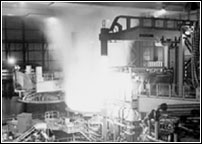 The government has failed to give any convincing argument in support of the hasty decision it took to sell off the Pakistan Steel complex at such a low price. The Privatisation Commission (PC) had itself earlier indicated a price of $3 billion.
THE divestment of Pakistan Steel Mills Corporation, commonly known as Pakistan Steel Karachi, has exposed the government to sharp criticism. The giant integrated steel-making complex—now a profit making state enterprise—has been sold at a throw away price of $362 million compared to its assets worth about $5 billion.
And the government has failed to give any convincing argument in support of the hasty decision it took to sell off the complex at such a low price, which was earlier indicated by the Privatisation Commission (PC) itself to fetch Rs3 billion dollars.
Interestingly, the highest bid received for Pak-American Fertilizer at Iskanderabad was of about Rs20 billion but the Pakistani investor withdrew his offer after learning that Pakistan Steel was being sold almost at the same price(Rs22 billion). The fertilizer factory, located in a remote area, was established in 1959 and revamped recently, and has no comparison whatsoever with Pakistan Steel. Likewise, Karachi Electric Supply Co (KESC) was divested at Rs20.24 billion.
The new buyers have already made 25 per cent payment and have signed the agreement, on April 24, for transfer of its strategic 75 per cent shares. In response to the expression of interest (EOI) issued by the PC, in all 19 foreign and domestic companies showed their interest in the proposal, by the due date October 8, 2005.
Out of these, only 13 submitted the request for statement of qualification (RSOD), which included investors from Kuwait, UAE, Switzerland, China and Czech, besides the winning consortium from Saudi Arabia and Russia. Finally, the PC pre-qualified six companies for bidding, which was re-scheduled many a times.
In a belated move however, these pre-qualified companies formed two consortia to participate in the bidding. This was against all ethics, norms, procedures and precedents, and should have not been allowed by the PC in the first instance. The rumours are that the two consortia manipulated the bidding. Thus the consortium of Tuwairqi Steel Mills of Saudi Arabia, Magnitogorsk Iron & Steel Works of Russia and Arif Habib Securities of Pakistan won the bid for Pakistan Steel.
The question is, why the PC allowed this arrangement that restricted competition and was in violation of rules and regulations? Furthermore, the PC had the option to offer 51 to 75 per cent shares, as indicated in the EoI notice. Why then did it offer optimum shares to the winning consortium?
It is reported that Pakistan Steel covers an area of 4,545 acres that would be transferred to the new owners, and not the total 18,660 acres owned by the government. It is not factual. The company documents reflect that the complex is, spread over an area of 10, 390 acres and the other 8,270 acres were reserved for future expansion.
The core plant facilities, consisting of sinter plant, iron-making plant, steel-making plant, billet mill, hot strip mill, cold rolling mill, galvanising unit, refractories plant and oxygen plant cover an area of 4,545 acres.
The non-core activities, like unloading facilities for imported bulk material, raw material handling facilities, coal handling plant, by-products plant and allied equipment, industrial water network and other services are located in the remaining area of 5,845 acres.
The water reservoir of 110 million-gallon capacity covers an area of 200 acres. What would be status of the remaining land, on which these auxiliary services and ancillary facilities exist, one may ask? Will the government manage and maintain the vast area at its own expense to providing services to Pakistan Steel, or will sell off later the additional land to the same group clandestinely?
Likewise, its leasehold rights of 7,520 acres for quarries of limestone and dolomite in District Thatta (Makli and Jhampir) are of great value and, apparently, have not accounted for.
Again, not many of us know that current assets of Pakistan Steel also include besides real estate in residential and commercial centres of Islamabad and Lahore, those of another estate enterprise namely Spinning Machinery Company at Lahore. The factory, which was a going concern when acquired by Pakistan Steel in 2002, is located at prime industrial area of Kot Lakhpat. What will be the status of this factory and who owns it?
It is said that Pakistan Steel technology being obsolete, its divestment to private sector was not attractive. If this was the situation, how as many as 13 companies, mostly foreign key players in steel business, could be interested in the deal? It may be recalled that the government, in January 1998, had decided to enter into a joint venture agreement with the Chinese for the up-gradation, expansion and management of Pakistan Steel.
A draft agreement was concluded between the two sides, according to which the Chinese had agreed to become joint venture partner in Pakistan Steel, with equity participation in the existing complex and also the 3-million ton production expansion scheme. The agreement however was not signed. The offer was repeatedly extended by the Chinese, again in March 2003, to the then Minister for Industries and Production Liaqat Jatoi.
The steel process technologies adopted the world over are (i) open-hearth furnace, (ii) blast furnace (BF)/basic oxygen furnace (BOF) and (iii) electric arc furnace based on steel scrap. Pakistan Steel employs the most common steel-making technology-BF/BOF, as the world’s maximum production of steel is through this process. The other technologies, such as of coke oven, raw material preparation, billet mill, hot strip mill and cold rolling mill are basically the same as being practised throughout the world. The fact is that Pakistan Steel is a well-maintained plant.
For the last four years or so Pakistan Steel had implemented, besides the capital repair work, the BMR programme, which included modifications, additions and revamping of different sections of hot strip mills and cold rolling mills, and adjustments at billet mill.
In order to get a complete picture of the deal. One may consider these additional facts:
Within a week of acceptance of the bid, Pakistan Steel increased prices of its various products, by about five per cent.
Employees of Pakistan Steel have been offered the most attractive Voluntary Separation Scheme (VSS) package ever, that is 1:4 salary for its 15,000 employees, which would cost the government Rs15.75 billion.
Pakistan Steel carried an inventory of finished goods, spares and stores valuing Rs12 billion, that of raw material Rs7 billion and cash balance in the bank was Rs7 billion.
The government has picked up the loan liabilities, including that of Rs 700 million annual interest, till the year 2013.
The Central Board of Revenue (CBR) has waived off outstanding tax liabilities of Pakistan Steel. In a nutshell, the government has presented the Pakistan Steel complex to its new owners practically as a gift.






























