



 0
0

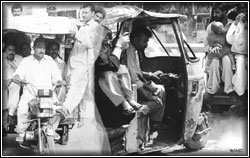 The rising diesel price over the last few years was partially responsible for making investors reluctant to invest in Sindh’s public road transport sector.
Even some transporters, who were operating a fleet of buses under the Urban Transport Scheme (UTS) in Sindh, have wound up their operations. Their representatives told Dawn that the return were so low that a few defaulted on their banks or leasing companies repayment obligations.
Their contention was that the government had granted permission to ply new buses under the UTS on the condition that they would not increase the fare for two years, but the persistent increase in diesel prices rendered their operations unviable.
Another discouraging factor was the law and order situation, especially in Karachi. Whenever there was some civil unrest, buses and trucks were targeted and torched. This tendency created panic amongst the investors and drove them away resulting in a vertical fall in new investment in this sector. Perhaps that explains why 50-year-old buses are still plying on intra- and inter-city routes of the province.
In sharp contrast to Sindh, investment in Punjab’s transportation sector has been flourishing despite the rise in diesel prices. One of the factors is round the clock mass traffic movement as compared to Sindh where people prefer to operate during the day to avoid victimization by hooligans.
No doubt making investment in transport business has always been considered a high return venture and received massive investment, especially in public and goods transportation segments, but for the last year, the flow of investment has been receding in Sindh.
To cope with the rising costs and high risk, some transporters resorted to the only option available: increasing fares. This, however, limits the scope of the business as public transport is mostly used by lower segments of society.
In response to tough competition and the deteriorating law and order situation on the highways of interior Sindh, some bus operators converted their inter-city buses into trucks. The business in truck operation is not dependent on the poverty-stricken masses and segments such as traders can afford even higher fares.
In Sindh on a general scale, sophisticated buses and large dumpers, container-carrier trucks and other heavy-vehicles have replaced the pre-Partition small lorries, trawlers and trucks. The quality of roads in Sindh has improved resulting in the reduction in transportation time.
Barring Karachi and a few other cities, the public transport system has yet to be developed in other towns and talukas of the province. Smaller cities have not been able to attract private business for comparably lesser returns on their investment as compared to other avenues available. In these places minivans, rickshaws and small wagons fill the gap. In some more backward areas of the province people are still using ancient modes of transportation — tanga (chariot), camel-carts and donkey-carts, especially for goods transportation. In Thar, trucks from the World War II era called “Kekra” are still in use.
In these areas even ambulances are not available for shifting patients to hospitals which are generally located far from peoples’ homes. Comparatively, the urban areas of Sindh have better facilities albeit not of international standard.
Transportation plays a crucial role in shipping goods from place of production to the consumers. A developed infrastructure could reduce the time and make the flow smooth. An efficient, economical and prompt transportation system is considered a pre-condition for an economic take-off. It is also important for both backward and forward linkages. A growing transportation sector can absorb semi-skilled manpower, easing unemployment in the province. In Karachi, the transport infrastructure received massive investment and many new roads, underpasses and overhead bridges are under construction. Unfortunately, the activity is limited to Karachi leaving the rest of the province to struggle with outdated facilities.
Figures reveal that investment in the Sindh transport sector has slowed down from July 2005 due to high cost of operations, with decreasing margins owing to a sharp increase in diesel and oil prices, says Haji Iqbal, president of the Superhighway and National Highway Bus Owners Association.
Mr Iqbal said that a brand new Daewoo bus for long-route operations was available at Rs12 million, while new and reconditioned makes of Nissan, HinoPak, Isuzu, etc., were available in the range of Rs2.6m to Rs7 million.
He said about 5,000 buses were operating on inter-city routes within the province, and if up-country operations were included, the number went to 15,000. “We operate only during the day-time due to rising cases of robbery,” he added.
“The situation in Punjab is totally different as the operators there feel safe and keep their buses operating round the clock and prospects of business are better,” he explained.
Mr Iqbal said the situation could be gauged from the fact that the operators were actually charging less than the fares fixed by the Sindh government. The fixed rates are 46 and 92 paisa per km for both non-AC and air-conditioned buses. “According to official rates, the fare for Hyderabad is Rs160 per seat, but the competition has brought it down to Rs100 for air-conditioned buses,” he added.
However, in Karachi alone 100,000 new vehicles had been registered last year, including private and commercial vehicles.
This was a result of liberal car financing schemes by banks and leasing companies.
According to official figures, more than 1.9 million registered vehicles, including 0.250 million commercial vehicles, were plying on the highways in Sindh in December last year.
An official of the Excise and Taxation Department told Dawn that out of total 1.9 million, about 1.5 million vehicles were registered in Karachi. He said the reason for registering automobiles in Karachi was that it increased the market value of the vehicle as compared to other cities.
Air traveling, the most efficient, luxurious and time-saving mode, is not popular for intra-province traveling as besides prohibitively high cost most cities lack the facility of air traveling.
In Sindh, only four airports — Karachi, Sukkur, Moenjodaro and Jacobabad – are operational. Nawabshah and Hyderabad airports were closed down for reasons best known to the authorities. Seven PIA flights go to Sukkur, five to Moenjodaro and two to Jacobabad from Karachi in a week.
Private sector planes do not operate in any of the destinations in interior Sindh as the operators see no chance of earning profit owing to low turnout of passengers. Recently, one private airline started a weekly flight to Sukkur, Dawn was told.
In 2005, only 25,646 passengers traveled by PIA flights to Sukkur, 4,823 to Moenjodaro and 380 to Jacobabad, while in the first three months (Jan-March) of this year, only 6,041, 1592 and 139 traveled to the above mentioned destinations, respectively.
Rail transportation of the country is the only segment that draws most passengers, but even this segment has not been improved over the last several years.
Divisional superintendent Nasir Zaidi told Dawn that people preferred to travel by buses to Hyderabad and other stations as trains took more time than buses to reach the destinations.
When asked if the number of rail passengers was falling, he said no. “May be it has not increased at a pace at which intra-province traveling has increased,” he said.
He said that being the port city the Karachi division was contributing 70 per cent of the total revenue earned by Pakistan Railways. “Of this 60 per cent is generated through cargo operations and the remaining from passenger traffic,” he explained.
On the scope of private sector investment, he said investors were invited to operate on the Pakistan Railways network and use its infrastructure by paying an agreed amount, but so far no investor has responded to the PR offer.
MDGs: key global scorecard
The Millennium Development Goals have become the key global scorecard for development. In September 2005, the MDG+5 United Nations World Summit re-endorsed the goals of 2000 Millennium Declaration and called on nations to review their performance on their promise to reduce poverty, illiteracy, inequality and disease to help achieve the goals. Pakistan is also a signatory to the declaration signed by 158 nations.
May be it is about time that the Sindh government take ownership of the commitment that leaders made six years back and readjust its development strategy in the light of MDGs.
The province can muster the resources and knowledge and evolve a sustainable development strategy to achieve these goals all it needs is the political commitment to make this happen. The policies focussed around the theme of deregulation, denationalisation and liberalisation have not delivered. There seems to be something wrong about the direction and not just implementation of economic policies. The business-as-usual approach will not work. A new more responsive development policy based on ground reality and evolved with maximum possible involvement of people is required.
This is the only way to make this province a more just and secure place for every single individual.
Goal 1: Eradicate extreme poverty and hunger. Goal 2: Achieve universal primary education. Goal 3: Promote gender equality and empower women. Goal 4: Reduce child mortality. Goal 5: Improve maternal health. Goal 6: Combat HIV/AIDS, malaria and other diseases. Goal 7: Ensure environmental sustainability. Goal 8: Develop a global partnership for development. — A.S.





























