



 0
0

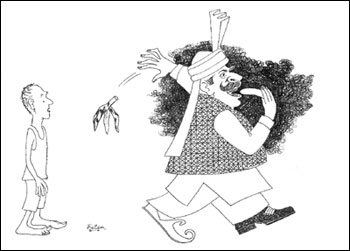 Call it pessimism, but if one were to describe the situation in the province of Sindh, it has to go this way: 6,000 ghost schools, complicated legal structures, a plethora of civil agencies that interfere in businesses, a skewed assets base, expensive industrial land, weak land management, an ineffective bureaucracy, a massive and constant influx of people, perpetual water shortage, a fragmented society, poor social indicators and a pathetic law and order situation. This is the same province which about two decades ago was envied by the rest of Pakistan for its high per capita income and better health and education standards. Situated in a region that was a commercial hub for ages owing to its geography, a long coastline and an industrious people, Sindh has failed to exploit these assets. Successive rulers made no attemp to realise its true potential. It is time for those in power to grab the shovel.
In this special report on the economy of the province a team of business reporters focuses on various aspects of the economy and seeks opinions of stakeholders to pinpoint the bottlenecks and hurdles that stand in the way of Sindh progress and rob its people of their right to a decent living.
Sindh boasts of Karachi, the only port city of Pakistan and one of top five most dynamic cities of the country. But look beyond that and the province displays a pathetic picture of economic exclusion. Here is a simple question: Do the major cities of Sindh, such as Hyderabad, Sukkur, Khairpur, Shikarpur and Larkana even remotely compare with the pace of progress and properity — experienced mainly over the last three decades — by Lahore, Faislabad, Gujranwala, Sialkot, Gujrat, Rawalpindi and Wazirabad?
The case for Sindh is that it faces a multitude of prblems, which include rising income disparities, a skewed rural/urban assets base, inefficient and insufficient public service delivery, poor governance, unemployment, massive influx of population from the rest of the country, corruption, a skilled human/financial resource drain, unsatisfactory law and order, weak land management, a messy transport sector, water shortages and so on. But for all that political neglect is not one of the problems: the province actually attracts more than desired political attention. It has long been the fertile ground for power players to test their mettle. And that in turn has led to fragmentation, factionalism and intense polarisation depriving Sindh of the most vital condition for development: the trust of its people in the future.
The resourceful landed elite does not seem to be inclined or trained to go for industrial investment. The law and order situation and political uncertainty scare away potential non-landed investors, resulting in a slower pace of urbanization and development of an industrial base in the region. All that Sindh has in the name of industry outside Karachi are a few flour, rice husking and sugar mills. This has happened despite the establishment of several industrial zones in the interior of the province.
Even Karachi, the pride of the province, that historically enjoyed the reputation for being the most investment friendly city of Pakistan is losing that edge. Reasons of its malaise are many but law and order is the foremost. All manner of protesters are attracted by the glittering charm of the city and mainly for mass coverage in the media. Be it workers, students, peasants, professionals, civil right activists, political workers, disgruntled elements from near or far or even gangsters. All of them inevitably converge on Karachi to forward their agenda. The issue at hand may be internal such as Kalabagh Dam or external such as US designs in the Middle East. It may be war or peace, the footage on electronic media cannot afford to miss mentioning Karachi. We have seen peaceful protests and also full-blown street battles fought on the roads and lanes of Karachi.
Memories of body bags and exchange of kidnapped rivals under state supervision are still fresh. During the 1980s the free flow of weapons to the province changed the very texture of society. Targeted killings all through the last two decades instilled fear and drained citizens of whatever trust they had in the system and in their fellow countrymen. If that was not enough, this city now has also become a destination of suicide bombers who pop up every few months to inflict new scars on the collective memory of the people of the province.
Dawn’s interaction with stakeholders and with literature on the state of economy of the province reconfirms the view that the wide gap between the potential and its actual realisation in Sindh is not closing. More alarming, however, is the fact that the province seems to be frittering away the advantage in terms of investment climate, per capita income, education and health that it enjoyed over the first 45 years after independence. There is a forest of question marks: What went wrong and why? More importantly, is there hope for the province to bounce back? What efforts are stakeholders making to turn the situation around to put the house in order and to realise the huge untapped potential? Our team of reporters posed those questions to members of the government, the private sector and representatives of civil society.
From the exercise it transpired that it is not just political opponents of the government who are frustrated with the prevailing tense environment in the province; the bureaucratic hierarchy is equally perturbed. The average tenure of a Grade 20 officer serving as a secretary in Sindh is three months against the normal of three years. “It takes about two months for an officer to adjust in a department. If he is transferred in the third month, how much can he really perform in a month’s time?”, exclaimed an officer on special duty (OSD) who was shunted out as he stepped on the toes of his incharge minister. In the education department seven secretaries have changed since 2003.
Another astonishing issue is the level of utilisation of development funds in the province. Currently, in the first 10 months of the fiscal year, only about 35 per cent of the development budget has been utilized. The finance department of the province asserted that the utilization will be a little over 50 per cent by the close of the year. While the majority in rural Sindh suffers in abject poverty without access to safe drinking water, electricity, cheap fuel and sanitation facilities, resources sit idle in government coffers awaiting viable schemes. No analysis of government insensitivity can beat this bare fact.
Some academics, professionals and economists felt that it would be unrealistic to expect a dramatic improvement in the economic scenario of Sindh any time soon. “The current political dispensation in the province is too fragile to endure the pains of working out a viable plan for a more inclusive development framework that reconciles all conflicting interests in the province and efficiently use all available resources and avenues”, said a senior analyst.
Some people blamed a fractured democratic political set up to be the crux of the problem. The record of the performance of duly elected political governments in Sindh in 1990s does not, however, substantiate this point of view. During this democratic phase of 1990s, the social indicators in the province actually worsened. A democratic set up may be necessary but does not seem to be a sufficient condition to rid the province of the hurdles in the path of sustainable development. A better, more responsive development strategy of the ruling party that encourages institutionalisation as opposed to patronage seems to be imperative. The question that pops up is: If there is uniformity in the political system in the country, why the variation in the performance by the four provinces and the greater inefficiencies in Sindh?
An intriguing report by Zahid Hasnain of the World Bank “The politics of service delivery in Pakistan: political parties and incentives for patronage, 1988-1999” may help to understand the dynamics of higher level of inefficiencies in the province. The paper attempts to explain why even elected political parties have failed to improve the efficiency of public service delivery in the country. It says: “Elected politicians in Pakistan appeared to be more concerned with patronage or doling out targeted favours to a small number of privileged groups, rather than on providing public goods that would benefit the majority of citizens”. The paper builds on the substantial literature on the relationship of institutions to economic development. It argues that “three features of the party system have an important bearing on this trade-off: the number of political parties or degree of fragmentation of the party system; the internal cohesion or degree of factionalism of political parties; and the degree of ethnic divide or polarizsation among political parties. The higher the level of fragmentation, factionalism and polarisation, the greater the incentives for patronage, and the poorer the quality of service delivery’.
There is little doubt that Sindh has the highest level of fragmentation, factionalism and polarisation. Therefore like others the institution of political parties is weakest in the province. A review of federal intervention over the last 25 years shows that all governments and particularly authoritarian governments have played on these divides to perpetuate their interests at the cost of society. Not only ethnic parties were encouraged, but worst still, more liberal political parties were discouraged.
A World Bank draft report “Sindh economic report mission, May 9-18, 2005” saw poor governance as the root cause of most ills that plague the public sector of Sindh. The draft report says: “Poor governance has many forms and reasons — from lack of political will to weak managerial and technical capacity. Irrespective of its form and reason, it has a severe negative impact on the quality of public service delivered to the citizens. Lack of merit-based recruitments, high frequency of staff transfers and incomplete authority of district governments over recruitments and career management of local staff were identified as main avenues through which poor governance impact service delivery in Sindh”. The provincial government did not accept the draft report for it had strong reservations over its the findings.
The report though quite extensive failed to highlight issues related to the skewed assets base, especially in rural Sindh, that renders all government initiatives for the socio-economic uplift of rural masses unproductive. Whether it is SAP (Social Action Programme), easy credits for small shareholders, tenants, landless farmers, subsidised agricultural inputs, water rights or some other targeted concession, it almost always lands in the pockets of the rural elite. Way back in the mid-1980s the report of the Agricultural Commission recommended effective land reforms for a qualitative change in the rural economy of Sindh. World Banks experts have not commented on this dimension.
There certainly is a problem with the broad development framework of the federal government that is replicated at the provincial level. If the framework based on neo-liberal economic tenets of liberalisation, deregulation and privatisation have failed to address the development concerns of the federation by perpetuating the trend of lopsided growth limited to a few sectors excluding the masses from gains, how can it succeed at the level of a province? Unfortunately it is not just the government that ignores this dimension of policy-making. The opposition political parties are equally confused on the issue of an alternative viable economic plan other than what the donors suggest.
In the light of input by stakeholders and the development literature on the province it would be safe to conclude that institution building is a prerequisite for promoting efficiency irrespective of the form of government and the party in power. The federation must also resist the temptation to resort to divisive politics to perpetuate its interests at the centre. There is also a need to re-evaluate policy options instead of treating policies of deregulation, denationalisation and libralisation as sacred. The most vital, however, would be to revive hope amongst the people of Sindh through confidence-building measures so that they are energised and develop a sense of ownership in utilising the immense potential of the province to the benefit of all.





























