



 0
0

Shrinking city roads
 Wearing Shalwar-Kamees, two men are sitting in a library, browsing a couple of Urdu newspapers. By appearance they seem to belong to an intelligence agency rather than being avid newspaper readers. Soon the two stride out.
It is around 11am and there is nobody except four library staffers, including two women, apparently discussing some social problem. The library has a good stock of books on a variety of subjects. There are English as well as Urdu newspapers and magazines. Notices on the board guide a first-time visitor on how to get books, become a member and what books are on which shelf. The staff are also keen to help. Although there is no air-conditioning in the room, the place is tolerably cool. There could be no better place for serious readers and researchers. But they are missing. And for good reason.
The Liaquat Hall (formerly Frere Hall) library in Bagh-i-Jinnah — linked on one side with Abdullah Haroon Road and on the other with Fatima Jinnah Road — is besieged by personnel of law-enforcement agencies. At the park’s entrances, Rangers have set up bunkers. At least two armoured- personnel carriers are parked at the ready. All hidden and not-so-hidden eyes are focussed on the occasional passer-by. Otherwise, the road leading to the park, Fatima Jinnah Road, is deserted and blocked for all vehicles. First it was made out of bounds for rickshaws and taxis, then for high-roof vans and then for cars also. Even pedestrians find it difficult to pick their way through the cement slabs, iron grilles, shipping containers and rolls of barbed wires.
The book bazaar the former city nazim had somehow managed to hold during his tenure is no longer allowed. The road forking to the Japan consulate is also strictly blocked.
The American consul-general’s residence and the Indian consulate, closed yet, are also situated on Fatima Jinnah Road. Besides, there is the Pak-American Culture Centre. Though it has nothing to do with the United States except that American English is taught there rather than British one, the name alone is enough to ring alarms. The residence of the Nawab of Junagadh is also located in the same row.
Elsewhere, too, foreign missions have been provided with equally stringent security. The roads leading to these missions are mostly blocked and the footpaths encroached upon by law-enforcers.
The security measures are understandable. But there is no justification for total closure of the roads. Probably the library, too, cannot be shifted to a place that allows book-lovers un-hassled access. The authorities must look for a solution. The sooner, the better.
Heritage preservation
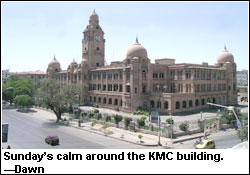 Last Monday’s newspapers carried a picture of the city’s Naib Nazim Nasreen Jalil climbing over the main gate of the KMC building on M.A. Jinnah Road. She was cleaning and painting the gate as part of city government’s campaign, launched to clean heritage buildings.
She was being helped by town nazims, naib nazims, councillors and senior staff of the city government. Some other prominent personalities, including Sindh local government adviser Waseem Akhtar, renowned architect Yasmin Lari and TV artiste Samina Pirzada, were also present to support the campaign.
The cleaning was apparently an attempt to draw the attention of the people towards the heritage buildings and their preservation. A few years back, Yasmin Lari had successfully highlighted the importance of these heritage buildings. Every Sunday she would hold colourful programmes involving schoolchildren, visiting a selected heritage building to clean and paint it. The programme was then called Karavan-i-Karachi. The city government is doing this task in collaboration with what is now called the Karavan-i-Pakistan, also a project of Ms Lari. Of the 600 buildings of historical importance, 50 are under the city government’s control.
Built with red stone of Jodhpur, the KMC building is a combination of Islamic, Egyptian and Hispanic architecture. Its foundation-stone was laid by the then governor of Bombay, Lord Sandhurst, on December 4, 1895. Its architect was Mr James C. Wyness. Besides a dome in the centre and four on the corners, the building has a 162-foot high tower with sweet-sounding bells jingling on all the four sides. Its second floor has a hall where the city council’s periodic meetings are held. The city naib nazim’s office is also in this building.
The building was built by the Pharaoh Construction Company under the supervision of executive engineer Jahangir Sethna and foreman Ali Mohammad Imam Bakhsh. It had cost Rs1.775 million and was inaugurated in 1932. Despite the many tall buildings that have sprung up around it, the KMC building maintains its distinction as a solid, magnificent structure.
The city government’s efforts need to be supported by commercial as well as non-governmental organizations and individuals who would like to see the heritage buildings preserved and properly maintained.
Globalisation
Apparently everything went well for last week’s mega event, the World Social Forum, which was held at the Karachi Sports Complex from March 24 to 29. There were so many colourful events, valuable, enjoyable, memorable. Some people unrealistically tried to diminish its importance by drawing a comparison between this WSF gathering and the one held in Mumbai two years ago.
Much has been written about and commented upon the WSF proceedings. One of the themes that featured at the forum was ‘globalisation’. Several delegates spoke on it. Almost everyone among the audience knew what it meant to the common man. But many still wanted an easy-to-understand explanation. The Oxford dictionary says ‘globalisation’ is: “the fact that different cultures and economic systems around the world are becoming connected and similar to each other because of the influence of large multinational companies and of improved communication.”
To some even this definition leaves something wanting. So, here is a description sent in by a friend to make the picture clearer: “Princess Diana, an English princess with an Egyptian boyfriend crashes in a French tunnel, driving a German car, driven by a Belgian who was drunk on Scotish whisky, followed closely by Italian paparazzi, on Japanese motorcycles, treated by an American doctor, using Brazilian medicines. This message was created by an Indian on a Chinese phone smuggled by an Afghan and sent to you by a Pakistani.” — Karachian email: karachi_notebook@hotmail.com
A book on Jinnah you can judge by its cover
INDIAN communists supported Jinnah’s demand for Pakistan but later, over a period of time, after falling in line with Nehru’s Fabianism, they quietly distanced themselves from the idea of an exclusive country for South Asia’s Muslims. As their politics evolved with time and they became more narrowly nationalistic, political exigencies landed them in poky patriotic corners where right-wing nationalists would otherwise feel more at home.
Today, as more and more communist leaders from India visit or are allowed to visit Pakistan, old idealism and camaraderie with fellow liberals is beginning to resurface. A standard communist party ‘line’ on any major issue is of course known by its rigidity. Thus any major change in approach to a significant issue can come as an inflection rather than a pronouncement from the pulpit.
It could be tantamount to reading too much into a mere fact, but it’s a fact nevertheless that a favourable book on the Quaid-i-Azam has resurfaced after many years among a large number of agreeable books sold by Sahmat, a cultural trust named after the late playwright Safdar Hashmi, and whose members are either full-time workers for the Communist Party of India (Marxist) or are its sympathizers.
Secular and Nationalist Jinnah by Dr Ajeet Jawed, whose Sikh father was her mentor, makes for riveting reading. It gives all the moral support and logical arguments to those Indians (such as BJP leader Lal Kishan Advani, why not) who are trying to see the founder of Pakistan through an objective prism.
Left to themselves Indian and Pakistani ideologues are masters at doling out spurious history through school curriculum and textbooks. Most Indians are thus told ad nauseum that Jinnah did not have a very high opinion of Nehru and Gandhi because he was communal. But what they are not told always so openly is that he had the highest regard for early nationalists such as Gopal Krishna Gokhale and Bal Gangadhar Tilak, both Chitpavan Brahmins of the highest order.
According to Dr Ajeet Jawed, Gokhale was Jinnah’s mentor and his model. “Together with Gokhale Jinnah worked relentlessly to strengthen the Congress organisation and for Indian reforms.”
He participated in all the political activities of the Congress and spent his own money on political trips. “He used to contribute Rs1,000 a month to the Congress funds.”
When the British government agreed to appoint one Indian member to the Viceroy’s Executive Council, the Congress wanted S. P. Sinha, a flourishing lawyer of Bengal, to be the Indian representative. But S. P. Sinha, in view of his enormous legal practice, was unwilling to accept a far less remunerative post. The task of convincing Sinha was assigned by the Congress to Gokhale and Jinnah. The two set out for Calcutta and argued with S. P. Sinha for a considerable time.
“It would be a pity,” said Gokhale, “if no Indian could be found suitable for the job. The government of India would then be justified in saying that Indians are not fit for highest posts.” When even this cajoling did not work, it was Jinnah’s turn to persuade Sinha. He was typically more direct.
“Do you think we are fools to waste our time like that?”, he tersely told Sinha. “Do you think Gokhale is a fool to draw only seventy-five rupees from the Servants of India Society? Is he not capable of earning more? Do you think I am not losing my practice in Bombay owing to my being absent from work? What are we begging you for? Do you think it is something for our own personal good? We agree that you lose much but you may resume your practice after you have served for some time in the executive council in the interest of the country and your people.” Sinha had no choice but to relent.
Jinnah’s selfless patriotism and an outstanding political contribution won him honour, popularity and the love of his people, says the book. According to Jawed, he was given the titles variously of ‘Apostle of United India’, ‘Uncrowned Prince of Bombay’, ‘Muslim Mazzini’, ‘Zaghlol Pasha of Indian Politics’, ‘Ambassador of Hindu-Muslim Unity’, ‘a great hearted prince of Indian nationalists’, and ‘Modern Akbar’.
Jinnah married Ruttie Dinshaw around 1918. She would often attend Muslim League meetings. Once she went to Kashmir with Jinnah. There she got fed up as she had to fill up a form in which a visitor was supposed to explain the purpose of the visit. At one place Ruttie wrote: “The purpose of the visit is to spread sedition.”
Once she and Jinnah were guests at the dinner at the Viceregal Lodge in Shimla. Instead of following the British system of curtseying to the Viceroy, Ruttie folded her hands in Indian style after shaking hands with the Viceroy.
Kanji Dwarkadas, who knew Jinnah closely, narrates another incident quoted in the book. Mrs Jinnah met Lord Reading at lunch in New Delhi in 1921. He said to her: “Mrs Jinnah how I wish I could go to Germany. I very much want to go there, but I cannot go there.” Mrs Jinnah asked: “Excellency, why can’t you go there?” Reading replied: “The Germans do not like us, the British, so I can’t go.” Ruttie quietly asked: “How then did you come to India?” Reading immediately changed the topic.
Speaking at a conference in Tilak’s honour, Jinnah said forthrightly: “After his release from Mandalay, I came in closer contact with him and Mr Tilak who was known in his earlier days to be communalistic and stood for Maharashtra, developed and showed broader and greater national outlook as he gained experience.”
The book captures a moment in the life of the subcontinent’s Muslims, which seems relevant if forbidding even today. “Jinnah warned Gandhiji against joining hands with the Ali Brothers. He characterised the Khilafat Movement as a pseudo-religious movement likely to lead to reactionary revivalism.” The revivalists saw in the Khilafat Movement an opportunity to recapture the League and to have a hold on the illiterate and ignorant masses.
Tilak also warned Gandhi for introducing religion in politics. He said: “Let us seek Muslim cooperation on the broad national question of Swaraj. In that, by all means, give them special privileges if these will satisfy them and bring them into the Congress fold, but never seek to introduce theology into our politics.”
India’s communist and liberal admirers of Jinnah must be particularly pleased with his upright opposition to obscurantism in public life.
Observes Jawed, in this heavily referenced and footnoted book: “Jinnah criticized Gandhiji for bringing Maulanas, Maulvis, Sadhus and Saints on the political platform.” Interestingly it was the same lot of people that were locked in a huddle with President Bush during his visit to New Delhi, a model of discourse that Jinnah had once opposed unsuccessfully. Read the book.
INDIA has a largely unheeded law to stop doctors from helping determine the sex of the foetus because millions of unborn babies are aborted if they happen to be female. Last week the campaign against female foeticide received a much-needed boost when the country got its first conviction for illegal sex determination.
A local court in Faridabad — an industrial satellite town of New Delhi — sentenced Dr Anil Samaniya, who was carrying out the banned tests on pregnant women at his ultrasound clinic for years, news reports say.
The clinic was first raided in October 2001 and a case was registered against the doctor and his assistant. After four-and-a-half years of legal battle, the Faridabad court gave its verdict and sentenced the doctor and his assistant to two years of imprisonment and slapped a fine of Rs55,000.
jawednaqvi@gmail.com


























