



 0
0

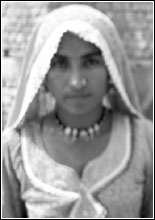 AMID the despair and desperation in the desert of Thar, there are stories of individual courage, inspiration and promise. Here are just three of them:
Kamla Devi, primary school teacher
In a tiny dark room in a mud hut, seven little girls sit on a wooden bench and pour over their books. A young woman, dressed in traditional Thari dress with white bangles all the way up her arms paces up and down in front of the bench, reading to the children. She is gentle but firm.
The girls look up at her with adoration. Kamla Devi has been teaching girls in this village of Guri in Nagarparkar, the south eastern Taluka of Tharparkar since 1993. She’s employed by the government and gets a salary of Rs 7000 a month but teaches in her own home since the government has never provided a building for the school. She has 34 students but most of them have migrated with their families to the irrigated areas of Sindh where they will help work the lands.
Kamla Devi, a mother of four, has a bachelor’s degree from the college in town where her father was also a teacher. Her three sisters have the same education and have all been looking for jobs as teachers so far unsuccessfully even though girls’ schools like abandoned all over the district. “Teaching is the best job one can ever do,” says Kamla Devi.
“That is what gives children a foundation. The only way out for the girls of Thar is to study, get good jobs and improve their lives.” In the 13 years she has been teaching, 20 of her students have made it to matriculation. None of them have gone beyond that. But Kamla Devi isn’t ready to give up yet. “We have to keep going,” she says. “Who knows, maybe we will produce a doctor from amongst our girls one of these days.”
Sakina, student
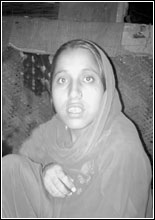 In the Hajam Mela neighbourhood in the town of Mithi, a group of women have gathered to talk to us about their lives. Some say they need electricity in their homes.
Others want an adult literacy center so that all the women can learn to write their names. Two women tell me they collect and sell firewood and make just Rs 20 for a full day’s work. But one voice stands out from amidst these demands. Her name is Sakina, a 20-year old with a sweet, soft face and the most fiery eyes I have ever seen.
She is bold but exceedingly polite, impassioned when she talks about her land and filled with hope and optimism. She does not exude the same helplessness, hopelessness that most others do.
Sakina completed her matriculation four years ago and is now planning to study for her intermediate exams at the Open University. When she’s done, she has no doubts of where she will head next.
“Ever since I was a little girl, I’ve wanted to become a teacher like my father,” she says. “People dream of success and money but my childhood dream has been to teach the poor girls of our villages.
I want to make Thar a shining star so that everyone says girls from Thar are the most educated of all.” As I prepare to leave, Sakina beseeches me to take a message from her to the world: “All our leaders say that all Pakistanis are equal. Then why do they look at Thar with such hatred?
Why are we strangers in our own land? We were very appreciative when everyone rushed to help Kashmiris in the earthquake but why is it that these sentiments are never shared with us even though we are persistently in a state of catastrophe with the drought?”
Mahawo & Arndoo, vegetable farmers
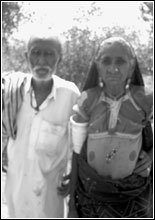 Near an ancient Jain temple in Guri, Nagarparkar is a surprising, entirely uncommon sight. An old couple, probably past their sixties, are busy at work tending to their land. The woman, Arndoo, plucks bers from a row of short trees and gathers them into her dupatta. Her husband Mahavo, inspects his plantation of yellow-flowered herbs and spring onions.
A fruit and vegetable plantation dead in the middle of this dry, barren desert feels both unnatural and greatly relieving. “About five years ago I thought that every time there’s no rain, our animals begin to die and we’re in a fix,” Mahavo explains. “I was getting too old to think about seasonal migration. And in any case I realized that our only salvation lies in learning to survive on our own land.” So he started experimenting with the water he could access and began growing a few vegetables and grass to use as fodder for the animals.
He did it without pesticides, chemicals or fertilizer of any kind. It was a success and today he has installed a water pump and grows everything from eggplant to carrots, spinach and cumin. Arndoo says they use the vegetables for their own family of 25 including all their grandchildren and also sell them to locals. “We make up to Rs 500 per day,” she says proudly.
The secret of their success: “We stick together,” says Mahavo. “We’re like the those birds called sarns, we will suffer if we ever separate from each other.”—NM





























