



 0
0

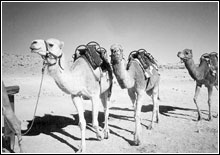 IN Pakistan camels, donkeys, horses and mules are raised for draught and game. There are areas with extremely arid pastures where only camels can produce milk, meat, wool and skin. These are also valued as pack animals for carrying up to 600kg on its back and for pulling the carts. Their contribution in national economy as a source of renewable energy supply (draught power) is nevertheless serving the mankind. The animal also contributes in provision of human food items viz. milk, meat and valuable by-products.
The population of animals is on decline, down to 800,000 or less in 2004 from 1.1 million in 1994. Yet, the prospects are comparatively bright due to a heightened demand for these animals in Afghanistan where the livestock economy collapsed after the war, and the country remains dependent on animal imports.
Cheelkand, a minor hamlet in Mirpurkhas district of Sindh is the scene of a thriving weekly market from where camels are trucked to the border with Afghanistan and Iran.
In the Tharparkar desert camels still count for much and are regarded as a symbol of wealth. A good animal costs Rs40,000. A recent survey identified 27 different camel breeds.
Food habits: The camel eats primarily thorny plants, dry grasses and saltbush; it eats anything that grows in the desert. Dromedaries primarily browse with shrubs and forbs compose up to 70 per cent of its diet.
About 8-12 hours per day is spent on grazing with equal time spent on ruminating. When foraging, camels tend to spread over large areas and select only a few leaves from each plant. This type of feeding behaviour reduces the stress on plant communities and eases competition with other arid region herbivores.
Additionally, dromedaries need about six to eight times as much salt as other animals for adsorption and storage of water. Consequently, 1/3 of their food intake must be halophytes. Dromedaries browse up to a height of 3.5 meter, breaking off branches or stripping off the leaves in one movement. While browsing, they use their lips to grasp the food then chew each bite 40-50 times. The mouth is kept open while chewing thorny food.
Reproduction: The dromedary camel has a lifespan of about 40-50 years. Males and females are seasonal breeders. Breeding occurs in winter and overlaps with the rainy season; both vary in respect to the camel’s geographic range. The gestation period typically lasts for a period of 15 months followed by the birth of a single calf. The calf can move freely by the end of the first day.
The camel was always valued as more than a mode of transport. On farm, as a beast of burden, and can be indispensable at the harvest time. It can carry a load of up to 300kg over long distances and more than 450kg over short distances.
Other chores performed by it include threshing, lifting water for irrigation and powering oil mills. It is also used as a riding animal. Its role in the rural economy is ignored in policy and overlooked by the development planners.
Economic potential: Camels are suited better than any other type of livestock for making productive use of desert areas. Some decline of the camel numbers in Asia can be attributed to the loss of its transport function, and may therefore be inevitable. But the camel also fulfils many other human needs and there is plenty of potential for value addition to its products. It is popular as a sacrificial animal for Muslims in South Asia.
Camel milk in various processed forms is an esteemed dietary item in the Central Asian countries. For instance, Mongolian herders process it into several types of cheese or distil it into vodka.
In the Central Asian countries such as Kazakhstan, camel milk is administered as therapy for a range of diseases, including tuberculosis and dropsy. The wool of the camel is valued highly. And then there is the usefulness of the camel in agriculture, to pull ploughs, to power oil mills, or to draw water. This may still be of interest for countries and people who cannot afford to keep up with the rising oil prices.
Camel milk is high in vitamin C and can be used to treat several diseases. It can be made into a large number of delicious and healthy products: cheese, ice-cream and even chocolate. Camel hides are used for making shoes and sandals. The wool is used for making string bags or sacks, blankets, clothing, making rope and used for making tents, carpets.





























