



 0
0

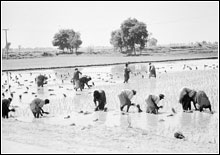 THE growers of rice, especially of IRRI-6, were hit by financial crises of the worst degree in Sindh this year. The sale of paddy fetched a price not only lower than the cost of crop production but it was also below the lowest rate recorded during past five years.
One maund of paddy was sold for Rs250 whereas the same quantity fetched Rs390 last year. The loss of Rs140 in this highly inflationary scenario has hurt the poor peasants most.
The price of paddy in the market last November hovered around Rs300 per maund but as threshing gained momentum, it exhibited a downward drift. Subsisting on the hopes that the current prices might be temporary and may rebound as usual during peak season in January, most growers held up threshing for about two months.
Unfortunately, the expectations of growers were not realized. All their castles, built in the horizon to wipe out the credit in entirety, to get their household members better clothing and feed them richer food, started dismantling brick by brick, when the prices plummeted further to Rs250.
Consequence of this scenario portraits a painful picture of growers when the credit was demanded back by the creditors as it was extended to them to buy seeds, fertilizer, pesticides and diesel for ploughing the land.
The escalation in the prices of inputs virtually cost them twice the rate, while they suffered loss of Rs140 per maund. The loss on buying costly inputs and selling commodity cheap has pushed the growers especially peasants to proverbial poverty line, not earning even a dollar a day.
Discussions with relevant quarters prove that the prevalent price structure of IRRI rice was not the consequence of some natural phenomenon. It was a mere manipulation of the cartel, constituted by rice exporters to dictate prices to the market.
Unable to bear the colossal loss, the hapless peasants, land owners and millers joined hands to draw attention of the government to the injustice, committed by rice exporters against them. They raised hue and cry in the print and electronic media, urging the government to fix fair price of the commodity and save them from exploitation.
They also exhorted the government to ask the Trading Corporation of Pakistan (TCP) to purchase paddy, set up procurement centres (PCs), accessible to growers. Finding no response to their concerns, they resorted to rallies and put up roadblocks to draw attention of the government.
The government did not take serious notice of the issue and accorded lukewarm response to the peasants’ demands by fixing procurement price of paddy at Rs300 per maund, as against the stakeholders’ demand of Rs400, though the same commodity was sold for Rs390 last year. This was all done unilaterally sans according them an opportunity to hear their grievances.
Even directives by the government to Islamabad-based Passco to set up the PCs with alacrity as the procurement season was in full bloom, was lacking. Passco opened only a few centres as eyewash. By the time the PCs started functioning, the growers had almost disposed of crop abysmally at low rate, suffering financial loss beyond their endurance. The other reason, compelling growers to dispose of yield was to ease the creditors’ pressure.
Growers rejected the price fixed unilaterally by the government. They argued that the cost of producing rice had flared-up with the rise in the price of inputs. The cost of 50kg bag each of DAP and urea for Rs720 and Rs312 at the time of sowing paddy last year was now available at Rs990 and Rs395 on cash and Rs1500 and Rs700 on credit, respectively.
Timing of the emergence of the Kalabagh Dam (KBD) issue on the political horizon was also not propitious for growers. When their pressure was at its zenith, the KBD issue raised its ugly head, dissipating pressure of the growers. Since their interests coincided with the anti-dam issue, the price issue of rice was adumbrated by the KBD, resulting in considerable loss to growers.
In such an anguishing scenario, when the cost of inputs went high while the price of paddy went down in inverse proportion, the resentment of growers was a logical conclusion.
The counter effect of the fixation of procurement price by the government was that it gave a lame excuse to millers not to exceed the government-fixed price on the advice of exporters. Capping paddy price sans setting up sufficient PCs and that too sparse and delayed, played havoc with the income of growers.
As the luck would have it, most of the growers had also suffered heavily in the preceding Rabi and Kharif seasons, when their crop of til and wheat suffered strokes of hailstorm and attack of pests, respectively. Sufferance of loss by growers in three consecutive cropping seasons has crippled them financially.
Burdened by escalating cost of agricultural inputs, the growers especially tillers of the soil already walk on a tight rope. Erosion of the value of their crop has further aggravated their economic worries.
As the social scenario delineates, more growers will fall into quagmire of poverty, unemployment, ignorance and disease. The attitude of the government creates question in people’s mind of the smaller provinces that they are being punished for their immutable stand on water, finance and dam issues.
Poor farmers are a vulnerable lot. Pushing them to join burgeoning ranks of poverty-stricken populace, already numbering 32 per cent in the country, as claimed officially, negates the government’s stand, that poverty line has fallen by six per cent. Failure of the government to provide relief to poor growers of rice belt would further swell poverty ranks in the country.
One can’t understand why the government follows the policy of duplicity. When the growers of cotton belt in Punjab in the not too distant past faced price decline in the open market, the government lost no time to ask the TCP to purchase cotton at fairly high price and protected the growers’ interests, but not so in the case of Sindh.
One is compelled to draw comparisons with the neighbouring country, how it cares to increase the agricultural production by providing growers with facilities commensurate with their requirements. The Indian states of East Punjab and Tamil Nadu provide free power to their farmers to boost agricultural production which helped their national economy tremendously, but in the case of Pakistan, growers’ basic needs are not taken care of.
The end result is that the country could not sustain the autarky in staple grain, achieved a few years back after the lapse of half a century, for want of facilities and incentives to farming community.
If the government is serious to develop the land of the pure, it will have to put more money into the agriculture sector as without prosperous agriculture, the industry could not flourish and have a secure base. And it need not be forgotten that the tillers of the soil are the spinal columns of the agricultural sector and to ignore them is to weaken the base of the industry.





























