



 0
0

 FROM outside, the health centre looks promising. A large, white building with vast grounds around it and probably plenty of space for everyone to wait comfortably inside. It’s noon on a weekday so it should be busy. A quiet boy of 14 or 15 emerges from the yard and appears bewildered, as if he’s unaccustomed to seeing people here.
Inside, a rickety desk in the verandah, and a soundless, abandoned feel to the building. At one end of the corridor is a room with a wrecked hospital bed, a moth-eaten bare mattress on it, three rusting drip stands. Cobwebs hug the corners of all walls, dust floats around and settles everywhere. Long-legged spiders scuttle, suddenly disturbed.
Another room has a solar-powered refrigerator stocked with a few scant bottles of anti-snake venom and polio vaccines. A heap of broken furniture in the third room. A fourth has a broken wooden bench and a blackboard with a message about polio stuck onto a chair.
The doctor’s room is next, two registers, a paperweight and a call bell on his desk. He isn’t there, neither is anyone else. Just the boy who quietly follows us around. The register shows a record of 464 patients in the month of February but one has to wonder where he examines his patients since not a single room is even moderately clean. Even the sole visitor’s chair across his desk is broken, the weave stripped away. On top of the steel cupboard in his room are a few dusty boxes of droppers.
The supply room is probably the filthiest. A box of used syringes sits open on the counter next to several uncapped jars of pills. Empty dettol bottles are strewn about.. This is the government’s basic health unit (BHU) at the village of Veri Jhap, some 40 kilometers south west of Mithi in the Taluka of Diplo.
All across the desert, the 30 BHUs in the district of Tharparkar are usually the only access rural dwellers have to any form of health facilities. Even many of these are over 20 kilometres away from villages with no means of transport but a long walk through the desert. And when they get there, the BHU’s are often in a state of abandonment like the one at Veri Jhap, with the sole doctor not on duty and no other competent staff available to help.
Some BHUs like the one at Dano Dhanal, 35 kilometers north of Nagar Parkar town are in somewhat better shape despite having been without a doctor until earlier this year. What is troubling, however, is the fact that the state and functioning of BHUs appears to depend entirely on the level of commitment of individual doctors. No system of checks, balances, inspections or accountability exists.
Says Dr Prabhu Lal, Dictrict Officer for Health: “It is mandatory for every BHU to have a doctor, two technicians, one midwife, one naib qasim, one sweeper and one guard. Each BHU has life saving drugs, antibiotics and other preventive medicine and we are fully satisfied with the workings of the BHUs.”
Even a cursory look at state of BHUs across the district makes it clear these guidelines are on paper alone. At the remote border village of Salhori in Chachro Taluka, the only access to a health facility is a dispensary set up in one of the village huts. It consists of one shelf of dusty medicines that no one in the village is able to administer. “A dispenser was appointed once but ran away in two days,” says Abdul Ghani of the village. Amla, an old midwife in the village says she has seen countless women die in childbirth since the nearest BHU is 17 kilometers away and that too is in a state of disrepair.
Women suffer most: The women of the desert are the worst off. At the Sukpur Village six kilometers north of the Rann of Katch in Nagarparkar, Wino, a 50-year old woman puts it like this: “We’re like endless travellers with no respite,” she says. “We have no access to health facilities, no medicines, not even lavatories. We women go in groups into the desert and have to constantly be on the lookout for men passing by.”
Not a single woman doctor has been appointed by the government for rural Tharparkar. Just four women doctors work in the district and that too at the four hospitals in the towns. Government figures show low rates of maternal mortality but it is amply evident that several women die in childbirth assisted by untrained midwives and the deaths goes unreported, unregistered, just like their lives.
There are just three specialists throughout the district, one each for chest, eye and skin. There isn’t a single gynecologist in Tharparkar and just eight lady health visitors for the entire district. Shehzeen Memon, a lady health visitor at the Diplo Taluka Hospital performs all the child births—about ten a month—since there are no female doctors to do so. “We have just one labour table at the hospital, no lamp to perform DNCs and not even an adult weight machine,” she says.
Problems like malaria, respiratory problems, peptic ulcers, anemia, dysentery and malnutrition run rampant throughout the desert, especially among women and children. “Tharparkar faces worse problems than anywhere else in Sindh because health facilities are inadequate and far from villages,” says Dr Bharat Kumar from the WHO Polio monitoring team.
“Every child suffers from malnutrition, almost every woman suffers from anemia and peptic ulcers are common because of the staple diet of red chillies and flour.” In times of drought, night blindness, a result of Vitamin A deficiency is a common occurrence in Thar.
Some 3,000 people a year fall victim to snake bites according to official government figures, of which they say just 0.5 per cent are fatal. Obviously, several people lose their lives to snake bites every year before reaching a health facility and these go unregistered.
Although DO Dr Lal says medical equipment “is sufficient and in fact underutilized,” health workers in the field such as Neel Kanwal, vaccinator at the Dano Dhanal BHU report that the lack of basic equipment such as x-ray machines, laboratory facilities and ultrasound machines limits the ability of the BHU to function effectively.
Money lenders in town take advantage of inadequate health facilities in rural areas which force those villagers who can afford it, to bring their ill to the towns. Bhavani Shankar and Hasrat Kumar, two money lenders in the town of Chachro say illnesses and snake bites are the most common reason for borrowing along with seed purchases and marriages. They lend at an interest rate of between three and five per cent per month but lend only against the deposit of gold or government salary checks. In the taluka of Chachro, total lending amounts to Rs 200,000 per day, they say. The very poor who have no collateral can only access store credit to buy flour. Their interest is built in by store owners who quote a higher price for credit transactions.
Animal health: The livestock economy of Thar also suffers for the paucity of animal doctors. Pooran, an old man in the village of Guri in Nagarparkar says livestock is dying from more than just starvation. A contagious disease has killed 300 goats in the last 20 days alone resulting in a loss of Rs600,000 to the villagers.
The district government’s agriculture department arrived on the scene too late with vaccination rather than treatment. There are no more than 12 animal doctors in this entire district of livestock owners, yet the Prime Minister’s Thar package did not include a single allocation to add animal health facilities to the region.
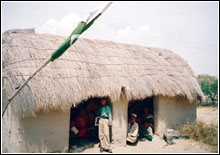
Ghost schools abound: Not far from the BHU at Veri Jhap is a mud plastered hut. A tattered flag of Pakistan billows outside on a crooked stick fashioned from the branch of a tree. The hut is a little different from the common Chounra. It is made of the same mud plaster and topped with the same thatch made from the reeds of a desert scrub. But it is rectangular, not round in shape. And inside, not a home or a kitchen but a squeeze of more than 30 children, slates in hand, cross-legged on the sand.
At one end, the teacher Baghchand points to his poster of the Sindhi alphabet and the multiplication tables and asks a question. The posters are barely visible in the dark. The teacher stands because his rickety chair has lived out its life.
The enchanting children are 8, 9, 10 and 11. The ten girls hunch together. The hut is hot, suffocating. Vijesh, a self-assured boy of eight in a too-big green t-shirt and dirty brown khakis, drones out from an English textbook about a blonde girl off to visit her grandmother.
He’s Bhagchand’s prized student and smiles shyly when asked what he wants to become when he grows up. The rest laugh, almost cynically. A striking girl called Marua sings a song about her beloved Pakistan. She doesn’t have a chair to sit on or even a cemented floor, but she sings with passion.
“We need a place for the children, furniture for them and materials to teach with,” Bhagchand says. “Even this hut we made ourselves because there is no school building and now we are trying to make two cemented rooms ourselves too.”
This is the government’s primary school at Veri Jhap. It is better than many since it at least functions and has a teacher who attends school. In contrast, schools all over the district, especially girls primary schools have been established on paper but remain without buildings and without teachers. Some estimates put the number of ghost girls schools at 70 per cent of the total.
The schools that do exist, many of them operating in homes or huts made by the community struggle to give the children an education in the absence of any facilities. Even the best of schools in the district battle with the most basic of problems on a daily basis. In the village of Guri in Taluka Nagarparkar, for example, middle school teacher Chelhar says he teaches nine subjects to 41 students because he’s the only teacher appointed for the middle school.
“There is water for the children here, no furniture and no materials to teach with,” he says. Worse still, thousands of children throughout the district spend their days running barefoot through the desert, playing with twigs, unable to spell their own names.
In Wingor, a village on the southern edge of the Diplo Taluka near the border with the Rann of Katch, hundreds of children have gathered around two fighting dogs. All of them are barefoot, their clothes torn, their faces encrusted with grime.
This village of 500 is involved mostly in the lowest rung of labour. They collect wood and leaves and cart them to town for Rs60 per day or transport bricks on donkey-back for Rs 125 per 1,000 bricks. None of the children are enrolled in school and just two boys in the village have studied a few grades. “If this boy goes to school, what will he get later?” asks Vikio, a young labourer. “If he goes out and collects a few leaves instead, he’ll at least bring home Rs15 at the end of the day.” Their village has just one primary school for boys but the teacher hardly ever comes to work, they say.
Further west, close to the border with India some 25 kilometers south of Khokrapar is the small remote village of Salhori, home to about 45 households. Abdul Ghani who has studied up to the intermediate level says the village has one school—a boys primary school— but no building since 1954. “Not a single one of these three or four hundred children can name even a single letter of the Sindhi alphabet,” he says. “There are four of us here who have passed intermediate and we have tried and tried to get jobs as teachers but nothing has happened and we sit here jobless.”
Yet, Ghulam Nabi Sahar, the District Officer for Education remains oblivious to these problems. “Enrollment has risen rapidly because of government campaigns and today there is not a single child in the rural areas who is not enrolled in school,” he says. When asked about the hundreds of children across all four talukas of Tharparkar who are not in school, he says: “No one told us that this is the case. But yes people over 40 are generally illiterate here and they don’t bother to check if their children go to school.” He doesn’t know the size of the education budget for Tharparkar. But he goes on to stress that quality assessment is being improved and monitoring would be even better if more vehicles and higher petrol allowances are approved.
While he waits for greater funding, thousands of people across the Thar desert are pushed deeper into poverty with simple, curable diseases taking lives and the new generation growing up into illiteracy and helplessness.






























