



 0
0

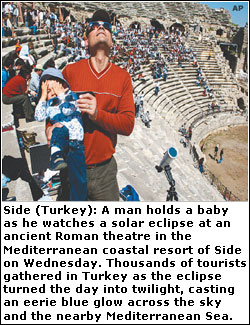 ASTANA, March 29: The faithful said prayers, astronomers and thrill-seekers gazed in awe and dervishes whirled in Turkey as a total eclipse of the sun turned day into night on Wednesday on a path halfway round the world.
Carving a narrow band over northwest Africa and parts of the Middle East, the eclipse expired on the steppes of the Russo-Mongolian frontier three hours and 14,500 kilometres after it began in northeastern Brazil.
“It was so good, it gave me goose pimples,” said Julio Paredes, a pizzeria manager from Madrid who travelled to Side, on Turkey’s Mediterranean coast, to watch the phenomenon.
“It was marvellous, unbelievable,” agreed Thomas Reichert, from Stuttgart, southwestern Germany. “I was fantastically lucky to be here.”
For many observers, it was a sign of divine might. For Ramatoutou, a farmer in the Niger village of Karey Gourou, it was a bad omen.
“What a disaster, the sun has disappeared!” he exclaimed. “I hope God will protect us.”
The fourth total eclipse of the 21st century began soon after dawn over the far northeastern Brazilian city of Natal when, at 0849 GMT, the sun disappeared for 10 minutes and it was night again.
Moving at dizzying speed, the lunar shadow reached Ghana at 0910 GMT, where sirens sounded as the capital Accra plunged into darkness for two-and-a-half minutes.
“I’m so emotional. And I’m also happy because now I’ll be able to say to my grandchildren: ‘I was there’,” said Sylvia Boateng, 35, in Accra.
Countries lying directly under the path, thus able to see a total eclipse, were Brazil, Ghana, Togo, Benin, Nigeria, Niger, Chad, Libya, Egypt, Greece, Turkey, Georgia, Russia, Kazakhstan and Mongolia.
Observers 2,500 kilometres either side saw a partial eclipse, with a fifth of the sun obscured in Britain but up to 80 per cent in the southern Gulf.
The phenomenon was welcomed by whirling dervishes in Turkey’s central city of Konya, a key religious centre.
In Iraq’s southern port city of Basra, the faithful went to mosques for a special prayer, called Salat al Qusuf.
Mosques in Niger’s Maradi region were packed with people reading the holy Quran and praying. “The eclipse only happens when God is angry with us and wants to prove his might,” one Muslim scholar said on local radio.
Libya, until recently an international pariah, relaxed entry rules to allow in 7,000 observers from 47 countries, and granted special permission for telescopes.
The only part of the European Union to lie on the path of totality was the tiny Greek island of Kastellorizo, a few kilometres from Turkey.
Some 3,000 people — an unprecedented influx onto the island, where hotel rooms had been booked up to three years in advance — watched it there, while cameras relayed the images to a giant screen in central Athens. Applause broke out as the screen showed the total eclipse at 1453 GMT.
Egyptian President Hosni Mubarak and his wife — wearing special glasses to filter out the ultraviolet light — and several thousand tourists converged at Al Salloum, near the border with Libya.
Eclipses should never be viewed without good optical filters as ultraviolet light, which is invisible to the human eye, can burn the retina even when the sun is covered.
Some observers took makeshift precautions, watching the event reflected on windows or in buckets of water, or staring through the tiny hole in computer disks.
By the time the eclipse ended, only a few dozen people were still watching on the main square of Astana, the capital of Kazakhstan.
The next eclipse will be on Aug 1, 2008, and will stretch across parts of North America, Europe and Asia.—AFP



























