Khyber Agency fighting
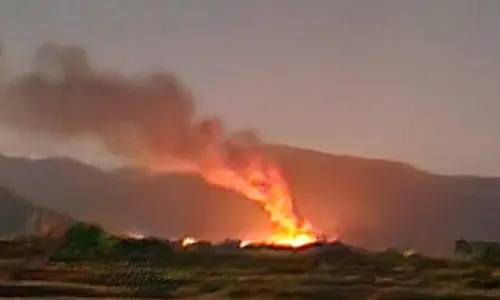
ANOTHER example of how religion can be exploited for petty purposes and can lead to death and destruction can be seen in what happened in Khyber Agency on Monday and Tuesday. Two days of fighting between two tribal leaders has left at least 25 dead, scores injured and houses and property destroyed. No major issues were involved, nor was there any trace of the on-going conflict between the Taliban and their opponents. The highly motivated and well-armed militants on both sides owe their allegiance to two tribal leaders, both of whom obviously attach more importance to their narrow interests than to their religion. The two have disappeared without a trace in the mountain fastness along the Afghan-Pakistan border. But behind them they have left many women widowed and children orphaned. More shockingly, some women and children have been taken hostage. Trouble had been brewing in the area since November, and there was bad blood between the two sides, the issues being the establishment of illegal FM stations, disputes over property and the foul language the two leaders were using against each other in their “sermons”. Gunpowder was thus ready waiting to be ignited.
Since the British days, the tribal areas have enjoyed a sort of autonomy that now seems anachronistic. The colonial power allowed the tribesmen in designated areas to carry arms, maintain their traditions and settle disputes according to tribal laws and customs. In return, the Maliks — tribal chieftains — were forbidden from making forays into the “settled” areas and told to maintain peace within their areas. No one was allowed to carry arms outside the tribal areas — now called the Federally Administered Tribal Areas. The British paid some of the Maliks money to ensure their loyalty. Pakistan has been paying this subsidy to tribal Maliks in the form of building roads, schools and hospitals. However, in the wake of the Soviet invasion of Afghanistan in 1979 and the civil war in the post-Soviet period, the rules of the game were violated. Pakistan became one big arms bazaar, as the Ziaul Haq government allowed tribesmen to operate throughout the country by establishing recruiting centres for the ‘jihad’ in Afghanistan and to establish madressahs of their own where only the Taliban version of Islam was taught. All these violations were ignored by sections of the military sympathetic to the Taliban, and as a consequence, the country stood in danger of becoming one big tribal entity.
The fighting in the Sur Dand area highlights this unpleasant reality. There is very little that the government can do besides what it has been doing — without any results. There may be no foreign militants in Sur Dand, as they are in Wana, and therefore there is no need for military action by the federal government. But the fighting and the background to it emphasize the need for doing away with Fata. If the purpose of Fata was to maintain peace within the tribal belt, the aim has failed. Time may not be right for abolishing Fata now, but there is need for developing a political consensus on a new approach to the issue. The tribal areas must be brought into the national mainstream, and the pace of economic development must be quickened to break the hold of pseudo-religious leaders and Maliks who like the sardars in Balochistan are interested in keeping the status quo, because it serves their interests.
WSF — successes & failures
THE World Social Forum that closed on Wednesday in Karachi proved to be an event of significance. It brought together thousands of people — those who normally do not make headlines — together on a common platform, clearly establishing that the city is potentially a vibrant one, all its civic and law and order problems notwithstanding. The forum also provided a rich ground for input from human rights and women’s rights activists, thinkers, intellectuals, trade union leaders, youth and others who have the potential of creating the “other world” that is on the agenda of the WSF. The foreign delegates and visitors from outside Karachi found this a useful occasion for networking and interacting with each other. That is the stuff social movements are made of and one hopes that Karachi’s experience will give a boost to the forces of change in different parts of the world.
But will the WSF make an impact on Pakistan’s social movements — whatever we have of them? The main function of the WSF, the poor man’s reply to the rich man’s club at Davos in January every year, is to create awareness of the alternative that is available to the market-driven capitalist system that dominates the world today. The WSF is also designed to be an exercise in mobilization. In that respect the Karachi edition of the WSF fell short of the expectations it had aroused. This is to be attributed to organizational deficiencies. In the absence of proper planning and efficient management, the optimum use could not be made of this occasion to spread the message of the WSF among the people. Although some sessions were very well attended — notably the ones on Kashmir and women’s issues and the dignity forum — many more had to be cancelled because of organizational drawbacks. At times the programme and schedules were not announced well in advance and on other occasions failure to observe punctuality deprived some sessions of the audience that could have been there if the organizers had attended to these seemingly small details which make all the difference. In any case, the organizers would do well to evaluate their performance and draw lessons from this exercise for the benefit of all.
Plight of people of Chitral
ONE cannot imagine what life must be like for those who live in Chitral during the harsh winter months — from December to April — as they are virtually cut off from the rest of the country. The Lowari Pass is the only way to get to the valley but it cannot be used during the winter. Since the 1970s, governments have promised to build an all-weather tunnel through the pass but plans have never materialized and the people continue to suffer as a result. As it is, living conditions are poor and the government pays little attention to the state of health care and education in this remote region. According to a report, life is particularly harsh these days as many people do not have access to essential items as hoarders are charging exorbitant prices for goods, confident that their products will be bought as there is no other choice. The replacement of the district administration has also worsened the situation as those in charge of affairs now like the nazims seem unable to manage or govern efficiently. That the price of 50 kilos of fuel wood — an essential requirement — went up from Rs 65 to Rs 140 the year the new administration took charge highlights just how difficult living conditions are and how ineffective the new administration is in dealing with problems.
To make matters worse, the federal government which used to subsidize essential items during the closure of the Lowari Pass, withdrew that subsidy a few years ago. These are just a few of the many problems people in Chitral face. The situation calls for serious attention, the most urgent being solving the problem of road links. The authorities also have to curb profiteering by adopting a clear-cut pricing strategy during the winter months.
Providing water, power and gas to all
AT a time when people are clamouring to have at least a small share of the fruits of high economic growth, President Musharraf has promised water, power and gas for all by 2008, and if possible by the end of 2007. On his part he means that. And he wants the prime minister and the chief ministers too to publicly make such a commitment to provide these basic services to people and actually deliver them.
Anyway the prime minister and the chief ministers are bound to honour his commitment and deliver such essential services by the early 2008. If people are cynical in their reaction to such announcements or commitments, that is understandable. They have been promised such facilities before as well by the past civilian and military regimes. And instead of getting the promised services, the conditions became worse for the common man and there was talk of great deal of corruption in such areas. People will have to see if it is really different now and that what is being promised is delivered too as well, and in full measure and not as a token or symbolic gesture.
But for the president’s commitments to be fulfilled, a great many steps are needed and there are vital prerequisites. To begin with, large funds are needed and these will have to be separated from the annual development plan outlay. And such funds will have to be adequate to meet the needs of the whole country and in time. Corruption shall not be allowed to squander such funds.
When the president says these basic facilities should become available before the end of 2007 there is a political dimension to it. General elections are due in the last quarter of 2007 and the president and the prime minister following the appointment of a new chief election commissioner have reaffirmed that. If the masses are provided water, power and gas before that date, they will be happy to vote for the ruling party.
To begin with, a study has to be conducted of the real cost of supplying water to all, including all those in the rural areas. And the cost has to be verified to make sure it is truly economic. Then the requisite water has to be found particularly for large cities like Karachi. The Sindh government and the farm lords have been objecting to more water being diverted from River Indus to Karachi, thus reducing the water availability for Sindh farms. If more water is taken out of Indus now will the same objection be raised again? That is an issue that needs to be attended. When it comes to providing electricity to all including those in the far off villages we need far more power than what we have at present. Will all the current efforts to increase power, initially through the thermal system be successful by next year and the power supply increase radically? If that does not take place the president’s commitment may not be fulfilled within the time frame suggested.
Mr Shaukat Aziz had earlier said that remote villages would be provided at least a bulb. That certainly is not power for all because that means enough power to run cottage factories as well. In the cities and towns where there is power now the transmission and distribution lines are too old and break down too often. Those lines have to be replaced at a high cost and if that is not done a great deal of power will be wasted and people will feel utterly frustrated.
In addition, theft of power which along with the technical losses is said to be 26 per cent in the Wapda region and 40 per cent in the KESC area should be greatly reduced. That will greatly cut the cost of power production and increase the profitability of the KESC and Wapda. Some of the additional power to be developed has to come through foreign investment and we hope the requisite foreign direct investment becomes available in time.
President Musharraf has now spoken of cheaper gas at a time when we are going to import it from Iran, Turkmenistan and Qatar at a higher cost after heavy investment on the pipelines. We do not have enough gas at present and those seeking additional supply are too many beginning with the fertilizer companies which have a higher priority. So the government may rely on LNG which is to be promoted in a big way in the country. That is not quite the same as receiving gas through the gas pipelines directly.
Fulfilling all the three promises by the president will be a great feat. And people will expect that from the government after 60 years of the birth of Pakistan. And that is what can give real meaning to high economic growth, and not the increased loans from banks and the multiplicity of credit cards and luxury cars provided on an instalment basis.
If clean and safe water offers great many advantages to people, that can be greatly helpful to the government as well. Clean water can save the people from half stomach ailments and other diseases and reduce the public health budget of the government.
The president has also asked the prime minister and the chief ministers at the centenary celebrations of the Pakistan Muslim League in Lahore to make a public pledge with him to do everything possible to bring down poverty and prices and provide jobs to people. This commitment has no time limit but is a broad one which will strain the resources of the government in full. Of course, such problems should not be handled in the manner the sugar crises was handled or mishandled. Ultimately the prediction came true that the federal ministers along with several sugar mills owners will prevail in seeking withdrawal of the inquiry initiated by the National Accountability Bureau. The mill owners with large sugar stocks promised to bring down prices if the inquiry into their conduct was withdrawn. The inquiry was promptly withdrawn but the sugar prices went up and now the sugar mills have been served with a routine show cause notice to tell the government why action should not be taken against them for indulging in profiteering.
Now that sugar mill owners have evaded action against them it is the turn of the cement industry to raise their prices. They have been doing it all the time and did far more recently as they are sure no action will be taken against them.
The response of the government to the sugar crises is to increase the number of utility stores and raise the sugar supply to such stores. But what the utility stores, despite an increase in their number and rise in the quantity of sugar, sell is a drop in the ocean, except in Islamabad. In other places the consumers have to travel a long distance and what they get by buying sugar at lower prices they lose on the higher cost of travel. So the consumers prefer to buy sugar locally and save travel time and fare.
The supply side of the economy needs to be attended well. That is what the new Governor of the State Bank of Pakistan Dr Shamshad Akhtar had also said before she assumed office. The prime minister has been talking time and again of improving the supply and logistic chain and is making positive moves in that direction. He is encouraging foreign companies to enter the wholesale trade in Pakistan. He met the officials of a European firm, Macro, which intends to set up 15 to 20 cash and carry outlets in Pakistan, beginning with one in Karachi and Lahore this year.
Macro would reduce the abuses of the middleman in trade and have direct contact with the farmers and give them a better deal. Mr Shaukat Aziz says that there is only one wholesale market in each city in Pakistan while in other countries there are several such markets in each city . He said the SHV Holding, another European firm, was interested in the wholesale market in Pakistan and would help the farmers to improve the quality of their products as well as promoting packaging and standardization of their agricultural products.
If we can have a number of distributors like Walmart of America which says the customer is the King that can be greatly helpful to people. In the final analysis what matters is what the government delivers and not what it promises. And its officials should not be allowed to practise the usual abuses and achieve what the government wants.
Resisting competition
JACQUES CHIRAC has a knack of making headlines and raising slightly embarrassed laughs that relieve the choreographed monotony of EU summits, but there are often very serious issues behind them.
So it was last week when he flounced out of the union’s spring economic council in Brussels because the French head of the European employers’ federation was addressing all 25 heads of government not in “la langue de Molihre,” but in English — the international business language.
Mr Chirac is in trouble at home with mass protests over an unpopular employment law intended to tackle some of the rigidities of France’s labour market; his sensitivities on the linguistic point are familiar. Both are closely linked to the wider issues of protectionism and economic nationalism that are casting a cloud over the union’s once grand ambitions to perform more competitively in a globalised world.
It was ironic that the message Mr Chirac missed was that EU leaders must avoid damaging the single market, for the raising of barriers to foreign competition is getting out of hand. In recent weeks the French government arranged a merger between Gaz de France and Suez, the Franco-Belgian energy giant, to stave off a takeover by an Italian rival.
France is not alone. Luxembourg has resisted a takeover of the steel maker Arcelor by Mittal Steel. Spain and Poland are being investigated for breaches of EU law.
— The Guardian, London