



 0
0

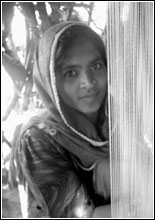 Four long years ago, Sarsi used to dream of teaching. She’d imagine herself as well-educated, pacing up and down before her students, her clean soft hands clutching a book. Now, she doesn’t dream of a better life. Maybe that’s why she never stops smiling. She wakes early every morning and no later than 8am, hunches down before the carpet loom in the small, damp, dark hut in her home.
The room is so dark that I can barely make out the strings in the loom but Sarsi’s eyes are well adjusted. She’s 15 and has been working the loom for four years now. That makes her a senior weaver and so she sits on one side, next to the intricate pattern that’s stuck against the side of the loom near her left knee. Every few seconds, she cranes her neck downwards, studies the patterns and calls out the instructions to her two younger partners.
One of them, Sushila, can’t be older than seven or eight. She concentrates hard, pulling the strands of coloured wool from behind her according to her tutor’s instructions. For eleven hours every day, Sarsi calls out instructions and Sushila follows. The girls find plenty to giggle about.
This isn’t the kind of teaching Sarsi had grown up dreaming about. But since her father died suddenly four years ago leaving her to fend for her mother and four younger brothers and sisters, this is her reality. “This work is hard,” she says. “My back hurts from sitting all day, my hands ache and the fluff from the wool gets inside my mouth so I cough all the time and become feverish.” Her tone is ever so gentle and the sweet smile never leaves her face. Not even when she puts her little hands in mine, palm up to show me the hardened callouses all along her fingers.
For her long, exacting day, Sarsi gets thirty rupees a day, forty if she’s lucky, just ten if she doesn’t weave enough. She smiles.
She is just one of more than 50 girls in this carpet weaving village of Kagia, just north of the town of Chachro, the largest Taluka in the Tharparkar district. Almost all the 400 households in this village work a carpet loom. The number of boys working the looms are beyond counting in this community of Menghwars.
According to a Household Economy Assessment Report of Tharparkar published by Thardeep, carpet weaving accounts for 29 per cent of total income for very poor households, the second highest source after casual labour which accounts for 54 per cent. The carpet industry was introduced in the desert in the early fifties by the government but it quickly became a form of labour to be used by money lenders and middle men to exploit the vulnerable.
Some 40 carpet entrepreneurs operate in the towns within Tharparkar, working for the wholesalers and exporters of carpets in Karachi. These entrepreneurs typically hunt for families in economic crises forced to put children to work.
The carpet industry has expanded rapidly on the back of persistent drought and unemployment and perpetuated a cycle of indebtedness, child labour and poverty. Sarsi and Sushila’s weaving will eventually make its way to the town of Chachro.
There, at the Chachro Carpet Center, carpet entrepreneur Vikram is sorting his stock. He buys his designs from Hyderabad and produces 4000 square feet a month for which he makes Rs 40,000. He needs 300 workers to produce that much and claims to pay the labour Rs 110 per square foot. Vikram says the materials, the cotton thread, Chinese silk thread and coloured wool costs Rs 125 per square foot and he sells the final product for Rs 250 per square foot, making a profit of Rs 15 per square foot.
We already know from the poor weavers in Kagia that this isn’t true. “I don’t need to know whether it is children working or adults because that isn’t my problem,” he says. “We do give loans to the labourers but we deduct that from their daily labour. And if a parent dies, the child must carry the debt. Someone has to pay our loan back after all.”
Locals tell me Vikram’s family hailed from a poor village but the carpet business has made him rich enough to send one brother to London. Further south, in the Taluka of Mithi is the village of Godhiar, just north east of the town of Mithi.
Nine-year old Kanwar works on a carpet loom for ten or twenty rupees a day to pay back a Rs 30,000 debt his long dead father took from a carpet entrepreneur. Kanwar wears a perplexed expression and dirty brown clothes torn at the seams. “My heart is in school but what can I do,” he says. “My eyes hurt but I know no one can help me. I can’t count on anyone to help me so I work.”
Like Sarsi, Kanwar aims to stop dreaming. It’s just easier that way.—N.M.



























