0
0

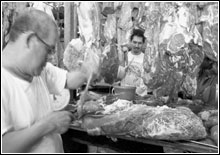 A large number of small slaughterhouses are scattered all over the country, some are licensed and others are not. A majority of licensed places lack modern amenities which are built and controlled by the municipal committees providing anti-mortem and post-mortem facilities under qualified veterinary officer.
The unlicensed slaughterhouses are spread in the villages without any proper plan. They do not provide any facilities and are devoid of a qualified veterinary officer.
The slaughtering of livestock in cities like Karachi, Hyderabad, Lahore, Rawalpindi and Peshawar is done in the municipal slaughterhouses, and at times in the streets and at shops. Butchers prefer to slaughter animals at their convenience.
According to the West Pakistan Slaughter Control Act 1963, the slaughtering of small and large ruminants should be strictly by undertaken in the recognized places with ante-and-post-mortem veterinary inspection.
Presently, for small and large ruminants, it is done in the recognized areas, municipal and cantonment and private slaughterhouses, and in the backyards. Municipal corporations operate majority of such places with few operating in the private sector.
In general, the existing facilities are insufficient for the requirements. The problem is severe in Karachi, Lahore and Faisalabad. Due to the shortage of facilities, the number of animals slaughtered outside is much higher than those within the boundaries. Therefore, official statistics greatly understate the number of animals slaughtered.
These houses can be referred to as mere slabs with no arrangement of hygiene and sanitation. These premises facilitate butchers and traders (not licensed) for the slaughter of livestock at a fee of Rs10 for small and Rs20 for large animal. There are no storage and quality control measures available. Meat rots, especially in the summer season. The problem is intensified when meat is sold through butchers to consumers. If all meat is not sold in daytime, there arises the problem of freezing.
Slaughterhouses are situated in thickly populated localities and the present facilities are not reasonable due to congestion on roads. There is no space to examine the animals and the water, drainage and electric facilities too, are limited. The slaughterhouses have no roof but only walls and floor with no arrangements to dispose off the waste material. The place is not properly cleaned, washed, and disinfected.
The slaughtered meat is transported to retailers’ through horse-driven carts, auto rickshaws, or pickups. While in the case of small ruminants, butchers take the meat on foot to the shops located nearby.
Livestock slaughtering is an important part of meat marketing. Butchers buy animals for slaughtering. They convert them to edible and non-edible and other useful products in merchandising channels through which they move on to consumers.
As for the quality, only ante- and post-mortem examination is carried out by the inspectors and the carcass fit for human consumption are stamped as passed. While in rural areas there exists no such system. At retail level, the food committee representatives rarely visit the butcher shop for quality inspection.
In urban areas, the inspector does not have the authority to condemn the whole carcass; only disease portions are rejected. It was also observed that all slaughter, carcass dressing and product handling are done in the same space. In addition to this, the facilities of drainage system, waste disposal and handling of by-products are inadequate and sometimes non-existent, resulting in the contamination of the carcass.
The quality of meat, particularly of cattle and buffaloes, is generally low but varies widely from locality to locality. The poor quality of beef is because of very old or young animals. Special breed for beef as evolved in other countries does not exist in Pakistan.
As a result, the average dressed carcass weight of cattle in countries rearing meat animals is over 500kg, whereas in Pakistan it is about 300kg. Similarly, the average dresses carcass weight of goat and sheep in Pakistan is about 15.9 g and 12.3kg, respectively.
The livestock producers keep most of the stock on their own preferences. They never think of consumers whose choice reflects on the price of the stock. Fair prices can be assured by standardization and gradation. Cooperative associations play a positive role for the livestock sector development. Such associations can accelerate the standardization and gradation, improve the distributive process and maximize the producer’s income.
According to the Pakistan Slaughterhouse Act of 1983, the killing of animals outside the boundary of slaughterhouses is prohibited. Recognized slaughterhouses usually provide separate buildings for slaughtering large and small animals. A majority are now located in thickly populated areas. The slaughtering, carcass dressing and by-product handling are done in the same space.
There area also suffers from shortage of various equipments such as pulley hoists, hooks etc., for hanging the carcasses. A large portion of the by-products such as blood, glands, intestines, and bones are either wasted or poorly processed. One of the underlying reasons is that these facilities are not periodically updated because of various administrative procedures. It can, therefore, be concluded that the slaughter facilities are obsolete, unclean, and poorly managed.
There are two slaughterhouses, one in Karachi and the other in Islamabad that have modern facilities. One slaughterhouse with modern facilities has been recently constructed at new cattle colony at Tando Muhammad Khan road but it is not functional.
Primitive conventional facilities result in wastage and damage of the by-products. The conventional and unhygienic meat processing system is mainly responsible for the setback to the export of meat from Pakistan to the UAE and other Middle Eastern countries.
Meat export was started in the beginning of the year 2000 when carcasses of goat and large animals were airlifted. The meat was processed under a special arrangement between the exporters and the Metropolitan Corporation.
The slaughterhouses can target the needs of health conscious people through departmental stores, chain stores, other retail outlets, but in the initial stage, opening of own retail outlet is not recommended, because it will require investment and specialized skills of retailing business.
Foreign contracts can be obtained with the assistance of the Export Promotion Bureau (EPB). The management of the EPB are already working on it to facilitate the export of meat. The slaughterhouse can also serve the existing meat exporters.
The is an investment opportunity in setting up an abattoir. The abattoir can provide slaughtering and allied services to local traders and butchers. However, some of the capacity can be utilized for slaughtering animals for own supply of meat in local and international market.
The proposed action plan will have the potential for further development of animal by-products processing industry. The slaughterhouses, which are technically equipped for slaughtering cattle, sheep, goats etc., will also have the potential for further development of operations such as by-product processing/utilization, meat preservation, meat processing butchering and development of meat market.
Lack of slaughtering techniques causes loss of meat and its by-products. Animals are slaughtered in places which are frequently polluted with blood, intestinal contents and dirty effluents. These are not well protected against insects and germs.
Meat produced under such conditions quickly deteriorates due to bacterial infections and could cause food poisoning. In the absence of inspections, meat from sick or parasite infected animals may well be a vector for spreading diseases, affecting human beings as well as animals. Furthermore, meat quality is adversely affected by careless handling under unhygienic conditions in the slaughterhouses. The capacity utilization varies depending on the staff efficiency and availability of animals.
Such problem could be solved by establishing a system of regional slaughterhouses at central points from where meat supplies could come. There is risk that such system would create new problem such as the need for specially equipped transport. It is suggested that organized slaughtering, collection, handling, and marketing of meat and by-products, inspection and grading of meat would be easier and more effective.