



 0
0

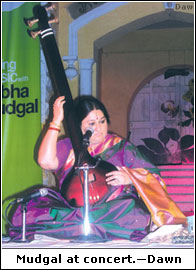 KARACHI, March 25: Shubha Mudgal, known for her excellence in classical music and soulful rendering of thumri and dadhra, performed to a select audience on Friday evening at the Karachi Parsi Institute (KPI).
Internationally recognized as a classical musician, composer and pop-star at one and the same time, she is widely respected for her performing skills and innovations in music.
The evening at the KPI began customarily late and not at the ‘sharp’ timing mentioned in the invitation. However, when Ms Mudgal began her performance after humbly thanking her hosts for the opportunity to perform in Karachi, the guests lost all track of the time in the sublime rendition that rang through the night until much later than initially intended.
Beginning with Raag Hamir and incorporating her ustaad’s bandish, she had the connoisseurs of music in attendance totally captivated. This was followed by a thumri in Raag Maala, which she explained is named so because it gently interlaces the varying cadence and rising tempo. Another thumri in Purbi, sundari sari mori maintained the same tempo and kept the crowd in an almost awestruck mood.
Supported by equally versatile accompanying musicians – Aneesa Pradhan on the tabla; Sudhir Naik on the harmonium and Murad Ali on the sarangi – Mudgal’s singing was highly complimented. Unlike many artists, she gave them many opportunities to enthral the crowd with their deft skills on their respective instruments, and especially Pradhan on the tabla was a high treat.
Born in Allahabad, Shubha Mudgal grew up in a family fond of music and literature. She is said to be a virtuoso in the classical Khyal song tradition and a passionate researcher in the field of Indian vocal music. On moving to the capital Delhi, she had more scope for experimentation and independence.
Though classical tradition is what she favours, her formal training began at the age of 16 which is traditionally a rather late beginning. But possessing a naturally deep voice, she mastered the wide range which classical renditions require and soon became a perfect champion of this genre of music. She has been trained under Kamala Bose in Allahabad.
The skill and mastery was more than evident throughout the evening, which saw the many devotees of classical form, deeply immersed in the poignant expressions rendered in her throaty voice. Among the notables included in the gathering were Nayyara Noor, Arshad Mehmood, Zia Mohyeddin and the acclaimed Ustaad Imdad Hussain and sarangi nawaz Ustaad Naseeruddin Sami.
Shubha Mudgal’s rather ‘colourful’ personality has pitted her in many controversies in the music world as well. Her contribution to the music of Mira Nair’s controversial and adult-rated film, Kamasutra, had classicists up in arms against her. She then applied her expertise to popular music, in the form of a collection of Sufi songs, which while it was an instant rage with the public, it also generated a lot of negative criticism and her cassette, Ali Moray Angnaa, was said to be an attempt to represent herself as the Indian counterpart of the Pakistani maestro and internationally acclaimed music megastar, Ustad Nusrat Fateh Ali Khan.
But her popularity prevails and to her credit are numerous awards which include the prize for best music-directing in a documentary film, Amrit Beeja at the Film Festival of India and for the music she set for film-maker Rajan Khosa’s Dance of the Wind. In 2000, the esteemed Order of Art ‘Padma Shri’ was awarded to Shubha Mudgal from the Indian government.
The lively and soulful Sufi lyrics have also made her an instant hit in the world of popular music even though traditionalists disapproved of the fact that a classical singer was compromising the revered genre to indulge in pop music.
But for the crowd seated at the sprawling garden venue she was faultless. With the cool spring breeze creating a serene ambience, they couldn’t seem to get enough of her and kept urging her on to continue.
The evening was organized by the Accident and Emergency Foundation (AEF) to raise funds for the JPMC Emergency Operating Theatre Project. Operating with the help of private donations, the AEF’s Emergency Operation Theatre commenced its operations in July, 2004 and till January this year had performed over 3,000 operations free of cost with each procedure amounting to Rs1,850 per patient.
With its patient turnover increasing rapidly, the organization is trying to raise more funds for its increasing costs. — MAR



























