0
0

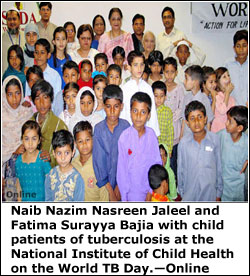 KARACHI, March 24: Naib Nazim Nasreen Jalil has asked local philanthropists to help constitute community citizen boards across the city. She was speaking at a seminar at the National Institute of Child Health organized by Sada Welfare Foundation to observe the World Tuberculosis Day 2006 on Friday.
Nasreen Jalil said that the CCBs could efficiently help streamline public welfare schemes, mainly related to health care, undertaken by philanthropists as well as NGOs.
“These boards could also emerge as a strong basis for sound and meaningful partnership between public and private sectors, as 20 per cent contributed by a single philanthropist or group of philanthropists will be complimented by 80 per cent funding by the city government of Karachi to meet recurring expenditure of CCBs-sponsored schemes,” she elaborated.
She mentioned that the city government had embarked upon several projects to strengthen infrastructure, with specific reference to provision of potable water, improved sewerage lines – protecting Karachiites against range of relevant diseases and expansion of road networks to protect citizens against atmospheric pollution.
This, she said, needed to be further expanded through close coordination among all those who were concerned and wanted to contribute towards improved life quality of Karachiites.
She said the seminar was an eye opener and it further strengthened the conviction that serious issues particularly those related to health should be addressed through joint efforts - focussing not only on public awareness but also involving community in general to prevent and address these.
Nasreen Jalil said: “We have to adopt prevention as the cornerstone of the approach to combat diseases haunting people.” She said that the registered number of TB patients at city government health care facilities came to 9,083 and it was now to be seen whether these patients were being regularly monitored or not and whether they were strictly complying with prescribed medication.
The naib nazim further said that 58 diagnostic units along with 109 medical care facilities were being run by the city government, while Rs18O million had been allocated for procurement of drugs. She claimed that to avoid pilferage of these medicines and prevent misappropriation of funds allocated for the purpose, a fool proof mechanism had been evolved including specific packing of drug/medicines, vaccines available at CDGK units.
Through the very strategy, she said, these drugs could be immediately identified if attempted to be sold by any one in the open market.
Dr Khalid Mehmood Arif, Consultant Paediatrician at the NICH, said that sense of complacency among adult tuberculosis patients put on treatment and registering marked improvement in their condition within first few weeks’ time was not only causing multi-drug resistance among them but also contributing towards spread of infections in children.
Maintaining that exact proportion of children with TB is unknown, the doctor said that the annual risk of acquiring infection was estimated at 2.5 per cent and eight per cent to 20 per cent of all tuberculosis deaths were seen in children.
“Tuberculosis among children is always transmitted from adult to children and never from children to children or adult,” he said.
Mentioning that diagnosis of tuberculosis among children is difficult, Dr Khalid Mehmood said that 60 per cent of all children reporting with tuberculosis at NICH were those not administered with BCG vaccines, which otherwise could have protected them against the ailment which besides being dreadful also had stigma attached to it.
“The children reporting with tuberculosis at the NICH aged between eight months and 14 years, with 12-year age group most affected,” he said.
Under the given situation, he stressed that once an adult is diagnosed with tuberculosis it must be made necessary for all his or her family members, particularly children, to be screened.
“There is every possibility that germs spread and children being vulnerable with poor immunity may contract the germs,” he elaborated. The doctor also underscored need for close coordination among public and private sectors to promote DOTS strategy with major focus at ensuring that patients strictly adhere to drug regimen and 100 per cent compliance is made.
He urged community members to play their role towards absolute compliance to standardized drug therapy available under DOTS strategy. The doctor also underscored need to channelize the diversified health care system existing in the country.
General public as well as patients have to be informed that completing the full duration of treatment can turn the germs resistance to drugs and the disease could strike them with more severity, he said.
While the chances of contracting the air borne germs by their very own dear ones as well as those coming into their contact aggravated to serious proportions, the doctor said mentioning that tremendous funding is available to treat the disease which is 100 per cent curable.
There was but need for a strong political will at all levels, he observed adding that the incidence rate of TB was about 177/100,000 population, which was about 250,000 new cases reported every year.
The age distribution showed tuberculosis is high among the younger age group of the country - 21 to 30 years, he said mentioning that Pakistan ranks sixth among the 22 countries with the highest burden (44 per cent) in eastern Mediterranean region of the WHO.
SADA Welfare Foundation Chairperson Fauzia Siddiqui said that 2,200 child patients were registered with the foundation under its TB Project at the NICH and every year approximately 500 to 600 new cases were registered with it.
“We have successfully treated 1,500 TB patients so far and others are still taking regular treatment,” she said adding that treatment is for a period of nine to 18 months depending upon the type of tuberculosis diagnosed.
Commonly diagnosed forms of tuberculosis among children included Lungs TB, Spinal Cord, Intestinal, Bones TB, she said.
NICH Assistant Director Dr Rehana Akhter said that the NICH, a 400-bed tertiary care hospital, was meeting child health needs of Karachi as well as children from other parts of Sindh and Balochistan provinces since 1970.
She appreciated support provided by NGOs for providing maximum possible health services to the resource-less individuals turning to the hospital.
WALK: In order to raise public awareness about tuberculosis affecting people of all age groups, a walk was arranged from the mausoleum of Quaid-i-Azam to Dadabhoy Chowrangi on Friday.
The walk, organized by the Ojha Institute of Chest Diseases in coordination with the Pakistan Chest Society to commemorate the World TB Day 2006, was led by Dow university vice-chancellor Prof Masood Hameed. Representatives of the Pakistan Chest Society, the Pakistan Medical Association and the World Health Organization along with other non-government organizations participated in the walk.
Addressing the participants at the culmination point of the walk, Prof Masood Hameed said that the day was being observed with the theme ‘Action of life towards a world free of tuberculosis’ was aimed at strengthening ongoing efforts to check tuberculosis which kills 2.5 million people each year and inflict eight million annually all over the world.
Ojha Institute Director Dr Mohamamd Ashraf Sadique emphasised on the importance of public-private partnership and requested all the stakeholders of society to come forward and play their vital role to control tuberculosis.
Prof Nadeem Rizvi requested media to come forward and play their role for the creating awareness among people regarding TB.
The speakers also stressed to achieve the target of 100 per cent DOTS coverage by the year 2006 and control of TB in the country by 2015. —APP