No alternative to talks
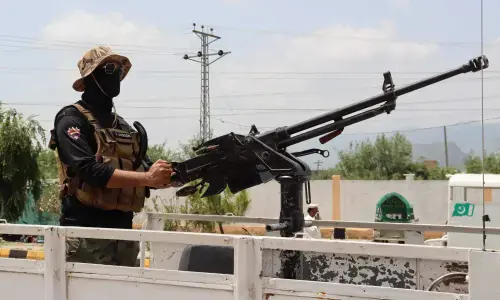
AS the Balochistan crisis deepens and acts of violence and sabotage escalate in the province, it is time a rational solution was found to the problem. It is therefore reassuring to find that a section of our lawmakers also disapprove of the government’s current strategy of use of force in a bid to check the dissidents and to suppress acts of terrorism. On Monday the Senate reached a consensus on bringing to a halt the on-going operations in Balochistan. The senators proposed renewal of reconciliation efforts to achieve lasting peace. It may be recalled that in 2004, with the parliament’s participation, a major peace process had been initiated in the troubled province. A committee headed by PML secretary-general Mushahid Hussain had visited Balochistan and met many of its leaders to resolve the crisis there. It had managed to arrange a truce and had then submitted a report proposing a number of confidence-building measures and steps to remove the grievances of the Baloch. Meanwhile, another committee headed by Senator Nisar Memon had worked on the issue of provincial autonomy but no report was made public. All these efforts came to nothing when the Mushahid report was not implemented and fighting was resumed in December last year.
Ever since then, the impression has gained ground that the government thinks that Balochistan’s problem can only be resolved by military means. This is a fallacy because past experience has shown that problems of this nature cannot be resolved by military means. They have to be discussed round the negotiating table and a solution found through a process of give-and-take. Of course, the first step has to be to arrange a ceasefire. Incidents of violence — blowing up of gas pipelines and the power transmission network, disruption of rail and road communication links and bomb blasts — have been on the rise. These have to stop. The parliamentary committee that is set up must immediately hold talks with the tribal chieftains to persuade them to ask their followers to halt acts of violence and reassure them that simultaneously the military operation in the province will also stop. This has to be a reciprocal process since no government can allow people to resort to acts of terrorism and not retaliate.
All the issues that have been agitating the minds of the Baloch for many decades — especially the demands for indigenous control of local resources, adequate royalty on gas, Baloch participation in national and provincial decision-making and ensuring that inter-provincial migration does not swamp the Baloch people in their own province — should be properly addressed to the satisfaction of the Baloch. It is also important that discussions be started on the provincial autonomy question. The Nisar Memon committee had failed to make an impact since it worked quietly and in isolation. It finally simply faded away without any announcement about its report, assuming that it had prepared one. A representative and high-powered committee should be entrusted with this task which has a direct bearing not just on Balochistan but on Sindh too. It is time the federal and the concurrent lists in the Constitution were revised. In fact, the concurrent list should be done away with and all subjects not included in the federal list should automatically be considered as falling under provincial jurisdiction. It is time the Balochistan problem was tackled seriously and not allowed to drag on, making the situation in the country much worse.
Stalemate in Palestine
IT would be unfortunate for the Palestinian cause if Hamas and other parties fail to form a coalition government. On Sunday, Hamas leader Ismail Haniye gave President Mahmoud Abbas a list of ministers none of whom belonged to Fatah or any other party. This gives ammunition to Hamas’s critics who say the party wants to reserve all key posts for itself with a view to sidelining Fatah. Some observers claim that this is a victory for the US, because it has succeeded in persuading Fatah and other parties not to cooperate with Hamas. This appears rather bizarre. Fatah might have lost some of its popularity because of the stories of corruption surrounding it since Palestinian “autonomy” began on a modest scale in some West Bank cities following the Oslo accords, but it appears highly unlikely that a movement that waged an epic struggle under Yasser Arafat’s leadership for the Palestinian people’s freedom will toe the line of Israel’s patron and ally.
The election which gave Hamas a stunning victory was held on Jan 25, but the failure to form a government even after two months is a serious reflection on the Palestinian parties’ ability to work democracy. Let the truth not be lost in the fog of the current crisis, which is that Hamas has won the election. For that reason, it has every right to form a government in coalition with other parties or entirely on its own. Nobody can question this right. If a Hamas government is not allowed to assume power or is made to fail, then Hamas will not be the loser. In the longer run, it will gain greater popularity among the Palestinian people, and most probably do better in the next election. But Hamas in power has no option but to show realism; it has to accept Israel as a reality and then negotiate for its withdrawal from the West Bank. It is doubtful, though, that there will ever be a change of heart in Tel Aviv, which has given no indication yet that it intends to withdraw from the West Bank and sincerely accept the emergence of an independent Palestinian state.
Centenary celebrations
THE point that an authentic history of the Muslim League has not yet been written hits us forcefully when we realize that celebrations are to begin tomorrow to mark the 100th anniversary of the founding of the Muslim League. Party workers from all over Pakistan will gather at Minar-i-Pakistan to attend a rally that is expected to be one of the biggest. While celebrations are indeed needed to remind the people, especially the youth, of the epic struggle waged by the Muslim League to create what in 1947 was the world’s biggest Muslim country, a greater task lies ahead in the form of compiling the party’s history — and to look at the depredations the party has suffered. In India, some books have been written on the party, including one by Lal Bahadur, but it is patchy work and cannot be called a history of the Muslim League. It is, therefore, of the utmost importance that this task is undertaken in Pakistan.
Some effort has been made in collecting and preserving Muslim League papers. The first volume of the Muslim League papers up to the end of 1908, titled >bs
How to turn the clock back
ACCORDING to a recent World Bank report, Pakistan, India and Bangladesh — quite contrary to the common perceptions — have higher prevalence of malnutrition than certain countries of Sub-Saharan Africa and are unlikely to achieve the millennium development goal of halving the number of underweight by 2015. The report warms that malnutrition is costing poor countries up to three per cent of their yearly GDP, while malnourished children are at a risk of losing more than 10 per cent of their lifetime earning potential.
India, Pakistan and Bangladesh are the three biggest states of South Asia that are endowed with rich human and natural resources and have yet failed to provide even the basic necessities of life to the majority of their people. What are the reasons for their failures when many small, medium and large countries have achieved phenomenal progress in fewer years?
Three such examples are Singapore, a tiny city state of about two million bereft of any natural resources; Malaysia, a middle-sized state of about 25 million endowed with many natural resources and China, the most populous state of the world with 1.2 billion people. All three have banished hunger, achieved universal literacy and provided modern health care to their people. Not only that, Singapore and Malaysia have even attained the same standard of living as the developed countries.
The question is why have these three done so well while the three South Asian countries have done so badly. The difference lies in the quality of their leadership. The first three found the right type of leaders who possessed the two indispensable traits essential for any nation’s progress and development while the last three have failed in this respect.
The two qualities that differentiate a dynamic from and sterile leadership are: 1) a sense of right priorities and 2) a spirit of pragmatism. The first means giving importance to people’s well-being over all else. The second means not chasing shadows or setting unattainable goals.
In the case of India, Prime Minister Nehru, in spite of his great intellect and unchallenged authority, especially after the assassination of Gandhi, was still unable to steer India towards the goal of rapid economic growth and development. Instead of adopting policies that would have unleashed the creative energies of the Indians and resulted in the production of wealth, he chose the path of Fabian socialism, which was incapable of transforming Indian society from its ancient mindset into a modern and dynamic entity.
He wanted India to emulate the USSR and China but did not realize that he was not a Stalin or Mao who had made these countries a one-party state, exercised absolute power and had the will to use it to modernize their nations no matter what the cost in human terms.
Nehru, on the other hand, couldn’t give up his commitment to a multi-party democracy and was incapable of using ruthless methods to make the Indians work on subsistence wages, accept forced literacy and give up personal liberties.
The result was a half-hearted nationalization, a wishy-washy land reform and a hamstrung licence-studded market economy controlled by a British trained haughty bureaucracy. This mixture of “teetar and batair” stunted India’s economic growth for over four decades to an extent that the economists began to call it the “Hindu rate of growth”.
In foreign policy Nehru created the Kashmir dispute which has since became an albatross tied around India’s neck, a cause of war with Pakistan and a source of perpetual discontent among the Kashmiris.
He dreamed of becoming a world leader by transforming NAM into a peacemaker between the two Cold War rivals, and then became a de facto ally of the Soviet Union. He took India’s relations with China to the level of “Chinee-Hindi Bhai Bhai” friendship and then provoked a disastrous border war with China that led to India’s humiliating defeat.
As for Pakistan, the story is even more tragic. Nehru at least gave democracy, secularism and a stable constitution-based political system to the Indians. The Pakistani leadership of all hues, since the death of the Quaid and Liaquat Ali Khan, have only followed a policy of expediency and ad-hocism. Consequently, instead of having a constitution Pakistan has only a piece of paper that can be suspended, mutilated, ignored and abrogated at the will of a single individual in uniform.
The guardians of this piece of paper, the judiciary, happily absolve themselves of all responsibility for its frequent distortion or suspension by hiding behind the law of necessity. Its main beneficiaries, the politicians with a few exceptions, readily collude in its mutilation and become partners of the usurpers until they themselves are jailed, exiled or disqualified.
On few occasions when they have ruled Pakistan, they have used power to give first priority to themselves, their families, their cronies, then their clan and “bradri”. By the time the common man’s turn comes, they are ousted from power to be replaced by a similar lot.
The cycle goes on and on while the number of the poor grows bigger and the future of the country becomes darker. But who cares?
In foreign policy, the rulers have found an ideal tool in the Kashmir issue to come to power, to stay in power, to fool the people and fill the coffers. They know as well as any half-wit that India will never give up Kashmir, that Pakistan can never take Kashmir by force, that the Kashmiris will never unite behind a single leader to win their freedom and that the world will never support Pakistan on this issue.
Yet, the pleading to the world opinion goes on and the preparation for war goes on and the expenditure on arms continues to grow while the people continue to remain impoverished. But why should it bother the rulers? Kashmir has become the goose that lays the golden eggs, hence it must be kept alive. And if that means a threat to Pakistan’s security, so be it.
The story of Bangladesh is not much different. Poverty remains staggering while the two leaders are busy trying to discredit and topple each other’s government. Instead of working together to improve the lot of the people, they expend their energies trying to excite people to come out in the streets, observe nationwide strikes, and close down offices and business houses losing precious time and resources that could be used for their well-being.
Nevertheless, the Bangladesh leaders have made at least two valuable national contributions. They have given 1) a modern political system called “democracy” to the people and 2) managed to reduce the birth rate to 1.6 per cent that has enabled the Bangladeshis to achieve a higher rate of literacy and reduce the level of poverty. Consequently, Dhaka today is a cleaner city than Karachi, has no plastic bags and fewer beggars in the streets. Bangladesh could have done still better only if its two leaders had possessed enough sense of priority and pragmatism — that is, enlightened self-interest.
The question is: what is to be done now? Can anything change the condition of the people in Pakistan, India and Bangladesh from poverty and impoverishment to prosperity, pride and dignity in the foreseeable future?
My answer is yes. If Asean countries, South Korea and China could change from poor developing countries into debt-free prosperous countries within a generation, there is no reason why the countries of South Asia cannot achieve the same results. All that they require is a stable constitution-based political system receptive to the will of the people whose well-being must be given the first priority in the real sense of the word and not as mere slogans, such as good governance, poverty alleviation, true democracy, empowerment of women, education for all etc.
We need to adopt pragmatic, realistic and rational policies which are based on attainable objectives rather than grandiose goals. For example, India should give priority to becoming an economic superpower rather than a world power with a permanent seat in the UN Security Council while its people remain steeped in poverty, superstition and an ancient mindset. Pakistani leaders should not be pushed by the fear of mullahs’ street power and attempt to turn the clock back by 1400 years, or keep exhausting the nation’s resources on the slippery slopes of Kashmir like Sisyphus was punished to push the stone up the steep slopes of the mountain.
And, the Bangladesh leaders should realize that their personalized political rivalry is slowing the rate of economic development of their country which is still in the category of LDC.
But obviously those who have been ruling these countries will never change into reformed leaders voluntarily. The people will have to do something about it.
This writer is a former ambassador.