



 0
0

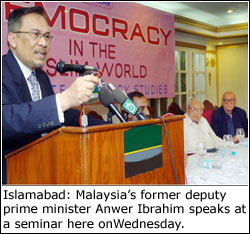 ISLAMABAD, March 8: Islam is not incompatible with democracy as the West ignorantly thinks, but the Muslim societies do need to build institutions before going for electoral democracy.
This view was presented by Malaysia’s former deputy prime minister Anwar Ibrahim in a lecture on ‘Democracy in the Muslim World’ arranged by the Institute of Policy Studies here on Wednesday.
“You must make institutions — an incorruptible judiciary included — before elections,” he told his large audience of former diplomats and bureaucrats, Islamic scholars and students.
Otherwise Zamindars and the like would continue to win elections, said the politician who was disgraced and jailed for six years in a tussle with Mahatir Mohamed.
He was acquitted by the Malaysian Federal Court in 2004 and now lives in the US.
Though he opposed Iraq war, he said he supported President George Bush’s call for democratic reforms in the Muslim world. “I have no objection to supporting his call and cooperating with it but he need not send 200,000 troops to do it,” he added.
Democratic values were not alien to Muslims. In fact there were instances where popular mandates in Muslim countries were sabotaged by Western nations for fear of the rise of radical Islam, he said, asking: “Who hijacked democracy in Indonesia after Mohammad Hatta held free and fair elections? Secular nationalists not Islamists. Who engineered the overthrow of Mosaddeq in Iran in early 1950s — the CIA”.
Observing that the US democracy itself had “very strong religious roots”, he advised that instead of trying to reform the Muslim societies in Western mould, they should be left to their own designs.
“Our battle has to be within. Change must begin with ourselves. We should not be obsessed with holding elections without having first established the moral and ethical basics.”
Muslim communities applaud when the US is denounced for its reprehensible treatment of prisoners in Abu Ghuraib. “But our silence over far worse happenings in the prisons in our own backyards is morally untenable,” he said calling for clearing our own house first.
It was important for the Muslims to realise that the high objectives of Sharia make democracy mandatory, he said. It was not an issue of compatibility but of “reconstructing the Islamic thought” as poet-philosopher Mohammad Iqbal advocated.
Mr Ibrahim said Ijtehad (innovation) must be allowed even if the Mujtahed (innovator) makes a mistake. But all reforms and change must keep in view what was permanent in Shariat and what was open to reinterpretation.
Earlier, introducing the speaker to the audience Senator S. M. Zafar of the ruling Pakistan Muslim League observed that in the entire political history of Islam, only the period of the first four caliphs stood out as democratic.
“At Karbala that democracy died. Do we need many more sacrifices to revive it?,” he asked.



























