



 0
0

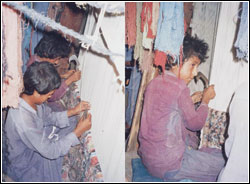 ACCORDING to an ILO study, over 60 per cent of working children live in Asia. “The Human Rights Commission of Pakistan (HRCP) estimated that in 1994, there were 11 to 12 million children, half of whom were under the age of 10, effectively working as indentured servants……often in excess of 80 hours per week, many in carpet and brick-making factories.”
A recent HRCP report cites a figure of 10 million child workers as opposed to the official figure of 3.3 million in 1996. If we were to go by HRCP’s latest figures, can we conclude that the number of child workers has declined by a million or two? Even if it has, it is no reason for being sanguine as child labour is still a widespread phenomenon not expected to go any time soon also in view of high population growth rates.
Even, if the overall population growth rate is declining, a large absolute number of child workers are still being added given the fact that population growth rate is higher amongst the poor and low-income segments.
Also, given the high momentum of population growth, absolute additions to population are expected to remain high despite decline in overall rate of population growth.
Child labour issue is, therefore, here to stay. It needs to be examined whether this issue is intricately intertwined with the issues of underdevelopment or whether it can be dealt with in isolation.
Those who like to see child labour as an issue unto itself that can be dealt with by raising the opportunity cost of child labour also cannot segregate it from overall income generation issue for the family which is, in turn, a function of national economic health.
For, the value of the next best alternative to child labour will gain worth from the vantage point of the household only if the adult members of the household are able to generate a regular income stream sizeable enough to declare children surplus for income generation and, therefore, available for schooling, training, and development in a formal setting.
Unless this happens, children will remain productive members of the household whose incomes the household would rely upon to stay in tact. The paradox is that while children are productive for the household, they are not as productive as adults in the industry in which they are employed. However, the employers have a vested interest in keeping this low-wage, underage workforce engaged.
While a ban on child labour is, therefore, that much more difficult to enforce, a ban will only complicate economic issues for poor and low-income households where children become a source of sustenance for the family as early as at the age of 10 and onwards.
The argument from neat economists’ point of view is that a ban on less productive child labour will raise demand for adult workers and their wages will go up to a level where they will not need to send their children to work prematurely.
The assumption, however, is that all the skilled and unskilled adult workers will then be fully employed almost as though as all the adult unemployed are a full replacement of all the child workers put together.
It further assumes that the demand and supply of adult workers will be a perfect match skill-wise too. While the unskilled adult workers are not even accounted for in the above analysis, it may not be borne out in real life in our society also because it is characterized by high adult underemployment as well. So, an outright ban on child workers is not likely to have child workers replaced fully with all the adult available workers.
While child labour should certainly be banned in hazardous industries harmful for the health of the young, outright ban on child labour would be hazardous for the poor households as well for the society. For, these children to whom the society offers no opportunities serve as not only income providers for own family but also acquire skills to live a law-abiding life in the future as well, if nothing else.
A forced ban in a vacuum of opportunities would make them go astray towards drugs and various kinds of crimes. This is not to justify child labour but to portray a situation against a backdrop of sordid reality. Against this backdrop, even phasing out of child labour is a remote possibility, if at all, if policy measures to integrate the marginalized into the mainstream are not contemplated at the helm of national affairs.
In this policy vacuum, we attempt to contemplate banning or phasing out of child labour which is symptomatic treatment at best. Even the commendable job done by the football industry of developing their child workers will not phase child labour out for as long as there is a continued supply of child workers for the sports goods industry.
Even if the industry is coerced to phase out child labour, the issue will be viewed as ‘tackled’ but only at the industry level as it will then spill over into the society that might still keep generating streams of child workers due to high population growth and underdevelopment both of which too are interlinked.
So, phasing out of child workers at the industry-level may not necessarily be synonymous with phasing them out from the society unless and until they actually are phased out from the society through integrative and inclusive development strategies.
The best example of child labour that will over time lead to phasing out of child labour is child labour helping the family on family-owned farms. This calls for land reforms through which land is given to the peasants who engage full family labour to raise output and incomes. As they transform into mixed farming, demand will be generated for agriculture-specific education whose utility the family will be able to see in the immediate future.
As agriculture-specific education of the young turns over directly and soon enough into raised agricultural output and incomes, the opportunity cost of child labour will have been raised sufficiently to induce child education instead of child work. The families would then be entering into a virtuous cycle of development whereby child education rather than child work would gain primacy.
Currently, poor parents see not much utility of education in an environment characterized with paucity of opportunity whose upshot is that opportunity cost of education is high which is why education is discouraged and work encouraged due to its low opportunity cost. If it is only an issue of raising the opportunity cost of child labour, then it can be raised in the above policy environment that would over time integrate all in the national economic mainstream.
In the absence of above policy climate, the poor do not see much need for education. For, in addition to immediate income streams, they also seek vocational training of their young ones in an environment where they know that their next generation too will exist not as a part of but on the periphery of a dualistic society.
Consequently, they also impart survival skills to their young through early initiation in various vocations almost on the same lines as the educated families do who start sending their children to schools from a young age of five or six which is no less laborious than child labour who too are trained for jobs in the future from a young age.
These drills from an early age equip both classes of children to cope with the requirements of life that one class will live in the formal system and the other in the informal system. Unless the formal and the informal are integrated and perceived as such by the poor, they will not see the value of education that we want them to realize. It is in this integrating poverty-alleviating policy environment that the aspirations of the two classes will begin to converge as both would now be growing together socio-economically.
Amongst other outcomes, another favourable impact will be on the family size outlook that all would want to restrict to a manageable level thus reducing both household demand for child workers’ income as well as supply of child workers into the economy. The issue will then take care of itself as a logical outcome of integrative and inclusive development policy.
Those who seek an outright end to child labour should then be demanding land reforms too in conjunction. But, they ignore land reforms as they think that land reforms are undoable and talk of only ending child labour when that too is undoable without land reforms.






























