



 0
0

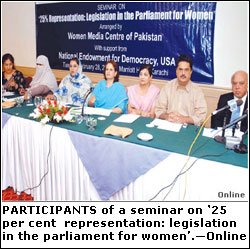 KARACHI, Feb 28: Networking among women legislators, belonging to both ruling and opposition parties, is urgently needed to counter the rampant tribal system and feudal mindset coupled with their consequent repercussions on the lives of both rural and urban women.
The submission was unanimously forwarded by Sindh Women Development Minister Saeeda Malik, MNA Fauzia Wahab and MNA Sherry Rahman of the Pakistan People’s Party Parliamentarians, MPA Farheen Ambreen of the Muttahida Qaumi Movement, MPA Kulsoom Nizamani of the Muttahida Majlis-i-Amal and a women rights activist Nuzhat Shireen at a seminar here on Tuesday.
The seminar on “25% representation: legislation in the parliament for women”, organized by the Women Media Centre of Pakistan with the support of the National Endowment for Democracy, the USA, was also addressed by MNA Nabeel Gabol, senior journalist Nazir Leghari and Sindh Ombudsman Khan Yousuf Jamal.
Reiterating government’s commitment towards the women cause, Dr Saeeda Malik said that economic empowerment was prerequisite for meaningful involvement of women in the decision making process right from grassroots level to provincial and state levels.
The minister sought concerted efforts to sensitize women of the country of their rights guaranteed under the Constitution and Islam. In this regard, she said that the Hudood Ordinance was being accordingly moidified.
She also urged women themselves to modify their attitude towards their own counterparts at all levels and shun the impulsive discrimination they might be practising against their own daughters.
MPA Kulsoom Nizamani, however, said that since Hudood Ordinance was not being properly implemented hence problem occurred that did affect women.
MNA Fauzia Wahab said that the very people of Pakistan, lamented to be discriminatory in their attitude towards women, were strong supporter of Fatima Jinnah and also voted for Benazir Bhutto twice as prime minister. “Even in the very initial years of the country we witnessed educated women as Shaista Suharwardy Ikramullah elected as a parliamentarian,” she said.
The MNA mentioned that today women legislators, be they have reached via reserved seats or open contest, were equally honest and committed towards the responsibility entrusted by the people of Pakistan.
Highlighting the importance of strong political institutions for progress and prosperity of any country, she urged educated women to be assertive and join the mainstream politics ultimately seeking their place in assemblies and senate.
Fauzia Wahab supplemented the observations made by MPA Farheen Ambreen that the need for quorum prerequisite for any assembly session, at both provincial and national assemblies, was fulfilled by women members very often.
The two legislators also referred to the fact that women parliamentarians had forwarded maximum number of bills, with specific reference to those affecting common citizens as well as those particularly related to women.
Farheen Ambreen and Dr Saeeda Malik did also mention Karo-kari bill unanimously adopted by treasury and opposition benches of Sindh Assembly.
All women legislators referred to the non-cooperative attitude of male MPs, reflective of certain bias and sense of superiority among them, but said despite this women legislators were attempting their best to bring about the change adding that more evident and significant development could definitely be witnessed in coming years.
Sindh Ombudsman Khan Jamal Yousuf suggested provision for an efficient system helping close and constant coordination between Members of National and Provincial Assemblies for timely solutions of the problems faced by people belonging to their respective constituencies.—APP





























