Time for a sane approach
IT IS yet too early to heave a sigh of relief on the Iranian nuclear crisis. Although after weeks of negotiations and persuasion, Iran has reached an accord on basics with Russia, the contentious issue of uranium enrichment on Iranian soil remains unresolved. Moscow’s proposal provides for a joint project for uranium enrichment on Russian territory which would supply fuel for the Iranian nuclear plants. Backed by the other nuclear powers, Russia wants Tehran to give up its indigenous uranium enrichment programme for which it has set up facilities at Natanz, Isfahan and Bushehr. But so far Iran has insisted on its right to enrich its own nuclear fuel and this could prove to be a major obstacle in the way of conflict resolution.
The nuclear issue has two dimensions. One is the legal aspect of Iran’s nuclear programme. The second is the political implication of the crisis as it has been developing over the last two years. The NPT, as it stands today, recognizes the right of every non-nuclear signatory to a nuclear programme for peaceful purposes provided it is under the IAEA’s safeguards. Iran also claims that its atomic enterprises have no military objectives and are designed to be used for energy generation. Since uranium enrichment can also be used for manufacturing a bomb, the US and other nuclear powers would prefer that Iran refrain from it. Since 2003, when Tehran signed the Additional Protocol giving extra powers to the IAEA to monitor and inspect the Iranian facilities at short notice, the IAEA has had no problem in its inspection process. In fact, Iran also suspended uranium enrichment for nearly 18 months to reassure the West and facilitate the dialogue process. When the government of President Ahmadinejad was voted into office there followed a deadlock in the Tehran-EU-3 (Britain, Germany and France) dialogue. Thereafter, Iran resumed uranium enrichment and matters have reached a critical point. Now the IAEA’s board of governors will be taking up the issue and is likely to refer Iran to the UN Security Council for sanctions.
It is here that the political implications come in and these have a direct bearing on international politics in the region. Discretion demands that Iran should not challenge the United States and Europe simply on the basis of legal technicalities. Ultimately it is political power that will determine the course of events. It is plain that there is strong distrust between Iran and the United States, and since Washington does not trust Tehran with enriched uranium, which President Bush believes will be used for making bombs, caution requires Iran not to insist on enriching uranium itself. This approach should make sense because simply insisting on a right and provoking a nuclear power would not be advisable. This is not the time for Iran to indulge in brinkmanship. The region is already in the grip of a serious crisis given the American intervention in Iraq and the chaos in Palestine created by Israel’s intransigence. There have been leaked reports of the possibility of Israel or the United States launching strikes on Iran’s nuclear facilities. This is no time for Iran to confront the nuclear powers just to prove a legal point. The Russian compromise formula, which may require Iran to enrich its uranium on Russian soil in a joint venture with Russia and not on Iranian soil, offers a via media and should be accepted by all parties concerned.
In a dilemma
THE government is admittedly caught in a cleft stick on the cartoons issue. It has been a number of weeks since the protests against the cartoons began, but there seems to be no end to them. If anything, Sunday’s arrests of opposition leaders and categorical statements by some of them that the rallies will continue till the government is dislodged have only raised the stakes higher. It shows that the protests have now become political, directed against the government and providing also an outlet for the expression of popular frustrations. Initially, the government tried to participate in them as well, partly to keep them in check and partly to show that it was also outraged over the offensive cartoons. It also recalled its ambassador from Copenhagen. Some ministers also mooted the idea of taking the issue to the International Court of Justice and meeting European Union representatives to tell them of the dangers in using freedom of speech as a cover to mock religious beliefs.
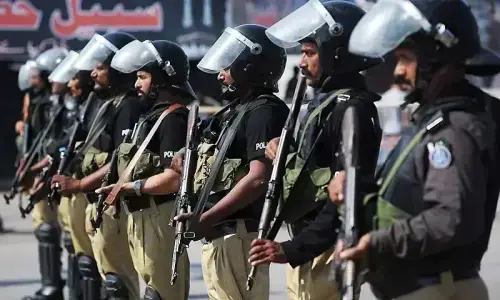
But the dilemma now is that if the government forcibly stops the demonstrations from taking place, as it did in Lahore on Sunday, it is seen as authoritarian, the right to protest being an essential political right. If it allows the protests, it risks letting a law and order situation develop, as happened, again in Lahore, on Feb. 14, when the organizers of the processions reportedly reneged on their promise to keep them peaceful. There is also the possibility that elements not linked to the organizers may seek to infiltrate the ranks of the demonstrators and intentionally provoke trouble. The opposition, particularly the MMA, has lost some of its moral high ground because of the violence and disruption that have accompanied some of the protests and because some religious party leaders have taken the lead in politicizing the rallies, linking them with attempts for the government’s ouster. The government has to strike a balance somewhere. Force as a means of preventing a demonstration has always proved counter-productive. Instead, agreement should be sought on routes to be used for processions and on keeping them peaceful. In any case, haven’t the demonstrations gone on for far too long? Public fatigue is already in evidence. After all, how many times can one make a point on this score?
Female doctors for quake zone
ONE of the continuing problems faced by the survivors of the Oct 8 quake is the dearth of women doctors to treat female patients in the affected areas. A recent WHO report has reflected on this deficiency in health operations up north and has recommended targeted medical care for vulnerable groups, including women and children. Even before the Oct 8 jolts, proper health care for women in the quake-hit zone was greatly restricted, not only because medical services were found wanting but also on account of cultural limitations which disfavour the examination of woman patients by a male doctor. Considering that women in these deeply conservative areas are not encouraged to study, much less take up a career, the dearth of women doctors is understandable. The crisis has been compounded after the quake, with thousands of women still suffering from injuries sustained during the quake and diseases in its aftermath, but refusing treatment at the hands of male doctors.
The situation calls for immediate action. While it may not be possible to change traditional mindsets overnight, the number of women doctors and lady health workers working in the quake-hit areas can be increased. No doubt, many doctors and their families would have reservations about working in places where living conditions are far from satisfactory. The government needs to allay misgivings on this count by ensuring that there is both security and a degree of comfort — especially in remote places — for women doctors who could then be sent to the north in batches for temporary periods. At the same time, efforts must continue to train and mobilize community support for lady health workers whose services in many parts of the country, especially in the conservative rural areas, are proving to be indispensable for the female population.
Getting out of the crevice
THE proverb: “Whom the gods wish to destroy, they first drive mad”, may seem at first to approximate the vandalism visited on Lahore and Peshawar consecutively on February 14 and 15, by radical mobsters protesting against the publication in Denmark and elsewhere of the offending cartoons on the Prophet (PBUH).
On second thoughts, however, the destructiveness seems to have been prompted by design rather than dementia, since the perpetrators were promoting the anti-Musharraf, anti-West agenda of the rightist bloc.
By now, the whole world, let alone Denmark, is aware of the Muslim reaction, so it is difficult to perceive how the sanctity of the Prophet (PBUH) has been served either by such wanton destruction of state and private properties or by the anti-Musharraf sloganeering.
And what is one to make of the reaction of the MMA to the outcome of these shocking events? While ascribing the devastation to non-MMA unruly elements, no leading cleric has so far condemned the destruction, or expressed regret for loss of life and property. Instead, more strikes are called for, regardless of the loss suffered by the people and the economy.
One wonders too about the failure of the Punjab government to anticipate mob violence by securing downtown Lahore from the rampage. More astoundingly, such a situation was allowed to recur in Peshawar the following day. First Lahore — the stronghold of the Chaudhry brothers and then Peshawar the cradle of the MMA administration.
One wonders also about the role of the central government and its military backers. It is one thing to have the writ of state flaunted in the tribal areas of the NWFP and Balochistan, but quite another to have it trampled upon in Lahore and Peshawar, especially when the country has many Indian visitors following the Indo-Pakistan cricket series, and Islamabad is playing host successively to the Saudi monarch, President Khaleda Zia of Bangladesh, President Karzai of Afghanistan, and the mightiest of all, President George Bush of the US.
Such developments have given rise to the view that the reaction of the various players in the affairs of state to the situations confronting them is symptomatic of the general affliction permeating the country. We are all trapped in a plethora of irrational behaviour patterns.
The deeper malaise is, of course, ascribable to two unresolved causes, namely: the supreme status of the military in our midst and the authenticity of our Islamic identity, both malingering concerns requiring long term therapy.
Currently, however, it is the contradictions at the day-to-day level of state affairs that has assumed alarming proportions, reducing hapless citizens to terrified spectators or ostrich-like entities burying their heads in sand. Of primary concern are the insurgencies in the NWFP tribal area of Waziristan and Dera Bugti, Balochistan.
The Waziristan scenario is the outcome of bungling, ineptitude and duplicity of the military handlers. Such mishandling has been occasioned by the unresolved dilemma of Al Qaeda sympathizers embedded in the army, who, from time to time, are constrained by state policy to eliminate the Al Qaeda threat. The problem is compounded by administrative reluctance to neutralize the nexus existing between the Pakistani Taliban and the Arab/Central Asian jihadis, because military functionaries operate on the dubious assumption that foreign elements can be dealt with without prejudicing local elements.
This dichotomy, which has persisted since the pre-9/11 Taliban heyday — has resulted today in the creation of a sanctuary in Waziristan where foreign jihadis, Taliban adherents (Afghan and Pakistani), militant radicals proliferating in our country and Pakistan army sympathisers commingle and plan strategy under the watchful eyes of indigenous tribesmen who are either bribed or intimidated into silence or who believe in the cause.
To effectuate official policy on this matter, logic dictates the implementation of certain basic measures. If Al Qaeda has to go (and go it must, as it is a foreign presence challenging the government while infiltrating into Pakistani soil) then all shelters must be eliminated, even if this entails bolstering the military forces operating in Waziristan with foreign forces and bunker busting weaponry equal to the task. Otherwise, we shall remain involved in a war of attrition for years to come. Justification for involving foreign forces in Pakistan lies in the realm of realpolitik, for just as acceptable explanation was found for the instant switchover after 9/11, a plausible one can be found for this move too.
Furthermore, such a campaign will necessitate additional steps to neutralize in-house jihadi sympathisers, eliminate militant radicals and redirect the Pakistani Taliban towards an Islamic reality reflecting the Pakistani ethos based squarely within national boundaries.
As for Balochistan, where the insurgency has been exacerbated by the intervention of foreign interests, these interventionists can be neutralized by resuming the dialogue at the highest level between government policy-makers and representatives of all significant Baloch interests (not restricted simply to the dissident sardars). This is a better option than the current strategy of bombing and strafing by one side, countered by the decimation of infrastructural amenities by the other, which harms the interests of both sides.
In the talks initiated for dispute resolution, three issues that, despite the sensitivities of both sides, need to be addressed initially, include, meaningful Baloch contribution in policy-making and participation in the Balochistan development projects themselves; cessation of the disruption of infrastructural facilities; and an objective review of alleged excesses attributable to, and compensation heretofore paid to, controversial Baloch personalities (in order to preclude future finger-pointing on this particular issue).
Several other issues also call for a balanced approach based on objective analysis and reason instead of the ad-hocism which plagues the system. There is a need for reliance on excellence instead of the mediocrity that impinges matters of policy or rides roughshod over the concerns of the electorate in the legislative assemblies. Then, there is a need for restoration of humanitarian and cultural values and decency in place of the prevailing lifestyle of pelf, criminality and self-interest.
There is also a need for disclosure of policy imperatives and consultation of interests on matters like the silting of dams (which affect the lives of major segments of the pollution) instead of the arbitrary approach which came up against strong resistance from Sindh and the NWFP so that the government had no option but to backtrack on the issue. There is a need for a return to constitutionalism, for revival of the democratic order, for strengthening of party system, for recourse to participatory government. There is a need for striking a balance between the interests of the central and provincial governments. There is also a need for neutralizing the omnipotence of the army and the authoritarianism of the religio-political parties which perceive their agendas as mandatory codes of conduct for all to follow.
Whether any of these will come to pass remains to be seen. The alternative course may lead inexorably to civil disorder, anarchy (exemplified by the mob violence unleashed in Lahore and Peshawar) and much worse.
However, if democracy is restored, a resuscitated Pakistan would continue to be influenced by global trends and international norms. Sadly, a review of current trends and developments generates despondency rather than hope. For Pakistan to face up to this situation is to put its own house in order under a democratic system oriented towards good governance, alleviation of poverty and illiteracy, public welfare and peace, stability and harmony in the country.
The writer is a barrister-at-law and lecturer in legal studies.
A coverup committee
THAT the United States Senate has a body called the intelligence committee is an irony George Orwell would have truly appreciated. In a world without doublespeak, the panel, chaired by GOP Sen. Pat Roberts of Kansas, would be known by a more appropriate name — the Senate Coverup Committee.
Although the committee is officially charged with overseeing the nation’s intelligence-gathering operations, its real function in recent years has been to prevent the public from getting hold of any meaningful information about the Bush administration. Hence its never-ending delays of the probe into the bogus weapons intelligence used to justify the invasion of Iraq. And its squelching of an expected investigation into the administration’s warrantless spying programme.
The committee adjourned without voting on a proposal to probe the National Security Agency programme, under which government agents have set up wiretaps on Americans without the warrants required by the 1978 Foreign Intelligence Surveillance Act. President Bush has acknowledged that he greenlighted the programme, essentially claiming that Congress gave him the power to break federal law and violate Americans’ 4th Amendment rights when it authorized the use of force after the 9/11 attacks. Though the administration’s legal defence has been laughable, its argument that the powers are essential to fight terrorism has scored political points, ratcheting up the pressure on the Senate.
—Los Angeles Times