0
0

Spectre of civil war
UNLESS the present slaughter is stopped, Iraq could descend into civil war, for the US-led forces and the elected government have both failed to give the country peace and stability. This provides the resistance with a big boost. All along it been attacking all sorts of targets — mosques, state institutions, especially police stations and recruitment and training centres, marketplaces and religious gatherings irrespective of who gets killed or maimed, the aim being to ignite sectarian passions. So far, the Shia leadership has exercised commendable restraint by not reacting to attacks on some of their most revered shrines. But the attack on Imam Ali Hadi mosque in Samarra on Wednesday has provoked a backlash that has resulted in at least 200 people killed and numerous others wounded. The intensity of the violence is evident from the unusual day-time curfew announced by the government in Baghdad and three provinces. If this level of violence continues, the resistance will have succeeded in its aim, for its goal all along has been to create a situation in which the US-installed government is unable to function.
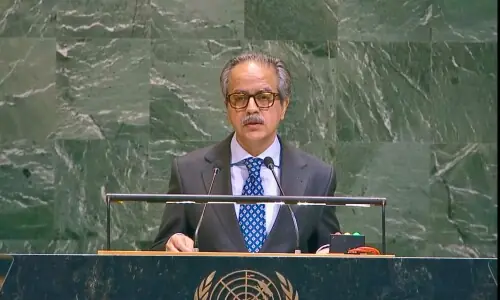
The political repercussions of the current bloodbath are already evident: the leading Sunni bloc in parliament, the National Concord Front, has dissociated itself from government formation talks and boycotted a meeting called by President Jalal Talabani. The task before the UN envoy to Iraq, Pakistan’s Ashraf Qazi, is daunting. Even though all factions have assured him that they want to do everything to avoid civil war, it is difficult to see how the various factions can bury the hatchet and work out a broad agreement to end violence. The moment of truth has now arrived for the victors of the Iraqi war. They attacked Iraq in March 2003 to liberate it from the Baathist regime and give peace and liberty to its people. Nearly three years after the invasion, the people of Iraq have neither peace nor liberty. It is anarchy and chaos with suicide bombers and ubiquitous gunmen killing and destroying at will. The US-trained Iraqi security forces have as much failed to restore law and order as those who trained them. Washington is now on the horns of a dilemma. If US troops stay on, violence will continue, and it would not know whom to side with in case there is a civil war. If it pulls out, then there will be a terrible civil war in which Iraq could split into at least three zones — the oil-rich Shia region in the south, the Kurds in the north and the Sunni triangle in the middle.
America’s follies apart, the fate of Iraq rests critically with the Iraqi leadership. Irrespective of sectarian and ethnic considerations they should first attempt to protect the unity and integrity of Iraq as one nation. If the centre collapses, the state structure could develop fissures. Separatist tendencies among the Kurds have been strong, and if they decide to declare independence there will be repercussions in Turkey and Iran where there are large Kurdish minorities in territories contiguous to Iraq. This could mean a widening of the conflict that may unleash a process of fragmentation of the Middle East. American blunders notwithstanding, the issue is now basically in Iraqi hands. They must renew the political process and try to put Iraq on the long and hard road to democracy.
Waziristan — what next?
IT IS difficult to make sense of the government’s decision to suspend its military operation in Waziristan. The governor of the NWFP said on Thursday that while it believed that tribesmen would be able to restore peace in their own way, the suspension did not mean that the government had backed out of its earlier responsibility. This is somewhat perplexing as during the last three years in which Waziristan has been a hot-bed of terrorist activities, the government has applied various strategies to rein in the militants suspected to be hiding there but without much success. It has conducted military operations in which many lives were lost. It offered amnesties to militants and then reneged on its promise and it has seen tribal leaders who supported it later on killed. According to one estimate last year, 300 civilians were killed and about 800 injured while 250 army personnel lost their lives and more than 600 were injured. To rely now solely on local leadership to deal with the situation may well prove counterproductive in view of the past failures. Will the army reduce its presence in the volatile area as a mark of confidence in the tribal leaders’ ability to tackle the problem? The government must look at the situation from a political point of view rather than a military one andwinning over the trust of the local leadership may prove useful in ridding the area of terrorist elements. But it has to bring Fata into the national mainstream and the longer the process is delayed, the greater will be the chances of local resentment to grow and add to the ongoing strife — as was witnessed after the Bajaur incident.
There are some advantages of asking local leadership to lend a helping hand, provided they are made to realize the dangers of harbouring undesirable foreign elements. The government has also to invest in Waziristan’s development and give the locals a stake in it. Despite claims that large amounts of development funds have been spent in the region, there is nothing much to show for it. Already deprived of basic amenities and means of livelihood many locals have migrated to neighbouring areas for lack of safety and for deprivation.
Threat of bird flu
WITH both India and Iran reporting cases of bird flu, there is every reason for the government to prepare for a potential outbreak in the country. So far, no case of the deadly H5N1 virus strain has been detected in poultry or wildfowl. But judging by the speed with which the virus, that surfaced in Southeast Asia some years ago, has crossed continents, it can only be a matter of time before Pakistan, too, is likely to be struck by avian flu. Pakistan has to be doubly careful because it lies on the migratory route of wildfowl some varieties of which carry the virus. While the economic loss resulting from an outbreak will no doubt be colossal — indeed, already poultry sales in the country have dropped — what is far more worrying is the possibility of men, women and children contracting the deadly infection.
So far, human casualties (numbering less than 200 worldwide) have included those in direct contact with poultry. But this could change with virus mutations making human-to-human transmission possible and triggering a pandemic of unpredictable consequences. Pakistan has taken some steps to lessen the threat and has banned the import of poultry products from countries where the H5N1 virus has been detected. Apparently, the government is also creating a fund to compensate poultry owners for the loss of birds in case the virus strikes and to encourage them to report cases of avian flu which otherwise they might not do fearing monetary losses. But the real challenge it faces is not only in closely monitoring poultry houses but also the borders with India, China and Iran, all of which have reported bird flu, to ensure that live birds and poultry products do not enter the country.
‘Processed language’ & Mideast conflict
IT was dawn and Ramazan’s second Friday, exactly 12 years ago today, when a Jewish terrorist, Baruch Goldstein entered the tomb of Patriarch Abraham — Masjid-i-Ibrahimi to Muslims — and opened fire on the believers as they prostrated themselves in prayer. His firing killed 29 Palestinians and wounded 170 others.
No Israeli security guard managed to stop Goldstein as his automatic rifle unloaded lethal bullets; instead, Israeli soldiers fired on enraged Palestinians outside the mosque, killing 29. The single day’s casualty figure on Feb 25, 1994, was 54 killed and hundreds injured.
Such, however, is the depravity of minds obsessed by an ideology that the grave of this mass murderer in Kiryat Arba has become a shrine for Jewish fanatics who lay flowers there. Let it be said, though, to the credit of saner Israelis that some citizens have asked the government to strip the grave of its shrine character — a garden with a fountain, besides benches for devotees to fanaticism.
The massacre shocked of the world, but the most unfortunate aspect of the crime was the way the western media covered the slaughter, for it made every attempt to suppress what it thought were awkward facts that would have cast Israel in a bad light. The word “Israel” was carefully avoided, and Goldstein was identified not as a terrorist or an Israeli terrorist but as a “settler” or at best an extremist. In sharp contrast, a Muslim committing such a deed would immediately be identified with his nationality — a “Saudi hijacker” or a “Moroccan terrorist”. Astonishing as it may sound, the western media suppressed the fact that Goldstein was an Israeli army officer.
Baruch Goldstein, a doctor who chose to become a mass killer, belonged to Kach, a Jewish fundamentalist movement founded by Meir Kahane, a fanatic rabbi who was convicted by an American court for resorting to violence after the Jewish Defence League he founded instigated his followers to attack “anti-Semitic” targets in New York. He was given a five-year suspended sentence, following which he left for Israel.
Once in Israel he began what even the Israeli authorities considered to be a quasi-fascist movement. He won a seat to the Knesset and in his book, They Must Go, pleaded for the ethnic cleansing of Israel and for driving all Palestinians out of the occupied West Bank and the then occupied Gaza. At best they could stay for one year and apply afresh so that their stay could be extended on a case by case basis for another 12 months. Goldstein was an ardent supporter of the Kach movement and was still allowed to be in the Israeli army, but the western media did not inform the public that Goldstein was a serving major in the Israeli army, was wearing an Israeli army uniform, and that the weapon he used for massacring Palestinian worshippers was an official Israeli army Glilon assault rifle.
A mass murderer being portrayed as a settler or being referred to at best as an extremist is part of what Hanan Ashrawi calls “processed language” in which the news about the Arab-Israeli conflict is presented to the western public. The same “processed language” can be seen in the treatment of the news concerning Mr Ariel Sharon when he was rushed to hospital following his second and what could be a fatal stroke.
The “liberal” Economist’s tone is one of reverence. In its issue of Jan 7, 2006, the paper calls him “a tough and popular leader” — “tough” for a man who was involved not in one but several massacres, including the carnage at the Palestinian refugee camps at Sabra and Chatilla in 1982 when he was defence minister during Israel’s invasion of Lebanon, and the last one at Jenin, when he was prime minister and chose to re-occupy the West Bank.
During that reoccupation he chose to murder Hamas leaders, including its founder, Sheikh Ahmad Yassin, and his successor, Abdel Aziz Rantissi. The most brutal murder, however, was that of Hamas leader Salah Sheheda when the missile that struck his home also killed nine children. Most western wire agencies and TV channels refer to these murders as “targeted assassinations”.
If Mr Sharon is a war criminal, then The Economist puts it as the Arab view of the man, saying “The Arab media more often calls him a war criminal”. Which means the paper itself does not believe in the findings of the Israeli Kahan commission investigating the Sabra-Chatilla massacre which held him personally responsible for allowing the camps’ access to the Phalangist militia under his control.
Then there is this myth about Israel making “concessions” to Palestinians. According to The Economist, Mr Sharon was thinking in terms of making “painful territorial concessions” to the Palestinian Authority. At the 2000 failed Camp David summit, too, Mr Ehud Barak and President Clinton were making “territorial concessions” to Yasser Arafat, while in fact they were asking the Palestinian leader to surrender more land to Israel.
What happened at Camp David is a story unto itself. Many American authors, not afraid of being branded “anti-Semitic”, have come out with the truth at the marathon summit. Clayton E. Swisher, in his book The Truth About Camp David, says the American camp, consisting of die-hard Zionists, including Ms Madeleine Albright, Mr Dennis Ross and Mr Martin Indyk and others, acted as an Israeli delegation, and wanted Arafat to sign an agreement in which no mention was made of Jerusalem or the right of the Palestinian refugees to return. Arafat rejected what obviously would have been a sellout and was portrayed by the American media as an intransigent man who was afraid of peace.
What are “concessions” supposed to mean? Israel already has 78 per cent of Palestine as it existed under the British “mandate”. When therefore Israel and its media supporters speak of concessions, they mean Israel pulling out of bits of the remaining 22 per cent left which have been under its occupation for 37 years. “Territorial concessions” actually mean that it is the PA that should concede more land to Israel out of the 22 per cent left with it.
A conscious attempt is now being made to avoid using the word “occupied”, the idea being to claim that the West Bank and until recently Gaza are “disputed”, not occupied territories. In their coverage of the Sharon hospital story, both Time and Newsweek conformed faithfully to this suppression of geopolitical facts.
Newsweek (Jan 16 issue) refers to the Gaza strip and the West Bank 13 times — seven times to Gaza and six times to the West Bank — in the main story and the various boxes, but the word “occupied” is missing all along. Time (Jan 16 issue), too refers to Gaza seven times and the West Bank six times, but everywhere the word “occupied” is missing.
Is Palestine a lost cause? The only hope is total faith in the ultimate triumph of truth. The tragedy is that the Muslim world has been thrown challenges to which it is not in a position to respond scientifically. The domestic scene is monopolized by clerics with mediaeval thinking. They are angry with and jealous of secular leaders in power. If they cannot burn enemy armies in occupied territories, the least they do is to burn restaurants, and fellow citizens’ cars and scooters.
On the road to the Rubicon
SEMANTIC arguments may not seem relevant when innocent people are dying in appalling circumstances, as more than 130 Iraqis now have been, many of them dragged from their cars and gunned down in cold blood, since Sunni insurgents blew up a Shia shrine in the city of Samarra on Wednesday.
But at what point does the intensifying sectarian violence of recent months become a fully-fledged “civil war” — a phrase which is taken as a sort of terminological Rubicon beyond which everything will be different? Has it now been reached? And if so, what are the implications for the US and Britain. Is their presence making things worse, or would it be even worse without them?
As the blood flows there is no mistaking the panic in Washington and London, as well as Baghdad, where President Jalal Talabani appealed for calm and unity in the face of the Samarra provocation. George Bush and Tony Blair both called for restraint. Iran’s president Mahmoud Ahmedinejad blamed the attack and its consequences on them and “Zionists” who had “failed in the face of Islam’s logic and justice” - a charge which shows how gravely the Iraq war and occupation has poisoned relations between the west and Muslim countries.
For the insurgents, the destruction of the Askari mosque has served its purpose: it makes it harder for the Shia prime minister, Ibrahim al-Ja’afari, to construct a government which includes Sunni politicians, as the US and Britain have been urging him to do. Without such a government, a split on the ethnic and sectarian lines that emerged from the December election seems inevitable.
US troops continue to kill and be killed, but like the far smaller British forces spend as much time defending themselves as fighting or helping Iraqis. British army morale has plummeted.
—The Guardian, London